

Quash
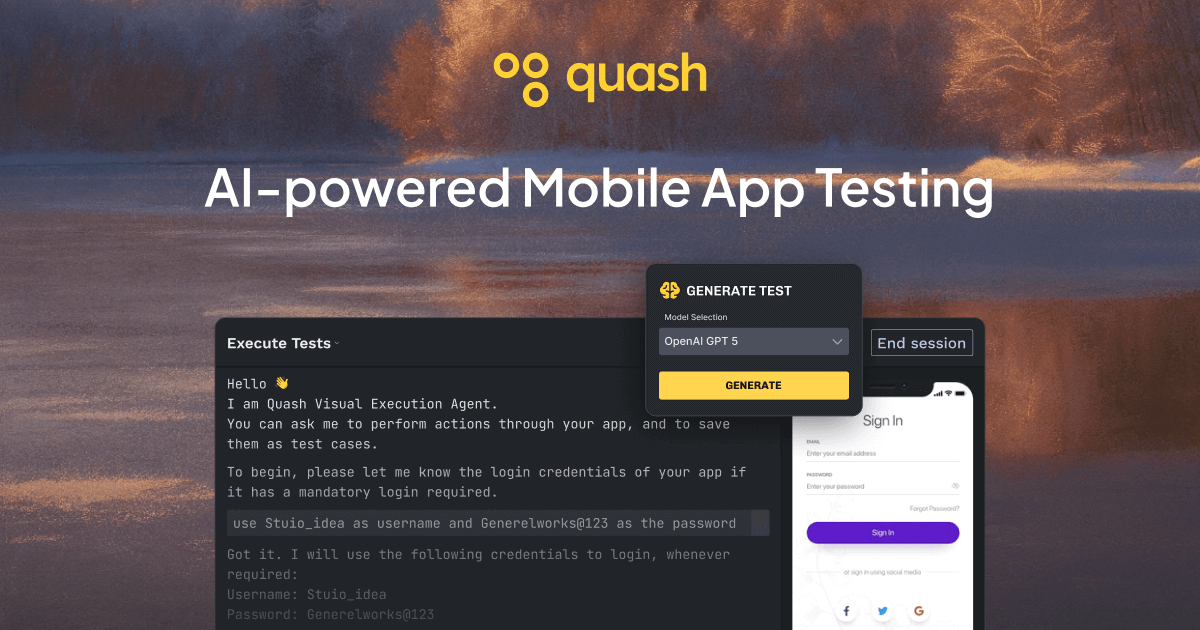
Quash is an AI-powered mobile app testing and QA automation platform that enables functional and visual testing using natural language commands instead of traditional scripting.
What is Quash?
What is Quash?
Quash is revolutionizing mobile Quality Assurance (QA) by introducing an AI-powered agent designed for human-like test execution. It allows QA teams to run functional and visual tests without writing a single line of code or complex selectors. By interpreting plain language descriptions of application flows—such as "Search & Filter to Cart" or "Add New Address Form"—Quash automatically handles all necessary interactions like taps, swipes, typing, and navigation. This intelligent approach ensures tests run against actual app behavior, adapting dynamically to UI changes, loading states, and dynamic screens, significantly boosting efficiency and coverage.
This platform aims to bridge the gap between manual exploratory testing and rigid automated frameworks. Teams achieve up to 87% increased test coverage and cover 4X more edge cases, all while accelerating test suite creation by 25X and achieving an 85% reduction in testing costs. Quash integrates seamlessly into existing workflows, offering a unified test management platform for generating, executing, and reporting on tests, making continuous test automation achievable for modern mobile development cycles.
Key Features
- Intent-driven Test Execution: Describe an app flow in plain language (natural language), and Quash converts this intent directly into executable actions, eliminating the need for scripting or selectors.
- Self-Healing Adaptability: Tests are resilient to change. The AI agent adapts execution dynamically to UI modifications, loading states, and data differences, drastically reducing test maintenance overhead across releases.
- Unified Validation: Perform both UI validation and backend validation (API & DB) within a single test run, ensuring comprehensive system behavior checks without needing separate post-UI testing steps.
- Flexible Device Lab: Execute tests across local devices, emulators, or cloud devices without the burden of setting up or maintaining complex testing infrastructure.
- Context-Rich Reporting: Receive clear, actionable execution reports complete with steps, screenshots, and debugging insights powered by AI, enabling teams to understand failures instantly.
- Seamless Platform Integration: Offers features for automated framework integration, complete analytics on coverage and quality, and role-based access control for better team management.
How to Use Quash
Getting started with Quash focuses on leveraging its natural language processing capabilities for rapid test creation:
- Access the Platform: Users can begin immediately via the Web Playground or download the Mobile-use Agent for Mac to run tests locally.
- Describe the Flow: Instead of scripting, users input the desired test scenario using natural language. For example, a user might type: "Log in with valid credentials, navigate to the settings page, and change the notification preference to off."
- Intelligent Execution: Quash interprets this intent, automatically generating the necessary taps, swipes, and data inputs required to navigate the application flow on the target device.
- Adaptation and Validation: During execution, the agent monitors the application state. If the UI shifts slightly, Quash intelligently adjusts its actions. Simultaneously, it validates backend responses against expected outcomes.
- Review Results: Upon completion, review the detailed reports, including screenshots of failures and AI-powered debugging insights, to quickly triage and resolve issues before deployment.
Use Cases
- Rapid Feature Validation: QA teams testing new features can quickly generate comprehensive test suites in hours rather than days by simply describing the required user journeys in plain English, ensuring immediate feedback cycles.
- Regression Testing for Dynamic Apps: For apps with frequent UI updates (e.g., e-commerce or social media), Quash's self-healing tests maintain high coverage without constant manual script updates, significantly lowering regression maintenance costs.
- End-to-End Transaction Testing: Validating complex multi-step processes that involve both front-end interaction (e.g., filling out a complex form) and back-end data integrity checks (e.g., ensuring the database reflects the new entry correctly).
- Exploratory Testing Augmentation: Testers can use the natural language interface to explore edge cases and unusual paths that might be tedious to script, allowing the AI agent to handle the repetitive navigation while the tester focuses on complex logic.
- Cross-Platform Consistency Checks: Utilizing the integrated device lab capabilities to ensure that critical user flows behave identically and correctly across various OS versions and device types without managing separate device farms.
FAQ
Q: Does Quash require any coding knowledge to create tests? A: No. Quash is specifically designed for execution without translation or scripting. Tests are created by describing the desired flow in plain language, making it accessible to manual testers and non-developers.
Q: How does Quash handle applications that change their UI frequently? A: Quash uses an intelligent agent that adapts test execution dynamically to UI changes, loading states, and data differences. This significantly reduces test maintenance, as the tests focus on the intent rather than brittle selectors.
Q: Can Quash validate API calls or database changes during a mobile test run? A: Yes. A core feature is the ability to perform UI and backend validation in one run. Quash can validate API responses and system behavior concurrently with mobile UI interactions.
Q: What environments can I run my tests on? A: You have flexibility. Tests can be executed on your local physical devices, emulators, or via cloud devices, without requiring you to maintain the underlying testing infrastructure.
Q: Is Quash suitable for large enterprise teams? A: Yes. Quash offers a unified test management platform, complete analytics, and role-based access control (admin/user roles) to effectively manage permissions and track quality across large QA organizations.
Alternatives

AakarDev AI
AakarDev AI is a powerful platform that simplifies the development of AI applications with seamless vector database integration, enabling rapid deployment and scalability.

Devin
Devin is an AI coding agent and software engineer that helps developers build better software faster.

imgcook
imgcook is an intelligent tool that converts design mockups into high-quality, production-ready code with a single click.

Rork
Rork builds complete, production-ready mobile apps from your description using AI and Expo (React Native).

PromptLayer
PromptLayer is a platform for prompt management, evaluations, and LLM observability, designed to enhance AI engineering workflows.

Radian
Radian is an innovative, open-source design and development library tailored for building high-quality, scalable web applications. Built using React, Radix, and Tailwind CSS, Radian provides developers with a comprehensive set of components, animations, and blocks that streamline the process of creating modern, responsive user interfaces. Its focus on speed, scale, and simplicity makes it an ideal choice for teams aiming to accelerate their development workflows while maintaining design consistency. The library is designed to facilitate seamless design-to-code synchronization, allowing changes made in design tools like Figma to be easily reflected in the codebase. This ensures pixel-perfect accuracy and reduces the time spent on manual adjustments. Radian's modular architecture and high-quality base components enable developers to quickly assemble robust applications without sacrificing flexibility or quality. Whether you are building new projects from scratch or enhancing existing ones, Radian offers a rich ecosystem of components, animations, and design blocks that cater to diverse development needs. Its open-source nature encourages community contributions and continuous improvement, making it a future-proof solution for modern web development.