
Multiple search providers
Choose Ceramic.ai, Exa, or Linkup with one provider parameter. Each provider returns a common result format, allowing provider changes without changing the rest of the integration.

Cloudflare Web Search API gives AI agents and applications live web search through AI Gateway, returning structured URLs, titles, and descriptions for grounding responses in current information. It supports Ceramic.ai, Exa, and Linkup through REST or the Workers AI binding.
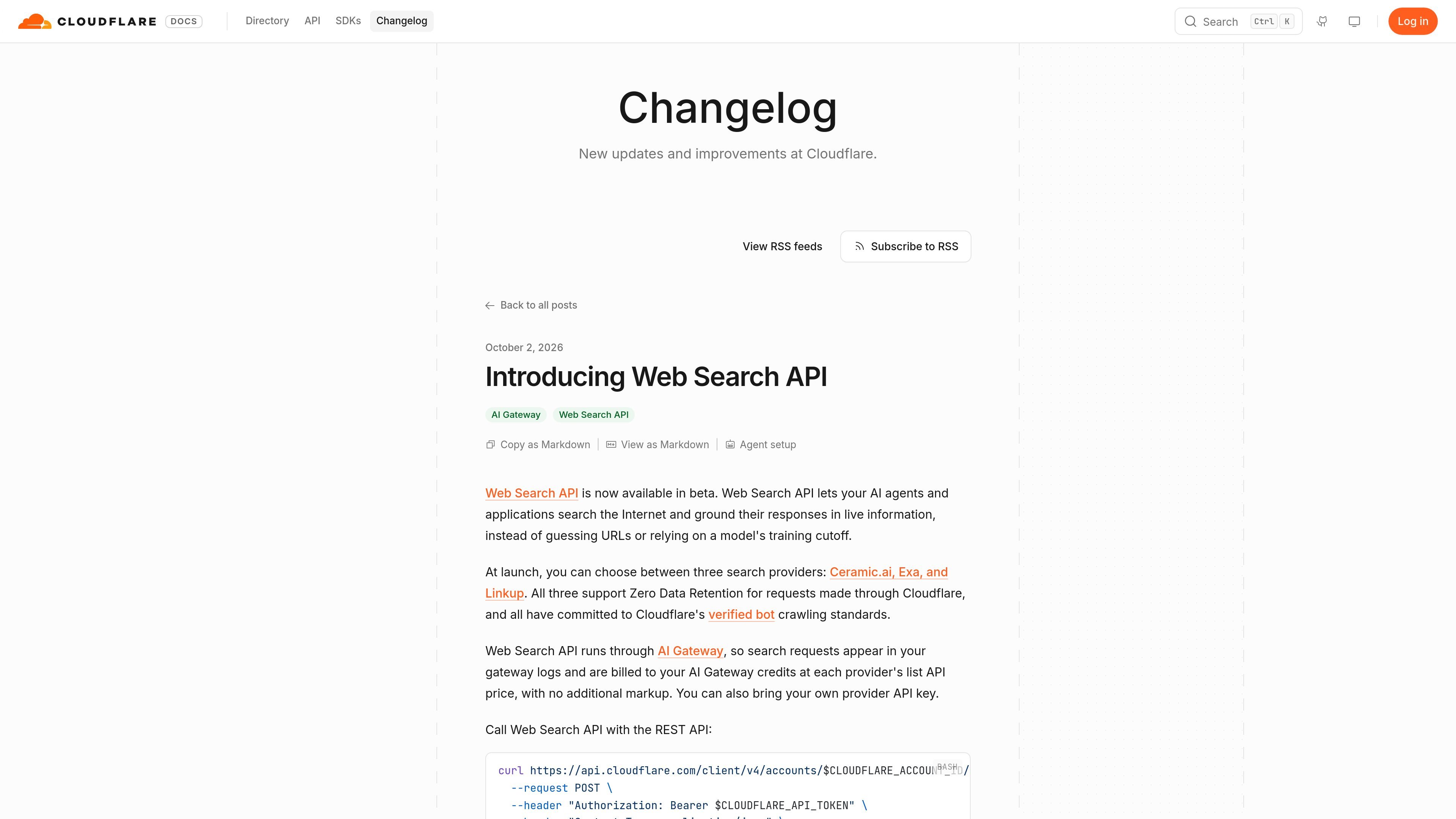
Cloudflare Web Search API is an open-beta API for giving AI agents and applications access to live web search. It routes searches through AI Gateway and returns structured results—titles, URLs, and descriptions—so applications can ground model responses in current web information rather than relying only on a model’s training data or guessed URLs.
The service supports Ceramic.ai, Exa, and Linkup through a shared request interface, and can be used from any backend with the REST API or from a Cloudflare Worker through the Workers AI binding. Search requests are included in AI Gateway logs and analytics, while billing can use AI Gateway credits or a provider key stored on the gateway.
Choose Ceramic.ai, Exa, or Linkup with one provider parameter. Each provider returns a common result format, allowing provider changes without changing the rest of the integration.
Searches are routed through AI Gateway and appear alongside model inference requests in gateway logs and analytics, with the gateway's access controls and operational visibility.
When using AI Gateway credits, searches are charged at the selected provider's list API price with no additional markup. Existing provider accounts can be used through stored gateway keys instead.
Results include source URLs, titles, and descriptions that can be passed into a model context. Provider-specific descriptions may be long page descriptions, highlights, or raw search-result snippets.
The API can be called from backend applications through REST or from Workers using the AI binding. A model can also invoke a web_search tool that triggers a search and returns results for a follow-up completion.
Ceramic.ai and Linkup are listed with Zero Data Retention, while Exa is listed without Zero Data Retention in the provider comparison. All three providers commit to Cloudflare's verified bot requirements.
Define a web_search tool for a model, execute the requested search through Web Search API, and pass the structured results into a follow-up model completion.
Use current web results to answer questions about events, places, products, or other subjects where information may have changed since a model’s training data was collected.
Run repeated searches from an agent workflow and select a provider based on the desired result style, such as long descriptions, query-relevant highlights, or fast raw snippets.
Use the returned URLs, titles, and descriptions as a source-aware retrieval layer for applications that need to show or retain links to the web pages behind generated responses.
You need a Cloudflare account, an AI Gateway, and either AI Gateway credits or a provider API key stored on the gateway. REST API requests require a Cloudflare API token with Account > Workers AI > Read and Account > AI Gateway > Read permissions.
You can send a POST request to the /ai/websearch/ endpoint from any backend, or call websearch() through the Workers AI binding from a Worker. Both routes use an AI Gateway.
A request returns a standard Response object. After parsing it with response.json(), the response contains items with a URL, title, and description, plus metadata such as the query, request ID, and latency when provided by the provider.
Set the provider parameter to ceramic, exa, or linkup. If you omit it, Ceramic.ai is used by default. The limit parameter accepts from 1 to 10 results and defaults to 10.
Yes. Store a provider key and alias in the AI Gateway Provider Keys settings, then pass the provider and byokAlias in the request. With BYOK, the provider bills you directly. If byokAlias is explicitly set but unavailable, the request fails rather than falling back to AI Gateway credits.

ClayHog es una plataforma de visibilidad en AI search para seguir cómo aparecen las marcas en ChatGPT, Gemini, Perplexity, Claude y Google AI Overviews. Centraliza citas, competidores, sentimiento y oportunidades de contenido.

Grok es un asistente de IA gratuito desarrollado por xAI, diseñado para priorizar la verdad y la objetividad al tiempo que ofrece capacidades avanzadas como acceso a información en tiempo real y generación de imágenes.

qbrin is an enterprise AI search and governed agent platform that turns company knowledge into cited answers and can abstain when evidence is missing. It is built for teams that need source-backed responses, policy controls, and traceable AI actions.

Octen is a search infrastructure product for AI applications that need live web context, structured answers, and retrieval tools for agents, copilots, and chatbots. It combines search, extraction, multimodal retrieval, and developer access paths such as API, SDKs, Skills, MCP, and CLI.

Scite es una plataforma de investigación con IA para descubrir artículos, verificar el contexto de citas y obtener respuestas basadas en literatura académica. Ayuda a evaluar evidencia en fuentes de texto completo, patentes y materiales relacionados.

Agregador de wikis impulsado por IA creado para mejorar la experiencia del usuario en Wikipedia al simplificar el consumo de conocimiento.