
Deliverable email inbox
Each agent gets a real address at [email protected] and can send, receive, thread, and label mail over API or MCP, with DKIM and verified senders called out on the mail page.

Mailgent provides email and identity infrastructure for AI agents, including a real inbox, encrypted vault, calendar, DID, and USDC wallet. It is built for developers who want agents to provision once and then operate through scoped API, MCP, CLI, or SDK tools.
Mailgent is an email and identity service for AI agents. It provisions a complete agent identity in one API call, combining a real inbox, encrypted vault, calendar, DID, and USDC wallet so software can operate with a persistent presence instead of ad hoc keys and prompts.
The product is built around a scope-gated workflow: an agent is provisioned, connected through MCP, CLI, or SDK, and then uses ready-made tools to read and send mail, store and retrieve secrets, generate 2FA codes, book time, sign requests, and pay for API usage when needed.
Each agent gets a real address at [email protected] and can send, receive, thread, and label mail over API or MCP, with DKIM and verified senders called out on the mail page.
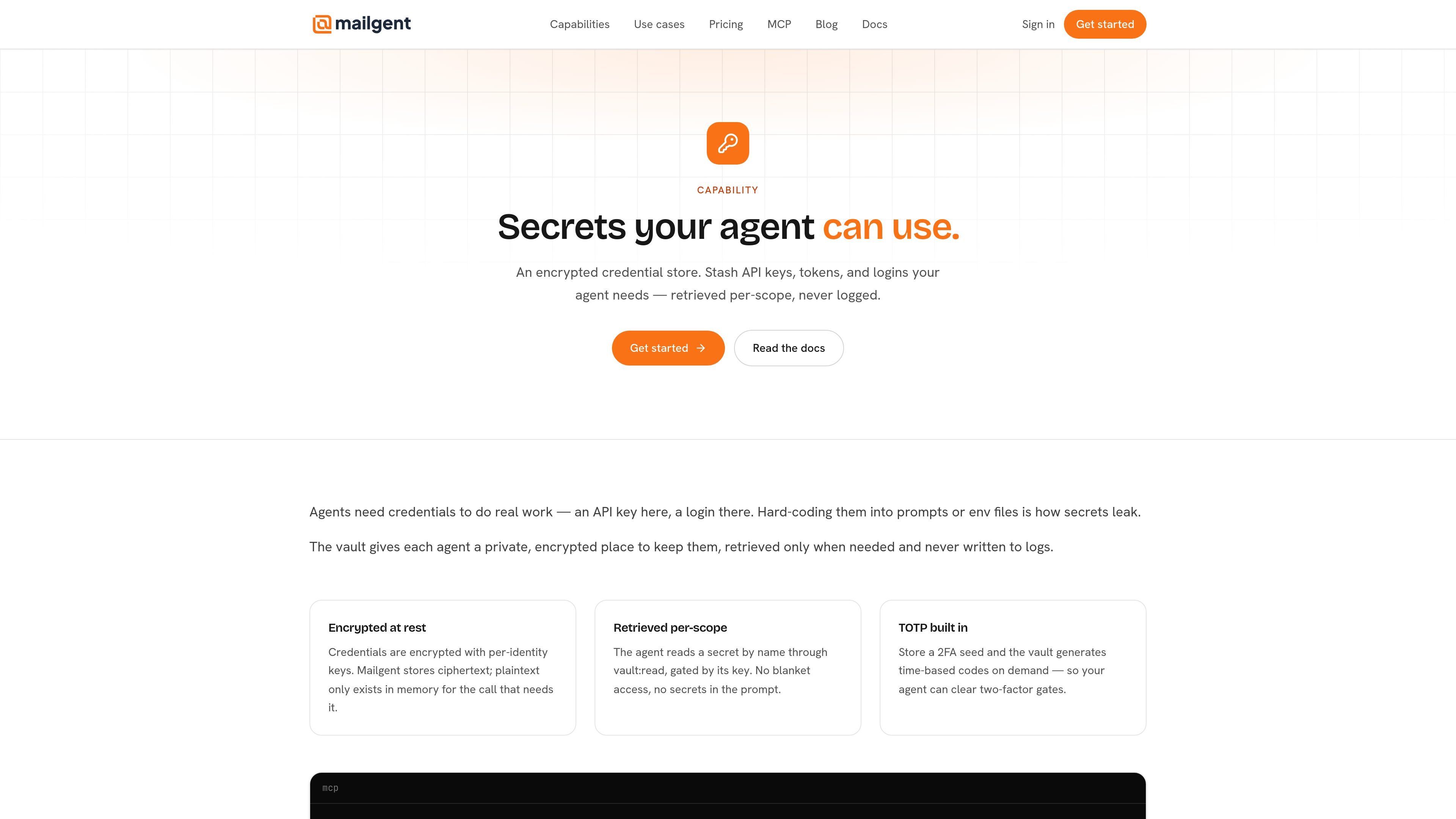
Store API keys, tokens, login credentials, and backup codes in an encrypted vault that retrieves secrets per scope and keeps plaintext out of logs.
Generate time-based one-time codes on demand from a seed stored in the vault, including backup-code handling for accounts that require 2FA.
Create events, manage availability, and share an iCal feed so an agent can coordinate scheduling through the calendar capability.
Assign each identity a did:web identity with an Ed25519 keypair so the agent can sign requests and prove who it is.
Fund a USDC wallet on Base so agents can pay x402-priced URLs under spending mandates set by the user.
Give an agent a real inbox so it can handle confirmations, receipts, replies, and other email-based workflows without scraping a UI or relying on IMAP.
Store API keys, tokens, logins, and backup codes in the encrypted vault, then retrieve them only when a task requires access.
Let an agent clear 2FA prompts by generating live TOTP codes from a seed kept in the vault, including recovery-code workflows where needed.
Use the calendar capability for scheduling tasks such as event creation, availability management, and sharing an iCal feed with other systems or people.
Assign a DID and signing key to an agent so it can prove its identity when interacting with services or signing requests in a controlled way.
Mailgent provisions an identity in one API call. The result includes a real email address, DID and signing key, encrypted vault, calendar, and a USDC wallet; these can then be connected through the MCP server, CLI, or SDK.
The pricing page shows plan tiers that scale from a Free plan to Developer, Startup, and Enterprise. It also says agents are provisioned as identities rather than seats, and higher plans add features such as a funded USDC wallet, spend mandates, audit logs, and SSO/SAML.
Mailgent is built around a clean API, MCP access, and a CLI/SDK. The site says it can be hosted at api.mailgent.dev/mcp or run locally, and it exposes tools such as mail_send, vault_store, calendar_create, and identity_sign.
Mailgent’s published materials emphasize email, encrypted secrets, TOTP codes, calendar actions, DID identity, and USDC wallet payments. The source does not list broader third-party integrations beyond MCP, REST, CLI, and SDK access.

AgentMail is an email inbox API for AI agents that lets developers create, send, receive, and search messages through REST APIs and SDKs. It supports agent workflows such as threaded replies, verification, customer support, scheduling, and inbox-based approvals.

Lasso is an ecommerce product data platform for enriching catalog records, processing supplier files, generating product content, and monitoring competitors. It combines a web app with a REST API, SDK, and MCP server for teams and developers.

CreateOS Sandbox is an isolated compute environment for running code and agent workloads inside Firecracker micro-VMs. It is designed for workflows that need machine-level isolation, private networking between sandboxes, and programmatic control through SDK, CLI, or MCP.

Liam is an AI copilot for managing inboxes, writing replies, prioritizing email, and scheduling meetings. It is offered free for individuals, with custom pricing for teams and enterprise.

Codex Plugins bundle reusable skills, app integrations, and MCP servers into workflows you can install in the Codex app or use from Codex CLI. They help extend Codex with connected-service tasks, reusable instructions, and shared team workflows.

Botacts is a web directory for finding AI bots and agents you can contact by phone, email, SMS, WhatsApp, Telegram, or Signal. It also lets creators suggest bots for manual review before publication.