
Typed decision outputs
Send a state and the answers or levels you allow, then receive the selected answer together with a probability for each option.

Nimble is a hosted API that turns text into typed decisions, returning an answer and probabilities for each allowed option. It is designed for workflows such as routing, tagging, grading, policy checks, and agent action gating.
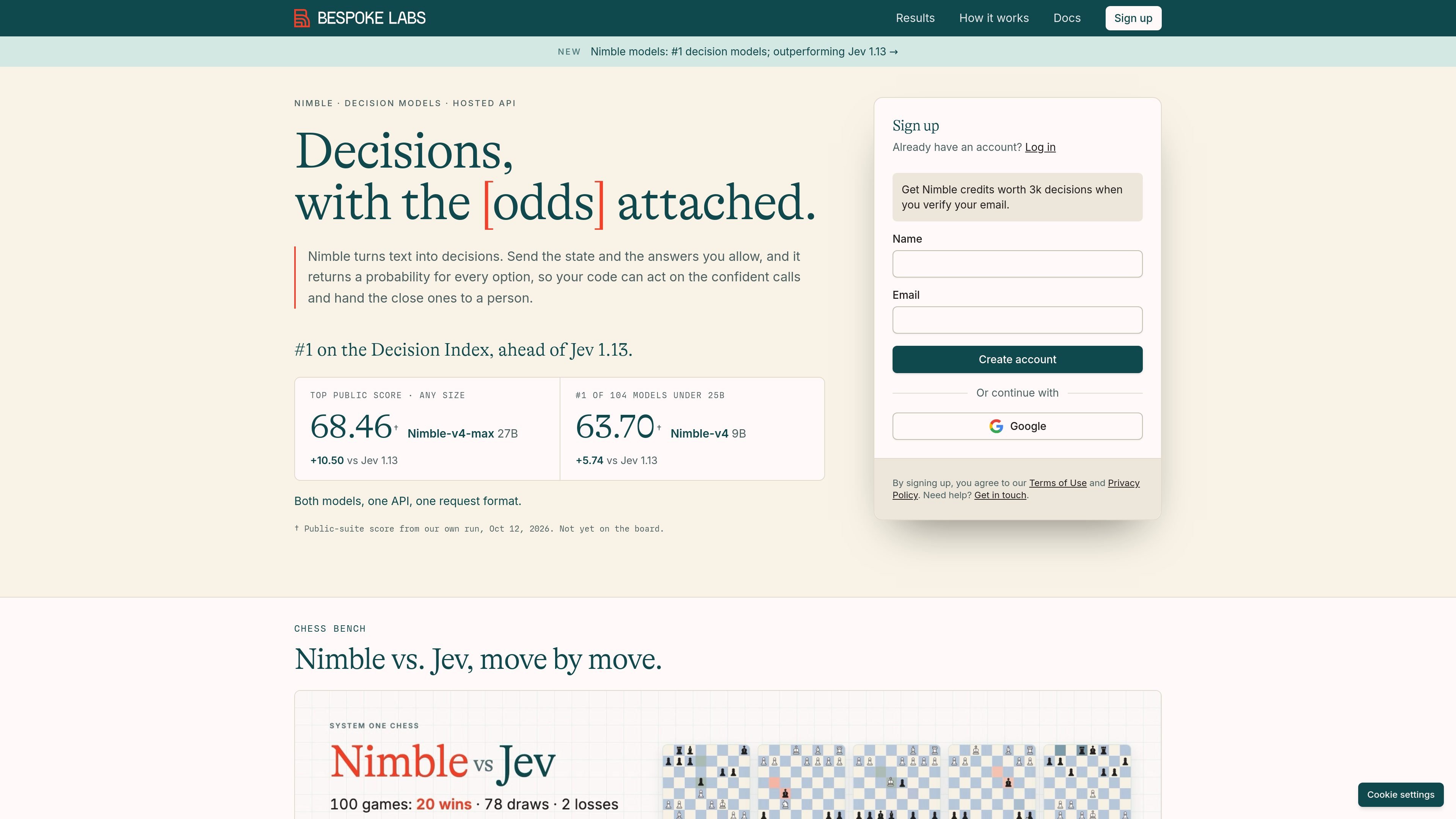
Nimble is a hosted API for turning text into typed decisions. You provide a state—such as a customer message—and one or more questions with permitted answers. Nimble returns an answer and a probability for every option, allowing software to proceed with confident results and route uncertain cases for human review.
The product offers Nimble-v4 and Nimble-v4-max through the same request format. The site positions the 9B Nimble-v4 for high-volume routing, tagging, and triage, and the 27B Nimble-v4-max for policy checks, grading, and agent decision steps. Documented question types include truth-probability checks, named-choice classification, and ordered scoring.
Send a state and the answers or levels you allow, then receive the selected answer together with a probability for each option.
Ask whether a statement is true and receive its estimated probability on a 0-to-1 scale.
Name the possible answers for a classification task and receive the chosen option plus probabilities for the available choices.
Provide ordered levels from lowest to highest and receive an expected level with a probability distribution across those levels.
Place multiple questions in one request. The site says Nimble reads the state once and returns an answer for every question.
Use Nimble-v4 at 9B for high-volume routing, tagging, and triage, or Nimble-v4-max at 27B for policy checks, grading, and an agent's next step.
Classify incoming tickets into departments such as billing, technical, account, or sales, then use the returned probabilities to send confident cases directly to a queue and review ambiguous ones.
Apply consistent labels to text at scale when the workflow needs a selected category and a confidence signal rather than an unconstrained text response.
Evaluate whether a request or response meets a stated policy, using the larger model for checks where the decision has greater operational importance.
Score a reply against ordered levels such as a 1–5 scale and retain the distribution for review or downstream quality analysis.
Use a decision result as a gate in an automated agent workflow, such as deciding whether the agent should take its next step or pause for a person.
Nimble is a hosted decision-model API. A request includes a state and one or more typed questions, and the response provides an answer plus probabilities for the available options.
The documented quickstart sends a request to the Bespoke Labs API with a bearer API key, a model name, a state, and a questions object. The supplied example uses the nimble-latest model identifier.
Nimble supports Noul questions for estimating whether a statement is true, choice questions for selecting among named options, and score questions for placing an item on ordered levels.
Nimble-v4 is positioned for high-volume routing, tagging, and triage, while Nimble-v4-max is positioned for policy checks, grading, and an agent's next step. Both use the same request format and return probabilities.
The site says users can start with credits worth 3,000 decisions after signing up and verifying an email. The supplied pricing page returned a 404, so no additional pricing, quota, or paid-plan details are documented here.

CreateOS Sandbox is an isolated compute environment for running code and agent workloads inside Firecracker micro-VMs. It is designed for workflows that need machine-level isolation, private networking between sandboxes, and programmatic control through SDK, CLI, or MCP.

GitBot is a local browser-based workspace for creating reusable coding bots powered by Claude Code, Codex, or OpenCode. It helps developers run those agents across repository folders with persistent threads and configurable permissions.

AakarDev AI helps teams manage AI provider access, project-level setups, logs, and analytics from one dashboard. It supports BYOK workflows and lists providers including OpenAI, Google Gemini, Anthropic, Groq, Mistral AI, and Perplexity AI.

Trigger.dev chat agent is a durable AI chat backend for developers building stateful conversations that can survive refreshes, crashes, and long-running turns. It connects with the AI SDK `useChat` flow and runs on managed infrastructure with no timeout on a turn.

ByteAsk is a terminal-first AI coding agent for C and C++ that edits repositories and verifies changes with the real compiler, debugger, sanitizers, and tests before showing a diff. It offers a free tier plus paid plans, with editor connectors and zero-retention handling described in the source.

Epherem is a static security scanner for web apps built with AI coding tools such as Lovable, Bolt, v0, Replit, Cursor, and Claude Code. It checks source files and dependencies for common security mistakes, then provides categorized findings and suggested fixes without running the app.