
Durable storage with automatic edge reads
Data is stored durably while reads are served from the nearest edge location automatically, so the product is built to combine persistence with edge caching.

Owl NoSQL is a serverless edge document database that stores data durably and serves reads from the nearest edge automatically. It is designed for developers who want a minimal SDK-based setup without managing clusters, connection pools, or a separate cache layer.
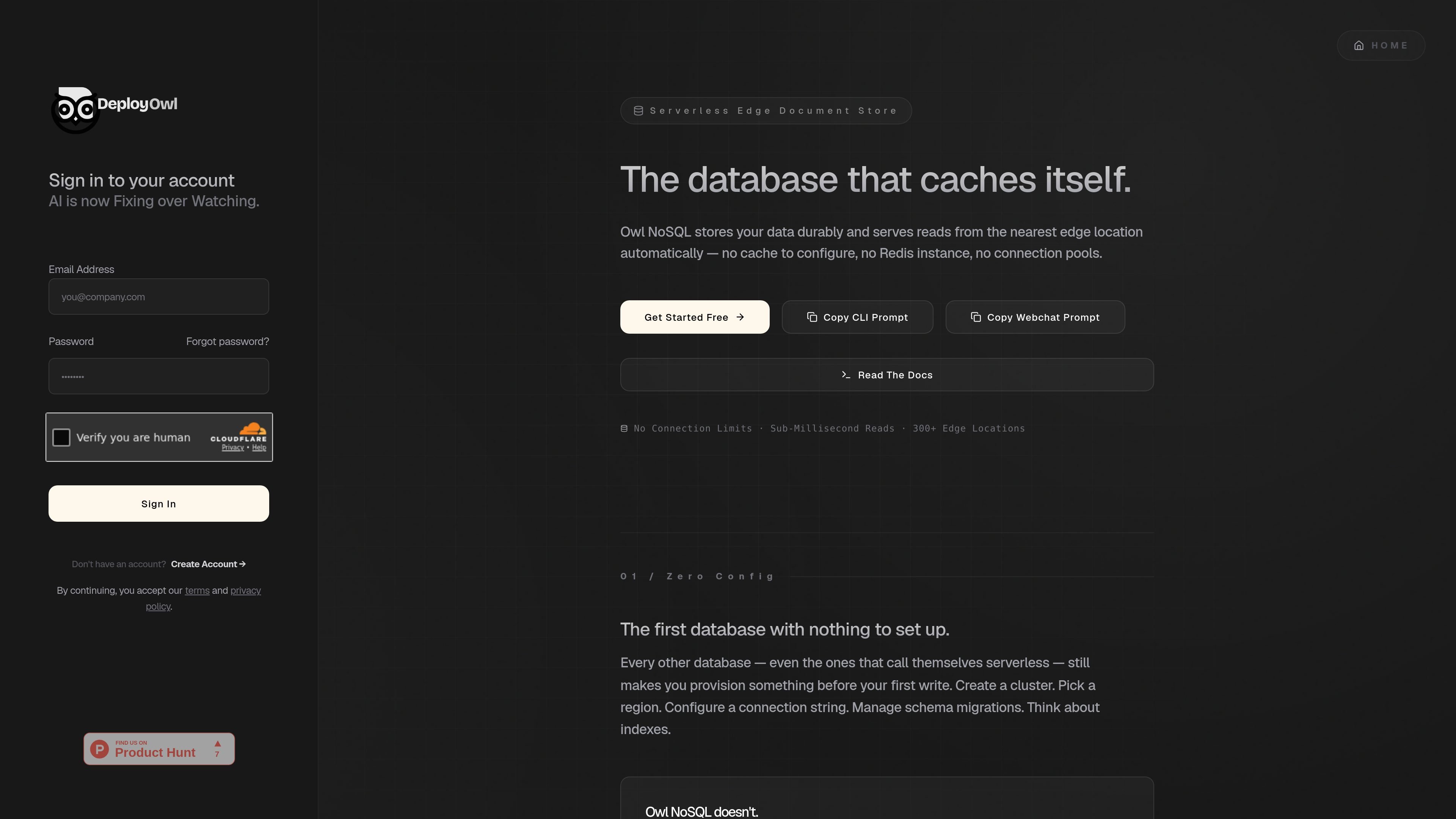
Owl NoSQL is a serverless edge document store that combines durable storage with automatic edge caching for reads. The product page positions it as a database for teams that want to start without cluster setup, region selection, schema planning, or connection pooling.
The homepage emphasizes a minimal workflow: create an API key, call the SDK, and the service handles edge caching, global replication, and index sharding behind the scenes. The pricing page places Owl NoSQL within the wider DeployOwl platform as a managed, edge-replicated serverless document database with sub-millisecond read times and zero cold starts.
Data is stored durably while reads are served from the nearest edge location automatically, so the product is built to combine persistence with edge caching.
The homepage states there are no connection limits and that the service uses stateless HTTPS with MessagePack binary transport, rather than a traditional pooled database connection model.
Writes use lock-free concurrency with HTTP ETag headers, and conflicting parallel writes are rejected at the edge instead of being coordinated through a central lock manager.
Collection indexes are sharded and edge-cached automatically, which the homepage says helps filtered queries resolve in milliseconds without manual index configuration.
A rollback feature lets you return the database to a past date, wiping documents written after that point and restoring the earlier state.
The homepage quickstart shows a client initialized with an API key and a collection read call, which suggests a minimal SDK-first workflow.
Use Owl NoSQL when your app needs durable document storage and fast reads without adding a separate caching layer or Redis instance.
The homepage frames the product as suitable for teams that want reads served from the nearest edge automatically, which fits read-heavy applications with globally distributed users.
Because connection limits are not part of the model described on the page, the product is positioned for workloads with many parallel serverless function invocations.
The rollback feature supports recovery after a bad migration, bad write, or compromised API key by returning the database to a previous date.
The source describes Owl NoSQL as a serverless edge document store that requires only an API key and the SDK to start. It does not document a longer setup flow on the pages provided.
The homepage says reads are served from the nearest edge location automatically, with the database storing data durably and caching reads at the edge.
The pricing page lists Owl NoSQL as a managed, edge-replicated serverless document database with sub-millisecond read times and zero cold starts.
The pricing page shows a Free plan with 0 credits per month and a Starter plan at $19 per month with 2,100 credits per month. It also says credits never expire and unused balance rolls over.
The homepage includes an FAQ section with questions about Redis, the free plan, where it runs, and whether database knowledge is needed, but the source text does not provide all of those answers in detail.

MacSpoof es un cambiador de MAC para macOS: cambia o aleatoriza tu MAC Wi‑Fi para reconectar y reducir el registro de identidad en redes públicas.
NomNak es una app gratuita para iPhone para descubrir restaurantes con recomendaciones de amigos, guardar lugares, crear tu pasaporte gastronómico y buscar ciudades.

Ctrl+Shift+3 is a calm, text-first community platform with a chronological feed, profiles, RSS, and private groups called Clicks. It is built for reading, posting, and joining smaller communities without algorithmic ranking or vanity counts.
TyeGit es un cliente Git nativo para desarrolladores que buscan control rápido y preciso de staging, commits, ramas y remotos en Windows, macOS y Linux.
Servey lets you mirror and control a Mac from an iPhone or iPad, with a real terminal and automatic local-or-remote connectivity. It is aimed at people who want full Mac access on mobile without VPN or port forwarding.

Terminal Candy is a native macOS terminal app that lets you run a real shell inside custom visual skins. It supports community skins, custom skin creation from images, and a one-time license after a free trial.