
Browseable archive
The archive organizes suspect startup pages into an index of roast entries, making it easy to browse the collection rather than only seeing the homepage highlights.

shitfa.st is an archive of landing pages that look generically AI-generated, with screenshots, ShitScore-style ratings, and short editorial roasts. It helps readers browse examples, inspect critiques, and submit suspicious sites for review.
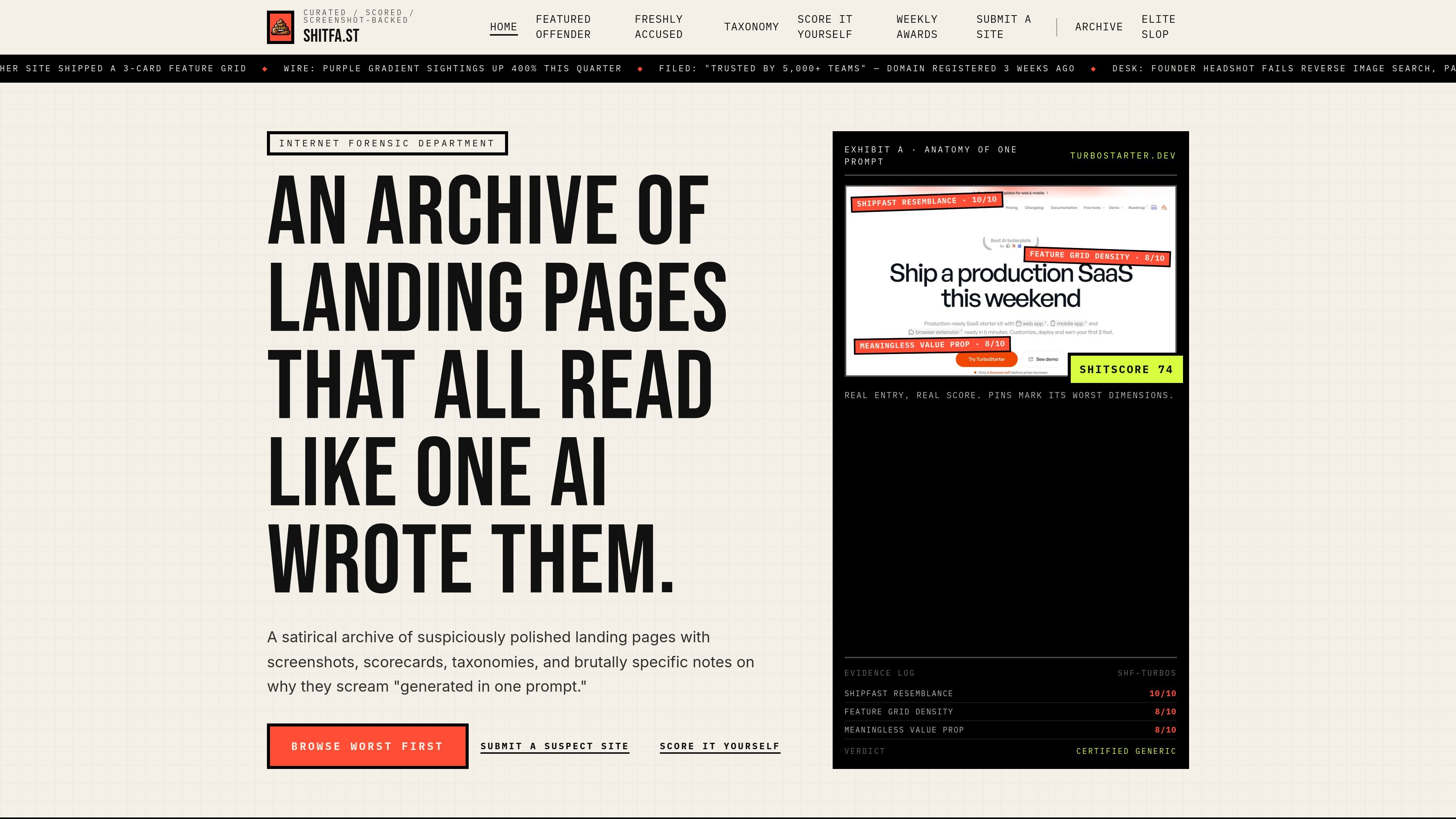
shitfa.st is a curated archive of landing pages that appear to follow the same generic AI-generated startup template. Its pages document suspect sites with screenshots, scorecards, category tags, and short editorial roasts that explain what looks repetitive or unconvincing.
The site is built around browsing and judging examples rather than selling a conventional software product. Visitors can open archive entries, inspect a ShitScore-style breakdown, submit a site for review, or score a page themselves. A pricing page exists, but it is written as satire and reinforces the site’s parody format rather than a normal checkout flow.
The archive organizes suspect startup pages into an index of roast entries, making it easy to browse the collection rather than only seeing the homepage highlights.
Each featured page is paired with a ShitScore and supporting notes that break down why the landing page reads as generic or AI-generated.
The site uses screenshots, tags, and editorial labels to document recurring patterns such as fake authority bars, waitlists, and overworked hero copy.
The homepage lets visitors move from browsing to participation by submitting a suspect site or scoring a page themselves.
The site surfaces recurring categories and filters, including B2B sludge, SEO hustle, AI agents, and authority-logo hallucination, to help readers find similar examples.
Individual roast pages include direct quotations and specific callouts, such as feature density, trust-signal suspicion, and ShipFast resemblance, rather than broad complaints.
Founders or marketers who want to compare a landing page against common AI-generated patterns can scan the archive for structural and copy cues.
People researching how AI-written startup pages tend to look can use the archive as a collection of annotated examples and critiques.
Visitors who notice a suspicious page in the wild can submit it for inclusion, turning a single example into part of the larger archive.
Readers who want a quick assessment of a page’s presentation can open an individual roast entry to see the score and the editorial breakdown.
The archive is presented as a hand-curated collection of landing pages that read like they were written by one AI. Entries include screenshots, tags, scores, and editorial notes.
The site combines a public archive with individual roast pages and scorecards. The homepage also invites visitors to browse the archive, submit a suspect site, or score a page themselves.
The archive entries show the site content, screenshots, tags, and a ShitScore-style critique. The homepage also surfaces filter labels such as B2B sludge, SEO hustle, AI agents, authority logo hallucination, and waitlist as product.
The pricing page is satirical and framed as a product that does not actually exist, with calls to start a free trial, book a demo, or join a waitlist. Based on the page text, those CTAs are part of the joke rather than a clear, functional commercial plan.

MacSpoof es un cambiador de MAC para macOS: cambia o aleatoriza tu MAC Wi‑Fi para reconectar y reducir el registro de identidad en redes públicas.

NomNak es una app gratuita para iPhone para descubrir restaurantes con recomendaciones de amigos, guardar lugares, crear tu pasaporte gastronómico y buscar ciudades.

Ctrl+Shift+3 is a calm, text-first community platform with a chronological feed, profiles, RSS, and private groups called Clicks. It is built for reading, posting, and joining smaller communities without algorithmic ranking or vanity counts.

TyeGit es un cliente Git nativo para desarrolladores que buscan control rápido y preciso de staging, commits, ramas y remotos en Windows, macOS y Linux.

Servey lets you mirror and control a Mac from an iPhone or iPad, with a real terminal and automatic local-or-remote connectivity. It is aimed at people who want full Mac access on mobile without VPN or port forwarding.

Terminal Candy is a native macOS terminal app that lets you run a real shell inside custom visual skins. It supports community skins, custom skin creation from images, and a one-time license after a free trial.