AgentGrade icon

AgentGrade

AgentGrade grades how visible a webpage is to AI systems such as ChatGPT, Claude, and Perplexity. It helps website owners and marketers check whether a page can be crawled, understood, and cited by AI agents.

AgentGrade

What AgentGrade is

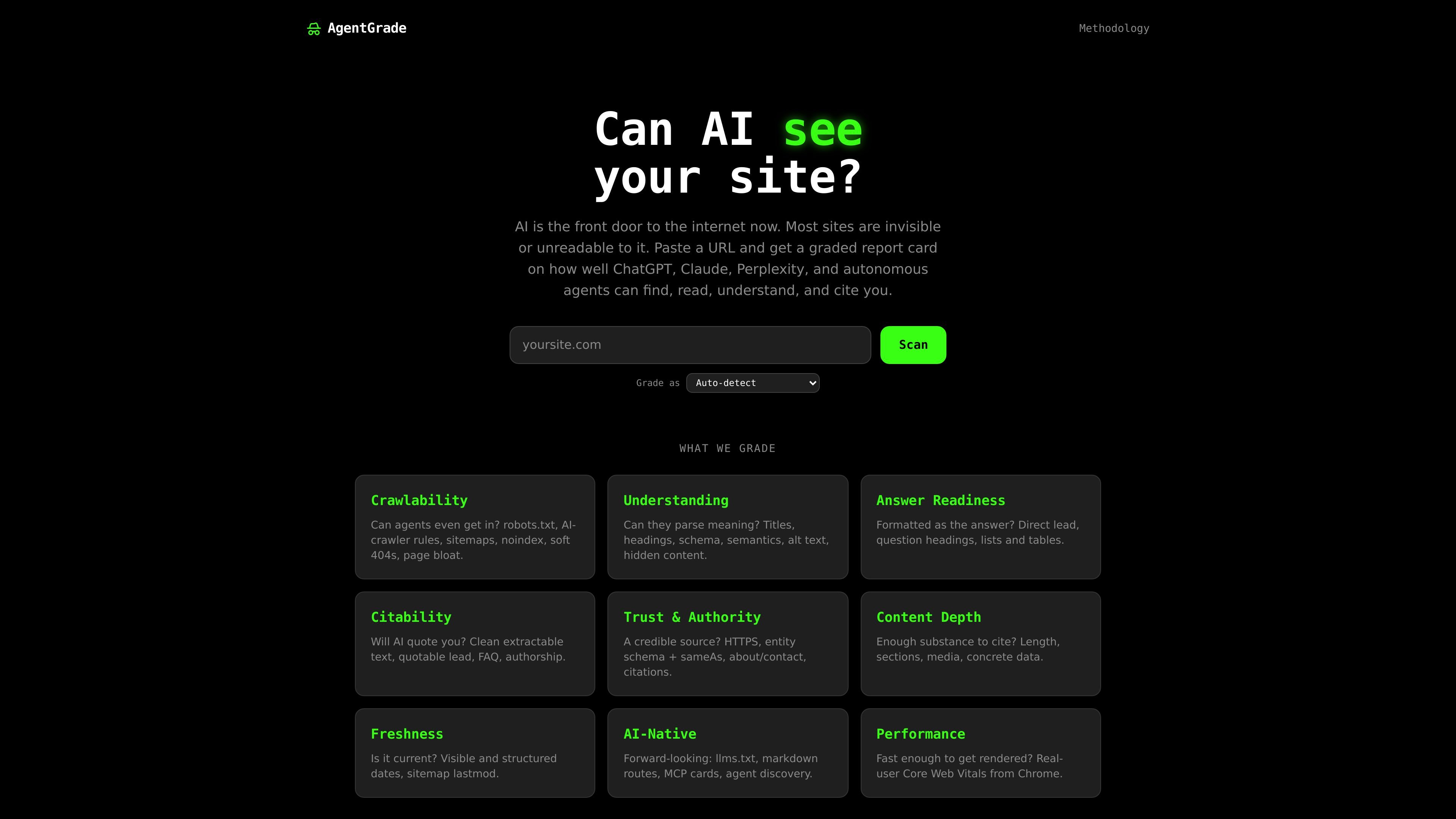
AgentGrade is a website scan tool that grades how visible a page is to AI systems such as ChatGPT, Claude, and Perplexity. You paste a URL and receive an A-F report card scored from 0 to 100 across categories that measure whether the page can be crawled, understood, answered from, and cited by AI agents.

The product is designed for the AI-first web, not for traditional blue-link SEO alone. Its methodology page says each scan uses a transparent checklist with weighted pass, warn, and fail signals, and the overall grade is adjusted by page type so a homepage, article, landing page, or API/app page is judged in context.

Core capabilities

Crawlability checks

AgentGrade checks whether a page can be reached by AI agents, including signals such as robots.txt, noindex directives, sitemap access, redirect chains, soft 404s, and whether the main content is available in server-rendered HTML.

Understanding signals

It evaluates whether AI systems can interpret the page by looking at titles, headings, schema markup, semantic structure, alt text, labeled form controls, and whether content is hidden behind interaction.

Answer readiness

The product assesses how well a page is formatted to answer a query, including direct lead-in answers, question-style headings, lists, numbered steps, and comparison tables.

Citability signals

AgentGrade checks whether a page can be cleanly quoted or cited by AI systems, using factors such as extractable text, quotable lead sections, FAQ content, authorship, and descriptive internal links.

Trust and freshness

It includes trust and freshness checks such as HTTPS, about/contact/privacy presence, entity schema, visible and structured dates, and sitemap lastmod values.

AI-native and performance signals

The methodology also includes forward-looking AI-native checks and real-user performance signals, including llms.txt, markdown routes, agent discovery files, and Core Web Vitals data when available.

Common ways to use AgentGrade

  • Homepage visibility checks

    Check whether a homepage gives AI systems enough structure and extractable content to find the main message, even when the page is short or marketing-led.

  • Content and article audits

    Review blog posts or articles for answer-ready formatting, clear headings, quotable text, structured data, and visible dates before publishing or updating them.

  • Marketing page reviews

    Evaluate landing pages for crawlability, content visibility, and answer readiness without expecting article-style features that do not belong on a conversion page.

  • App and API page scans

    Verify whether an app or API page exposes enough semantic structure, metadata, and plain HTML content for AI agents to interpret the page correctly.

  • Technical AI access checks

    Inspect technical signals such as robots.txt, sitemap access, and AI crawler rules when you want to understand whether major AI systems are allowed to reach the site.

Pros and Cons

Pros

  • Checks whether AI agents can access, parse, and cite a page, which goes beyond standard SEO audits.
  • Uses a transparent scoring model with weighted categories and clear pass, warn, and fail signals.
  • Adapts scoring to page type, which helps avoid penalizing pages for content that is not relevant to their format.
  • Includes modern AI-facing signals such as llms.txt and markdown routes alongside traditional technical and content checks.
  • Does not store the report itself or the user's IP address, based on the site's privacy statement.

Cons

  • The pricing page is currently unavailable, so cost and plan structure are not verified from the source.
  • It only scans one URL per report, so it is not a full-site crawl tool.

FAQ

How does AgentGrade work?

Paste a website URL into AgentGrade and it generates a graded report card for that page. The product says it fetches the page the way an AI crawler does, using the raw HTML rather than relying on JavaScript-rendered content.

What kinds of pages can it evaluate?

AgentGrade is aimed at websites that want to know whether AI systems can find, read, and cite their content. The page says it auto-detects page type and grades homepages, articles, marketing pages, and API or app pages differently.

What does AgentGrade score?

The site says the grade is based on a transparent checklist with weighted categories such as crawlability, understanding, answer readiness, citability, trust, freshness, AI-native signals, and performance.

Is pricing available on the site?

The site does not show pricing details. The pricing URL currently returns a 404, so plan structure and cost are not verified from the available source.

Does AgentGrade store user data?

AgentGrade says it stores submitted website URLs with timestamps to understand usage and improve the tool, but it does not store the report itself or the user's IP address.

Quick Facts

Category
AI visibility audit
Platform
Web app
Primary users
Website owners, marketers, and SEO teams
Source domain
agentgrade.app
Input
A single website URL
Output
A graded report card with an A-F score

Alternatives à AgentGrade

PromptScout icon

PromptScout

PromptScout tracks how ChatGPT, Gemini, Google AI Overviews, and Perplexity mention your brand or competitors, then pairs those results with source analysis and website audits. It helps teams decide what to fix in content, positioning, or site readiness next.

ClayHog icon

ClayHog

ClayHog est une plateforme de visibilité SEO IA pour suivre la présence des marques sur ChatGPT, Gemini, Perplexity, Claude et Google AI Overviews. Elle aide les agences, équipes marketing et SEO à suivre citations, concurrents, sentiment et opportunités de contenu depuis un seul tableau de bord.

beehiiv icon

beehiiv

beehiiv is a newsletter platform for creators, publishers, and brands that want to build, grow, and monetize email newsletters and websites from one place. It offers a free Launch plan, plus paid tiers for more advanced growth, monetization, and support features.

Skayle icon

Skayle

Skayle is a content and AI search visibility platform that researches topics before writing, publishes structured content to a CMS, and tracks whether brands are cited in AI search. It is aimed at teams that want one system for publishing, schema-rich content, and visibility monitoring.

SaveMRR icon

SaveMRR

SaveMRR is a Stripe retention tool for SaaS teams that scans billing data for churn and MRR leaks, then automates recovery through dunning, cancel-save offers, win-back emails, and onboarding nudges. It is built for founders and bootstrapped teams using Stripe.

Hype icon

Hype

Hype is a web tool for finding trending YouTube topics by category, time range, and scoring mode. It helps creators spot emerging ideas, inspect source videos, and decide what to cover next.