
Shared team knowledge base
Compendium keeps team knowledge in one shared place that both people and agents can access, so context is not trapped in private chats or scattered documents.

Compendium is a shared knowledge base for teams and AI agents that keeps context, decisions, and session history in one place. It is designed to help teammates and agents work from the same persistent memory across handoffs, onboarding, and live Claude sessions.
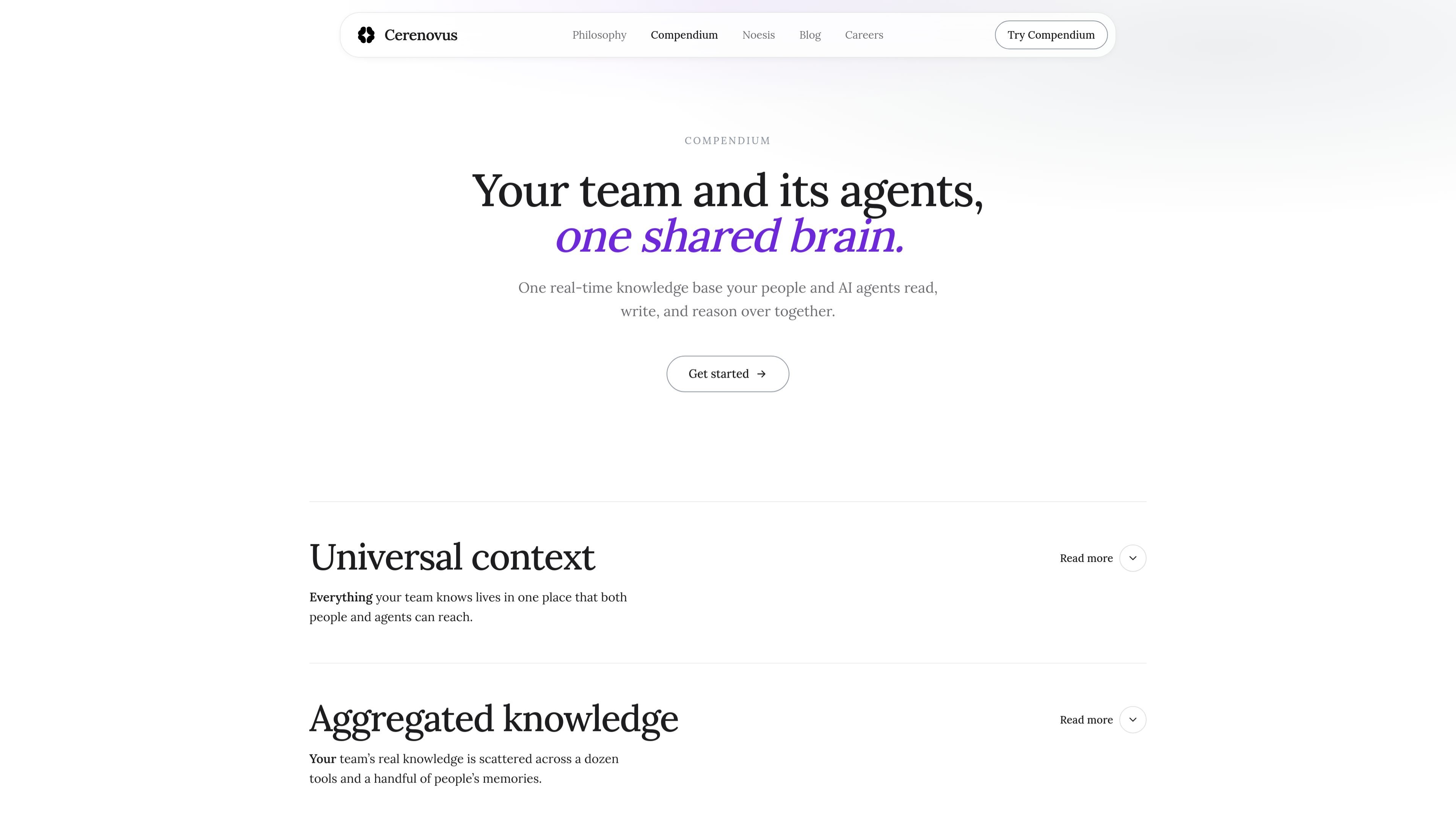
Compendium is a shared knowledge base for teams and AI agents. The product page describes it as “one shared brain” where people and agents can read, write, and reason over the same context instead of keeping knowledge in separate tools or private chats.
Its core purpose is to preserve organizational memory across sessions, machines, and handoffs. The page emphasizes that engineers can recover the reasoning behind decisions, teammates can pick up work without restarting from scratch, and new hires can ask the vault directly instead of interrupting the team for background.
Compendium keeps team knowledge in one shared place that both people and agents can access, so context is not trapped in private chats or scattered documents.
The product organizes information as a knowledge graph with wikilinks, making it easier to connect specs, decisions, customer calls, and other notes into one trail of context.
Multiple teammates can work inside a live Claude session together, watching the model reason and steering it in real time instead of starting separate chats.
A teammate can pick up a run where someone else left off, with history and context intact, so work does not reset every time ownership changes.
Because everything lives in shared context, an agent can answer questions about prior decisions and cite the sources it used when following the trail of information.
The product is positioned as a memory layer for both humans and AI agents, so the same knowledge can be read, written, and reasoned over by the whole team.
Keep customer calls, specs, decisions, and follow-up notes connected so the team can trace why a change was made and what it affected later.
Let multiple teammates work in the same live Claude session, so a run can be observed, discussed, and handed off without losing context.
Give new engineers a place to ask questions about internal conventions and past choices, reducing the need to interrupt busy teammates for background.
Use the shared vault to find the reasoning behind a feature, policy, or implementation choice when a teammate needs to pick up work midstream.
Allow agents to answer questions by following links across the team knowledge graph and citing the source trail behind their response.
Compendium is presented as a shared live knowledge base for a team and its AI agents. It is meant to keep context, reasoning, and team memory in one place that people and agents can both read and write.
The source shows Compendium as available today and includes a sign-in page with email/password and Google sign-up options. It does not provide a pricing page or published plan details.
The page describes shared Claude Code sessions where multiple teammates can sit inside one live session, watch the model reason, and steer it together. It also says teammates can hand off a run without losing history or context.
The sources do not list specific integrations. The product page emphasizes shared knowledge, live sessions, wikilinks, and agents that can read and write the same context.
Compendium is aimed at teams that want persistent organizational memory across people, agents, sessions, and machines. The copy highlights onboarding, shared context, and retaining the reasoning behind past decisions.

Falconer is an AI-powered company brain that keeps internal documentation accurate, searchable, and up to date by syncing with tools like GitHub, Slack, and Linear. It helps engineering and cross-functional teams centralize knowledge and answer questions from a shared source of truth.

Dcyde is a decision log for product teams that captures what was decided, the reasoning behind it, and the source in one shared place. It supports pinning decisions from Slack, Figma, or inside Dcyde and keeps the record searchable over time.

runevr is a connected workspace for creative teams that combines boards, media review, chat, recordings, drive, calls, and AI agents in one room-based environment. It is designed to reduce tool switching and keep project context together.

Goldfish is an AI memory app for macOS that helps you reply, write, summarize, and continue using the context already on your Mac. It stores memory locally and writes in your tone.

Lasso is an ecommerce product data platform for enriching catalog records, processing supplier files, generating product content, and monitoring competitors. It combines a web app with a REST API, SDK, and MCP server for teams and developers.

Biji est une plateforme polyvalente conçue pour améliorer la productivité grâce à des outils et des fonctionnalités innovants.