
Packaged food scoring
Scan a packaged food and get an instant 1–100 FoodHealth Score designed to help you compare products in the aisle or on screen.

FoodHealth is a dietitian-built shopping companion for people on GLP-1 medications. It scans packaged foods, assigns a 1–100 score, and helps users decide what to buy, eat, or swap.
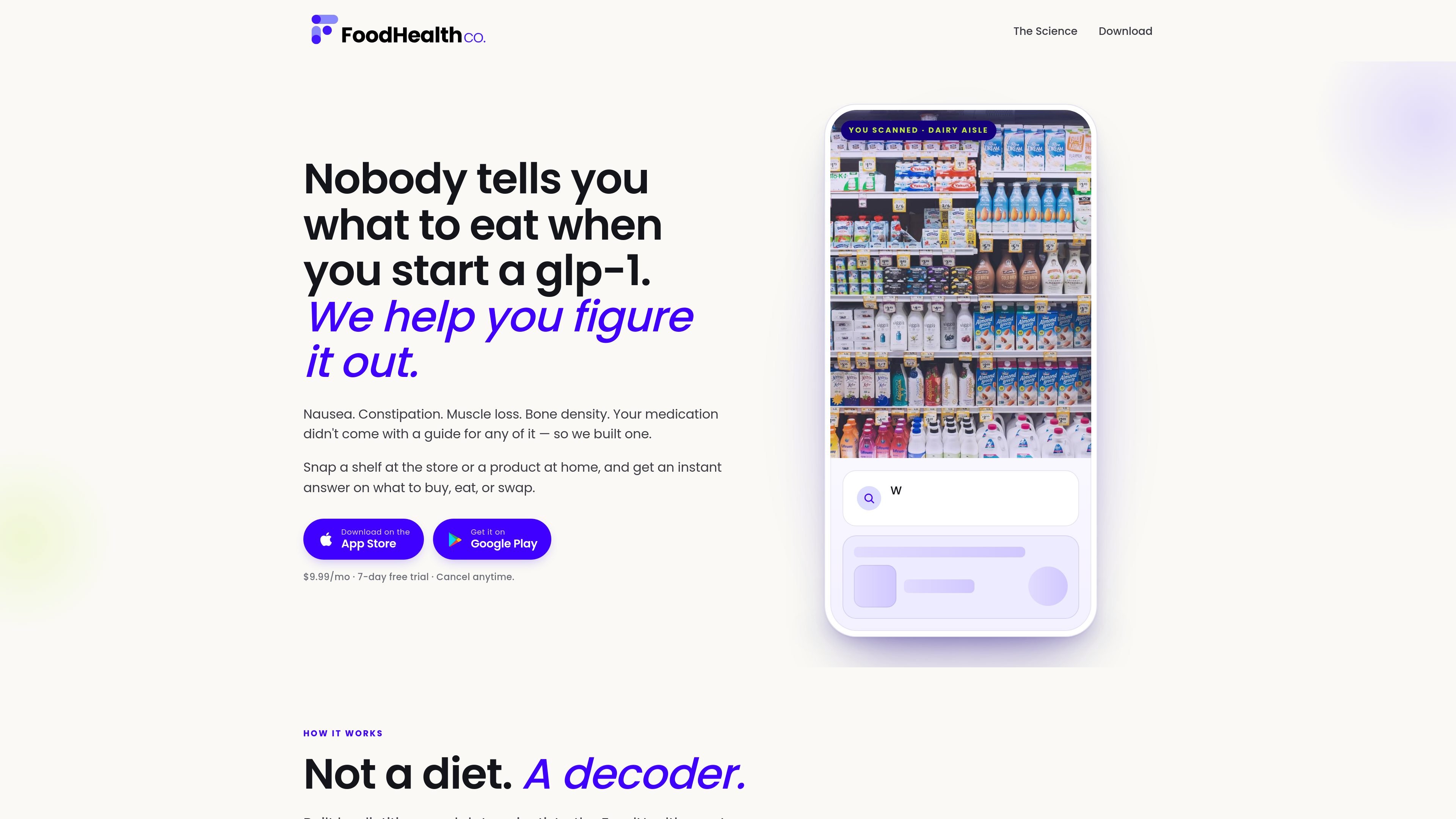
FoodHealth is a mobile shopping companion for people using GLP-1 medications who want a faster way to choose packaged foods. It lets users scan products and get an instant 1–100 score, then uses that score to suggest what to buy, eat, or swap.
The product’s science page says the FoodHealth Score is built by dietitians and based on peer-reviewed nutrition research. It combines ingredient quality and nutrient density, then applies a GLP-1-specific lens that emphasizes protein, fiber, hydration, and foods that are less likely to worsen nausea, reflux, or constipation.
Scan a packaged food and get an instant 1–100 FoodHealth Score designed to help you compare products in the aisle or on screen.
The score combines Ingredient Quality Measure and Nutrient Density Score so product comparison reflects both ingredient quality and nutrient content.
If you identify as being on a GLP-1, the app shifts recommendations toward protein quality, fiber per calorie, and hydration-supporting foods.
The app flags foods that may be harder to tolerate on GLP-1s, including empty-calorie, high-fat, added-sugar, and ultra-processed options.
FoodHealth adjusts guidance over time, with early-stage suggestions that can favor easier-to-tolerate foods before shifting toward more protein and fiber density.
The product is available on iPhone and Android and is offered as a subscription with a free trial.
When you are comparing several similar products in a store aisle, the app gives each one a score so you can move on without reading every label line by line.
If you are trying to eat better while taking a GLP-1, the app shifts recommendations toward higher-protein, higher-fiber, and hydration-supporting choices.
When you are not sure which item is worth keeping in the cart, the score helps you decide what to buy, what to swap, and what to leave behind.
If you are early in treatment and want easier-to-tolerate foods, the app can surface options that are softer, simpler, or less likely to aggravate common GI side effects.
For shoppers browsing on a phone, FoodHealth can score packaged foods directly from the app instead of sending you back to search engines or external nutrition apps.
FoodHealth is an app that scores packaged foods on a 1–100 scale and helps GLP-1 users decide what to buy, eat, or swap while shopping.
The science page says the FoodHealth Score is built from two weighted parts: Ingredient Quality Measure and Nutrient Density Score, with a GLP-1 lens that shifts recommendations toward protein, fiber, hydration, and foods that are easier to tolerate.
Yes. The download page says the app is available on the App Store and Google Play.
The site says the app is built for people on GLP-1 medications and adjusts recommendations based on that context, but it is also positioned as a shopping companion for scanning packaged foods.
The site describes a $9.99/month subscription with a 7-day free trial, cancelable in-app, and says there are no ads or upsells.

Malyatko is a baby tracker for logging feeding, sleep, growth, teething, and milestones in one app. It works on iPhone, Apple Watch, and widgets, with no sign-up, offline use, and family sharing through iCloud.

Goldfish is an AI memory app for macOS that helps you reply, write, summarize, and continue using the context already on your Mac. It stores memory locally and writes in your tone.

ArtDeck is a visual reference board app for iPhone, iPad, and Mac that lets artists collect mixed reference material on one canvas and study it with ToolBox lenses. It works offline, supports optional iCloud sync, and is sold as a one-time purchase with no account required.

Biji est une plateforme polyvalente conçue pour améliorer la productivité grâce à des outils et des fonctionnalités innovants.

MIRA vision develops synthetic-data-driven AI for pathology image analysis in medical diagnostics. Its website positions the product for teams that need privacy-compliant training data, automatic annotations, and controlled data generation.

Redline is a budgeting tool for Claude Code that paces sessions to stay within time, token, cost, or plan-percentage limits. It uses Claude Code’s native hooks and statusline to help sessions finish with a usable result instead of stopping abruptly.