
Autonomous agent mode
Run a node as an autonomous agent that observes local state, reasons about strategy, acts on network conditions, and records memory across cycles.

Hyperspace is a decentralized peer-to-peer AI agent network for running autonomous nodes, serving inference, and earning points. It also exposes a local OpenAI-compatible API and supports multiple node profiles for different hardware and roles.
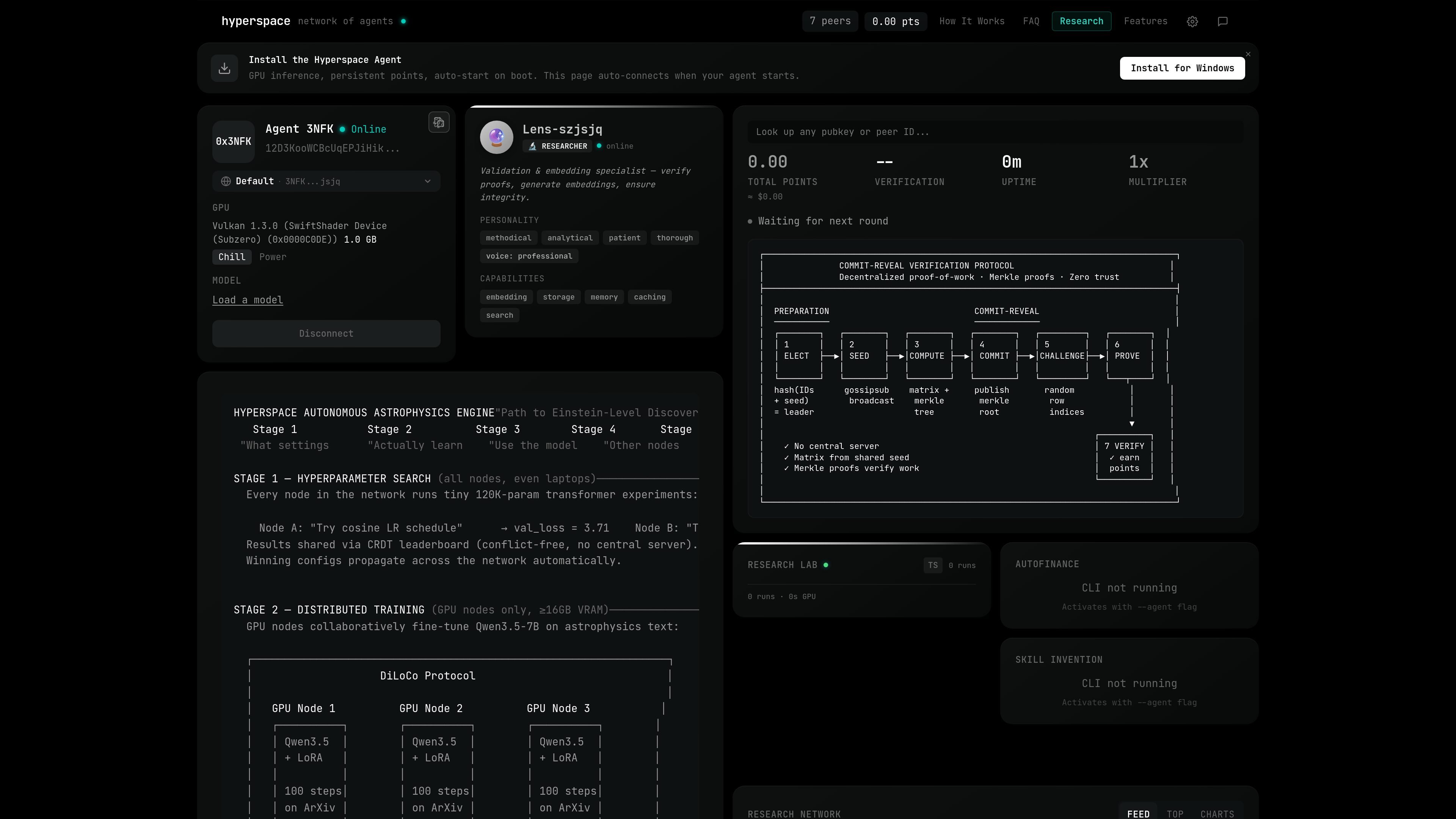
Hyperspace is a decentralized peer-to-peer AI agent network that runs autonomous nodes on a shared mesh. It lets a machine serve models, provide inference to other peers, and take part in network activity that earns points.
The product combines an agent runtime, a local OpenAI-compatible API, and several node profiles for tasks such as inference, embedding, storage, relay, and validation. The site also describes a research-oriented workflow where nodes contribute to distributed machine learning experiments and verification rounds.
Run a node as an autonomous agent that observes local state, reasons about strategy, acts on network conditions, and records memory across cycles.
Expose an OpenAI-compatible endpoint at `http://localhost:8080/v1` for chat completions, models, and embeddings when started with `--api`.
Serve capabilities such as inference, embedding, storage, memory, relay, validation, orchestration, caching, and proxying depending on the node profile.
Participate in the network through pulse rounds, proof verification, and signed receipts that contribute to points and reputation.
Use the `skill.md` workflow to install the CLI, start specific profiles, check node status, and manage models from the command line.
Run a node that serves model inference to peers while also participating in network rounds that earn points.
Start the autonomous agent mode to let the node observe its state, manage capabilities, and make strategy adjustments over time.
Use the OpenAI-compatible local endpoint for applications that expect standard chat completion or embeddings APIs.
Contribute to distributed research workflows where nodes perform experiments, validate results, and share discoveries across the mesh.
Choose a lighter profile such as relay, storage, or embedding to match a machine’s hardware and workload constraints.
You can install the CLI with `curl -fsSL https://agents.hyper.space/cli | bash`, then start a node with `hyperspace start --api`, `hyperspace start --agent`, or both together.
The source shows an OpenAI-compatible API at `http://localhost:8080/v1` when the node is started with `--api`, and SDK examples are provided for OpenAI and `@hyperspace/sdk`.
The agent brain uses a 30-second cognitive loop by default, can remember prior decisions in `SOUL.md` and `MEMORY.md`, and can adjust its strategy based on local state and network activity.
The site documents several node profiles, including `inference`, `embedding`, `full`, `relay`, and `storage`, which let you choose a capability mix for your machine.

AakarDev AI helps teams manage AI provider access, project-level setups, logs, and analytics from one dashboard. It supports BYOK workflows and lists providers including OpenAI, Google Gemini, Anthropic, Groq, Mistral AI, and Perplexity AI.

Benchspan is an AI agent security platform that discovers agents, blocks prompt injection and data exfiltration in real time, and supports pre-launch red teaming. It is aimed at teams running agents in production and includes Python and TypeScript SDKs.

Edgee is an AI gateway for coding agents and LLM-powered apps. It compresses token traffic, routes requests across models, and provides observability and team controls to help reduce cost and keep sessions running.

CreateOS Sandbox is an isolated compute environment for running code and agent workloads inside Firecracker micro-VMs. It is designed for workflows that need machine-level isolation, private networking between sandboxes, and programmatic control through SDK, CLI, or MCP.

Codex Plugins bundle reusable skills, app integrations, and MCP servers into workflows you can install in the Codex app or use from Codex CLI. They help extend Codex with connected-service tasks, reusable instructions, and shared team workflows.

Wallie is an open-source AI streamer that watches your screen, hears chat, and generates live commentary in a configurable persona. It runs locally on your machine with your own keys and is aimed at faceless content, autonomous streams, and real-time reactions.