
Digest queries for market signals
Ask an MCP-aware agent for a digest of owned-brand, competitor, demand, and reply-worthy mentions in one call, rather than checking separate dashboards.

MentionDrop MCP Server connects MentionDrop’s monitored market signals to MCP-aware AI agents such as Claude, Cursor, Windsurf, and Hermes. It helps agents retrieve mentions, competitor signals, demand signals, and reply drafts using account-scoped API keys.
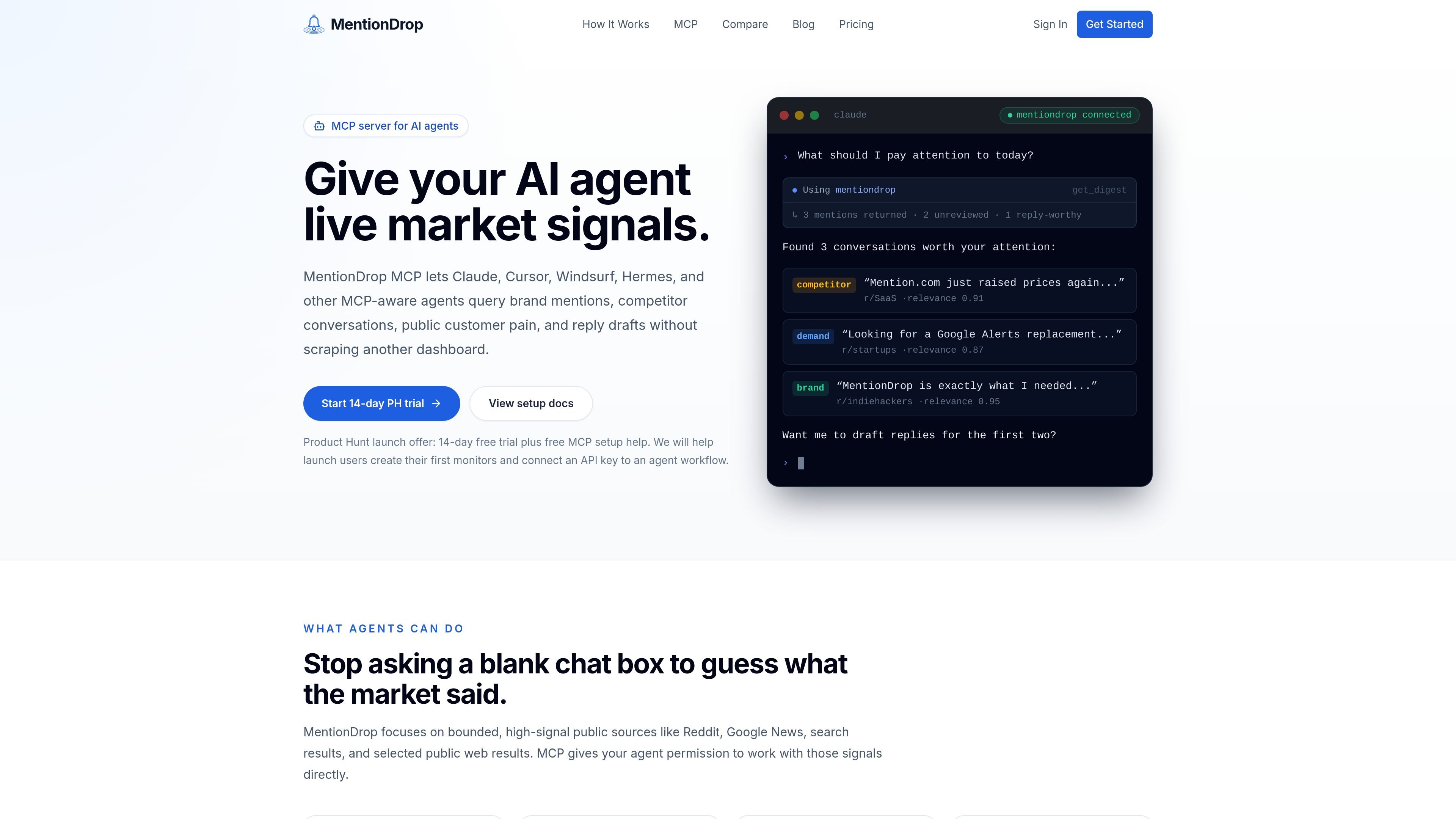
MentionDrop MCP Server is a connector for AI agents that need live market signals from MentionDrop’s monitoring system. It lets MCP-aware clients such as Claude, Cursor, Windsurf, and Hermes query brand mentions, competitor conversations, public customer pain, and reply drafts using the same account-scoped API keys as the HTTP API.
The product is aimed at turning mention monitoring into an agent workflow. Instead of asking an agent to infer what matters from a blank chat box, you can ask it to retrieve digests, surface high-signal public conversations, draft replies for review, and help organize monitors for your account.
Ask an MCP-aware agent for a digest of owned-brand, competitor, demand, and reply-worthy mentions in one call, rather than checking separate dashboards.
Fetch recent mentions and filter by role, keyword, source, sentiment, or date, then search returned results by title, summary, URL, suggested action, or keyword.
Pull competitor-role mentions and industry or demand mentions so agents can surface complaints, comparisons, positioning gaps, and public pain signals.
Generate a reply or outreach draft from a processed mention for human review, without allowing the agent to post automatically.
Create or update monitored keywords, mark mentions reviewed, and keep the account organized through action tools that work inside plan limits and keyword-risk checks.
Use the same account-scoped API keys and documented HTTP API surface across MCP and direct API workflows, with support for Claude, Cursor, Windsurf, Hermes, and other MCP-aware clients.
Use the MCP server to ask an agent for a daily digest of owned-brand mentions, competitor conversations, and reply-worthy items so you can triage what needs attention first.
Pull competitor-role mentions and public complaints to identify comparisons, objections, and positioning gaps that an agent can summarize for research or messaging review.
Surface Reddit, news, search, and selected web conversations where people are asking for help, then ask the agent to group them as demand or pain signals worth responding to.
Generate a reply draft from a mention ID and keep the output for human review, which is useful when you want an initial response but do not want the agent to post anything automatically.
Create and update monitored keywords, then use the HTTP API or MCP workflow to keep monitors organized as brand, competitor, or category coverage changes.
MentionDrop MCP is set up by creating a MentionDrop account, generating an API key in Settings, and adding the MCP endpoint to an MCP-aware client such as Claude, Cursor, Windsurf, or Hermes. The docs also provide a paste-in prompt that can help the agent find the right config file.
The docs say MentionDrop MCP is backed by the v1 API and uses the same account-scoped API-key authentication as the HTTP API. It also respects plan gates and account scoping, so the agent only sees the keywords and mentions your account can access.
MentionDrop MCP exposes read tools for digests, mentions, competitor signals, pain signals, and reply drafts, plus action tools such as creating or updating keywords, marking mentions reviewed, and generating reply drafts. The docs note that action tools can make real changes, so they should stay behind human intent in agent workflows.
MentionDrop describes its data sources as bounded and high-signal, including Reddit, Google News, search results, and selected public web results. It explicitly says the product is not full social firehose coverage.
The pricing page lists a 14-day money-back guarantee and says there are no contracts. The MCP launch page also mentions a 14-day Product Hunt trial offer with free MCP setup help for launch users.

CreateOS Sandbox is an isolated compute environment for running code and agent workloads inside Firecracker micro-VMs. It is designed for workflows that need machine-level isolation, private networking between sandboxes, and programmatic control through SDK, CLI, or MCP.

ByteAsk is a terminal-first AI coding agent for C and C++ that edits repositories and verifies changes with the real compiler, debugger, sanitizers, and tests before showing a diff. It offers a free tier plus paid plans, with editor connectors and zero-retention handling described in the source.

hob is an independent workspace for coding agents that keeps agent sessions, terminals, history, and follow-up work organized around the tools and providers you already use. It is aimed at developers who want local control over routing, history, and workspace structure rather than a bundled model stack.

Manta AI is an autonomous web app testing tool for teams that want to map application behavior, catch regressions, and generate tests without writing scripts or maintaining selectors. It works from a URL and supports plain-English test flows, run results with screenshots, and scheduled or deployment-triggered checks.

SonOf connects to your repo and PM tool, audits the codebase and surrounding product context, and turns approved work into shipped tickets with senior engineering review. It is aimed at founders and engineering leaders who need backlog help without hiring a full team immediately.

Ghost est un assistant IA en terminal pour discuter, générer du code et lancer des tâches en ligne de commande. Modèles gratuits, Linux, macOS, Windows, open source.