
Coding and agentic reasoning
MiniMax M3 is described as a frontier coding and agentic model with native multimodal understanding, intended for production-grade engineering tasks beyond simple code generation.

MiniMax is an AI platform for multimodal models, developer APIs, and AI-native products. Its highlighted model, MiniMax M3, focuses on coding, agentic workflows, and long-context multimodal tasks.
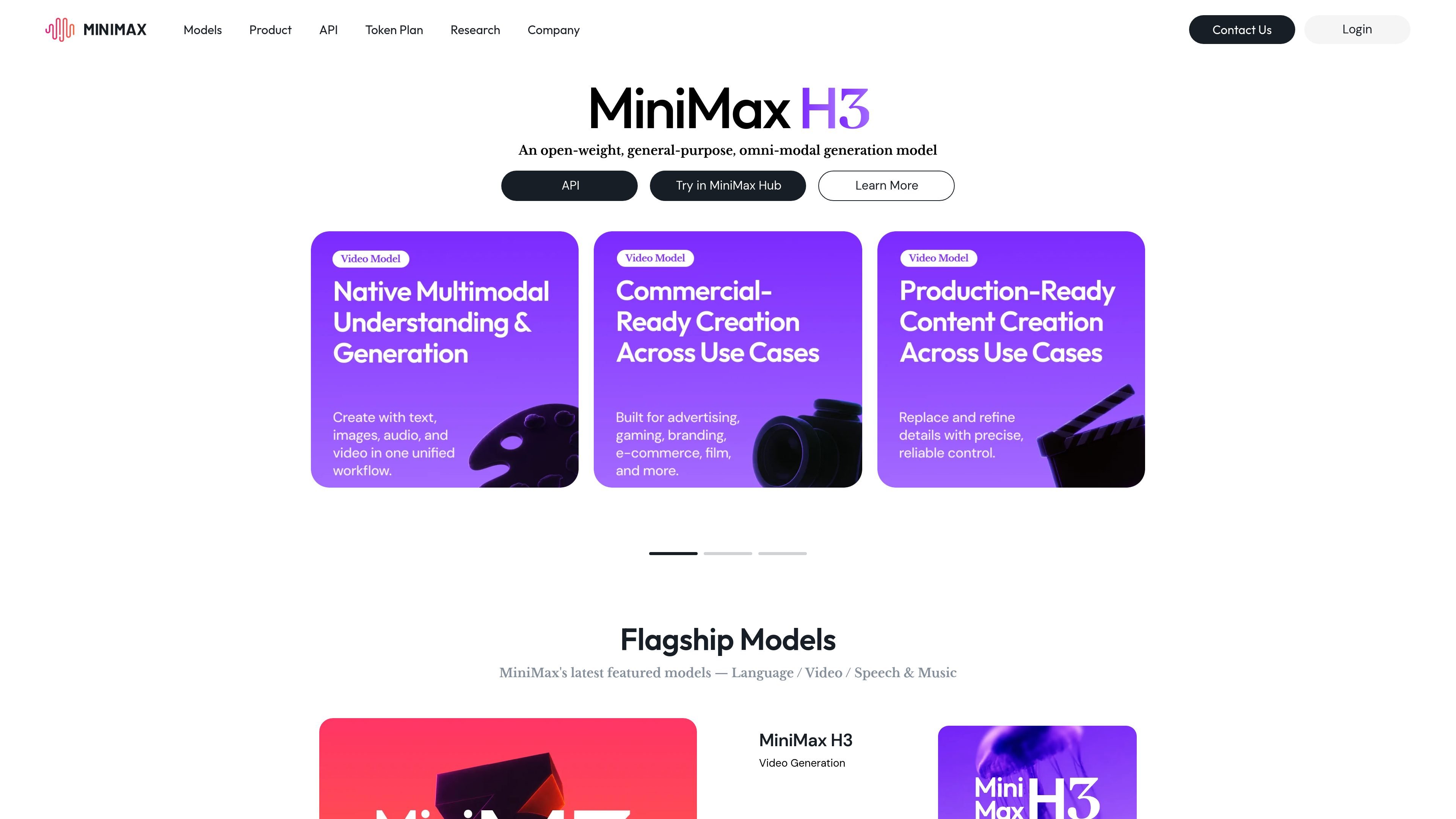
MiniMax is an AI model and product platform focused on multimodal foundation models, developer APIs, and AI-native applications. The company presents itself as a world-leading general AI technology company and says its products are built around models that can work across text, audio, image, video, and music.
The product pages in this source emphasize MiniMax M3, a coding and agentic model with native multimodal understanding and a 1M-token context window. MiniMax also offers MiniMax Code for agent-style workflows, an open platform for enterprises and developers, and separate pricing paths for API use and subscription plans.
MiniMax M3 is described as a frontier coding and agentic model with native multimodal understanding, intended for production-grade engineering tasks beyond simple code generation.
The M3 API supports up to a 1M-token context window, with a guaranteed minimum of 512K tokens, which supports long-horizon tasks, large codebases, and extended documents.
M3 is trained as a natively multimodal model, with the data pipeline rebuilt for step-zero multimodal training across text and visual semantic spaces.
MiniMax Code adds an agent workspace around the models, including task decomposition, tool use, memory, schedules, skills, and team-oriented workflows.
The pricing structure separates real-time API billing from monthly subscription plans, including token plans for individuals and teams and prepaid packs for audio and video products.
The API overview and model pages indicate an open platform for developers, with a documented endpoint example for text chat completion.
Use MiniMax M3 for software engineering tasks that need long context, autonomous task decomposition, tool use, and multi-step reasoning, such as working across large repositories or extended debugging sessions.
Use the platform when a workflow needs to combine text with visual material, for example analyzing documents that include charts, formulas, or other image-based context.
Use MiniMax Code when you want a higher-level agent workspace for repetitive work, custom skills, memory, schedules, and team-based task execution.
Use the API when you need direct model integration into an enterprise or developer application and want to connect to the documented chat-completion endpoint.
Use the subscription plans when you are an individual or small team that wants monthly quota-based access rather than per-call billing.
MiniMax exposes an open platform and API documentation for enterprises and developers, and the pricing page indicates API pricing as well as subscription plans. The source does not list a full SDK matrix or every supported platform, so setup should be validated against the specific product or model page you plan to use.
MiniMax positions M3 as a coding and agentic model with native multimodal understanding and a 1M context window, which makes it suitable for long-running workflows that combine text, code, and visual material.
The pricing page separates usage into pay-as-you-go API pricing and subscription plans, with separate pricing categories for audio and video products. Exact prices and limits are not included in the supplied source text.
MiniMax describes products including MiniMax Code, MiniMax Hub, MiniMax Audio, Talkie, and an open platform for enterprises and developers. The source does not provide a complete integration list for each product.

ByteAsk is a terminal-first AI coding agent for C and C++ that edits repositories and verifies changes with the real compiler, debugger, sanitizers, and tests before showing a diff. It offers a free tier plus paid plans, with editor connectors and zero-retention handling described in the source.

CreateOS Sandbox is an isolated compute environment for running code and agent workloads inside Firecracker micro-VMs. It is designed for workflows that need machine-level isolation, private networking between sandboxes, and programmatic control through SDK, CLI, or MCP.

hob is an independent workspace for coding agents that keeps agent sessions, terminals, history, and follow-up work organized around the tools and providers you already use. It is aimed at developers who want local control over routing, history, and workspace structure rather than a bundled model stack.

Manta AI is an autonomous web app testing tool for teams that want to map application behavior, catch regressions, and generate tests without writing scripts or maintaining selectors. It works from a URL and supports plain-English test flows, run results with screenshots, and scheduled or deployment-triggered checks.

SonOf connects to your repo and PM tool, audits the codebase and surrounding product context, and turns approved work into shipped tickets with senior engineering review. It is aimed at founders and engineering leaders who need backlog help without hiring a full team immediately.

Ghost est un assistant IA en terminal pour discuter, générer du code et lancer des tâches en ligne de commande. Modèles gratuits, Linux, macOS, Windows, open source.