
Compact 7B multimodal architecture
The model is presented as a 7B-parameter vision-language model with a ConvNeXt V2 vision encoder and a transformer language backbone for reasoning and generation.

Reka Edge is a 7B vision-language model for physical AI, edge deployment, and real-time visual reasoning. It is built for robotics, automotive systems, wearables, and other use cases that need low-latency grounding and local execution.
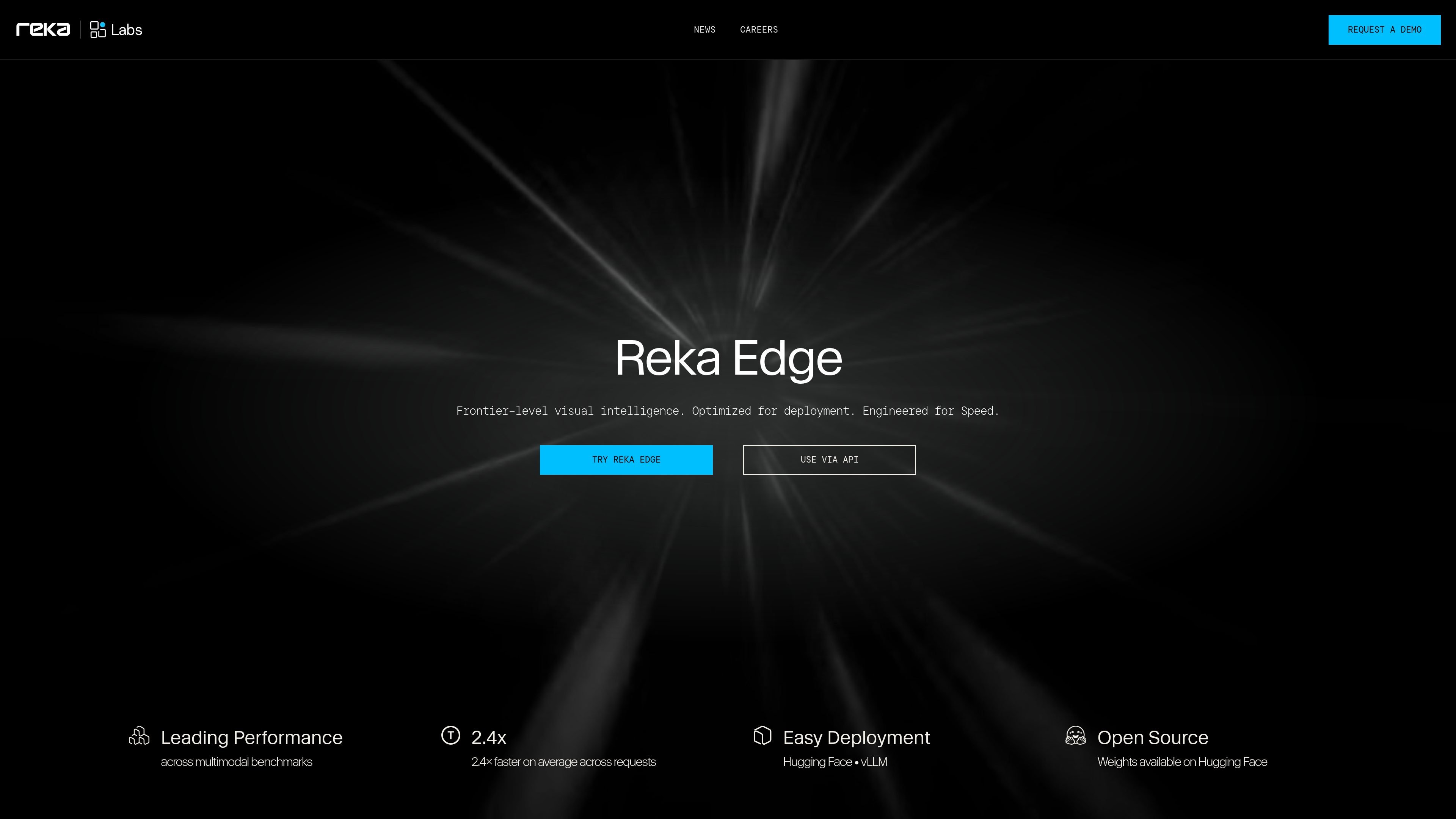
Reka Edge is a 7B vision-language model designed for physical AI and other edge deployments where low latency, grounded visual reasoning, and reliable local execution matter. The site presents it as a fast, open, and easy-to-deploy model for robotics, automotive systems, real-time video, wearables, and agentic automation.
According to the product and blog pages, Reka Edge combines a ConvNeXt V2 vision encoder with a transformer language backbone, uses a token-efficient visual representation, and is available with weights on Hugging Face. The product is positioned for deployment on edge hardware, on-premise systems, and cloud environments, with local runtime options such as vLLM and API access mentioned in the source.
The model is presented as a 7B-parameter vision-language model with a ConvNeXt V2 vision encoder and a transformer language backbone for reasoning and generation.
The source states that Reka Edge is optimized to emit only 64 tokens per image tile, which helps preserve context window space and reduce inference overhead.
The site highlights use of Hugging Face weights and vLLM, with support for local deployment and API access.
The product page and blog both emphasize object detection and grounding, including bounding-box outputs for detection prompts.
The model is positioned for video understanding, including real-time video analysis, multi-image reasoning, and temporal event understanding.
The source describes tool use for agentic workflows, including interactions with external tools and APIs in autonomous systems.
Deploy visual grounding and sub-second spatial reasoning for robots that need to locate tools, identify obstacles, and support motor control without waiting on a cloud round trip.
Run privacy-first cabin intelligence on vehicle compute to combine driver monitoring, multimodal input, and infotainment control while keeping processing offline.
Support technicians and frontline workers with hands-free visual Q&A on smart glasses or other wearables, especially in remote environments where connectivity is limited.
Analyze live streams for captioning, highlight generation, surveillance, or drone-based object detection where immediate response matters more than batch processing.
Route visual input into external tools and APIs for autonomous or semi-autonomous systems that need to act on what they see, not only describe it.
Reka Edge is designed to run on edge compute, on-device, on-premise, or in the cloud. The source highlights local deployment through Hugging Face and vLLM, plus access via API.
The source positions Reka Edge for robotics and physical AI, automotive in-cabin systems, wearables and field AI, and real-time video and media workflows. It is aimed at applications that need visual reasoning, grounding, and low latency.
The rendered product page highlights Weights available on Hugging Face and easy deployment through Hugging Face and vLLM. The labs page also references run locally and use via API.
The source does not show public pricing on the pricing page; it returns a page-not-found response and a request-demo path. That suggests users should contact Reka Labs for commercial access or current pricing details.
The source emphasizes 64 tokens per image tile, offline operation in some use cases, and production deployment on constrained hardware. It does not provide full setup instructions or supported SDK details in the collected text.

Tavus is an AI video platform for building real-time, face-to-face agents, digital twins, and AI companions. It combines APIs, custom replicas, and multilingual conversational workflows for developers and teams.

HiringPartner.ai is an autonomous AI recruiting platform for sourcing, screening, and interviewing candidates 24/7. It supports ATS-connected workflows, bulk resume uploads, and reviewable interview outputs for hiring teams.

Lasso is an ecommerce product data platform for enriching catalog records, processing supplier files, generating product content, and monitoring competitors. It combines a web app with a REST API, SDK, and MCP server for teams and developers.
Botacts is a web directory for finding AI bots and agents you can contact by phone, email, SMS, WhatsApp, Telegram, or Signal. It also lets creators suggest bots for manual review before publication.
Macuse is a macOS app that lets AI assistants control native Mac apps through MCP and use Computer Use for any app. It works with clients like Claude Desktop, Cursor, and Raycast, and keeps automation on-device.

AgentMail is an email inbox API for AI agents that lets developers create, send, receive, and search messages through REST APIs and SDKs. It supports agent workflows such as threaded replies, verification, customer support, scheduling, and inbox-based approvals.