
Map-based mission planning
Operators create survey routes directly on a facility map from a phone or desktop dashboard, then set stops and mission settings without waypoint files or coding.
Salem Robotics is software for autonomous inspection, data collection, and reporting in hazardous industrial facilities. It helps operators plan robot missions on a map, run them without teleoperation, and review compliance-ready outputs.
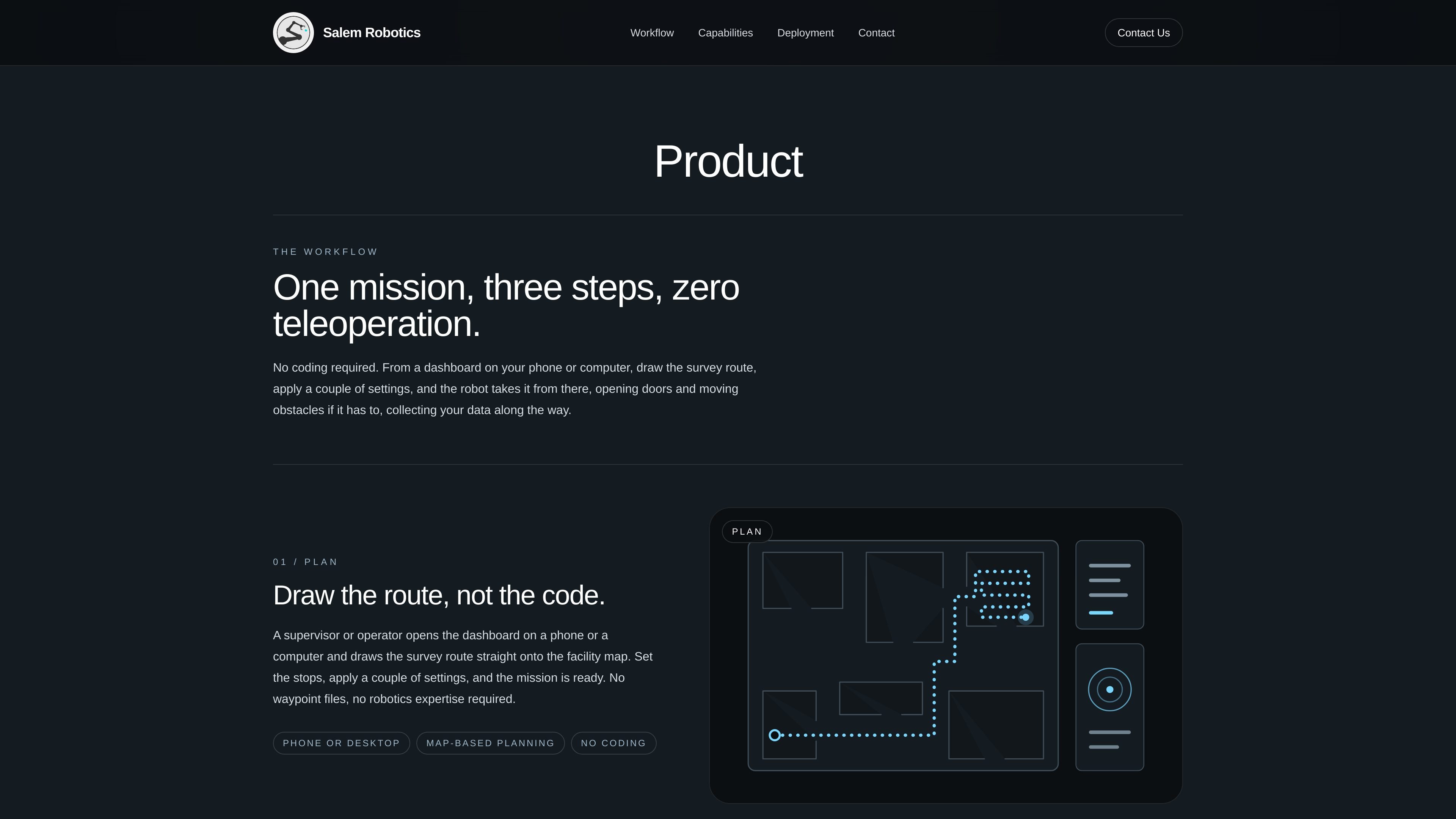
Salem Robotics is a software platform for autonomous inspection, survey, and monitoring in hazardous industrial facilities. It pairs robot-side autonomy with an operator dashboard so teams can plan missions, run them without teleoperation, and review the resulting data in one workflow.
The platform is presented as a fit for regulated and field-constrained environments where inspection work needs to be mapped, time-stamped, and tied back to facility geometry. The source emphasizes a simple plan-execute-report process, hardware-agnostic deployment, and support for local or low-connectivity operation.
Operators create survey routes directly on a facility map from a phone or desktop dashboard, then set stops and mission settings without waypoint files or coding.
The platform handles execution autonomously, including navigating around people and equipment and moving obstacles when needed.
Salem combines surveying, inspection, and manipulation in a single mission so the robot can collect data while carrying out the route.
Mission results are turned into compliance-ready reports with heatmaps, AI insights, and spatially linked readings.
Salem is designed to extend existing robotic systems rather than require a single hardware stack.
The system supports connected, low-connectivity, and air-gapped operation, with local or dock-based dashboard access.
Map a route for routine inspections, then let the robot collect readings and close out the mission with a report that ties data to facility locations.
Use the platform for specialized industrial surveys such as nuclear inspection, radiological survey, LDAR, corrosion checks, NDT, or temperature measurement.
Operate in industrial spaces where the robot must work around people, equipment, and changing conditions without direct teleoperation.
Deploy on sites with limited or no internet access by running autonomy on the robot and using dashboard access at the dock or a local server.
Extend a robot fleet already in use instead of adopting a fixed hardware system, then layer on a planning and reporting workflow.
Salem Robotics is designed for autonomous inspection and data collection in hazardous industrial facilities. The source specifically mentions nuclear inspection, radiological survey, LDAR, corrosion, NDT, and temperature measurement workflows.
A supervisor or operator uses a phone or computer dashboard to draw a survey route on a facility map, set stops, and apply a few settings. The robot then executes the mission without direct teleoperation.
The platform produces compliance-ready mission reports with time-stamped, spatially linked readings, heatmaps, and AI insights that flag potential safety risks found during the run.
The source says Salem is hardware-agnostic and can extend robotic systems already used in industrial facilities. It can also support a complete deployment with a robot paired to Salem's autonomy and data workflow.
The source notes support for connected, low-connectivity, and air-gapped sites, with run-time operation on the robot and dashboard access at the dock or on a local server.
OpenFlags is an open-source, self-hosted feature flag platform for modern JavaScript teams. It supports local evaluation, targeted rollouts, and controlled launches while keeping flag data in your own infrastructure.

PromptScout tracks how ChatGPT, Gemini, Google AI Overviews, and Perplexity mention your brand or competitors, then pairs those results with source analysis and website audits. It helps teams decide what to fix in content, positioning, or site readiness next.

Biji est une plateforme polyvalente conçue pour améliorer la productivité grâce à des outils et des fonctionnalités innovants.

Sleek Analytics is a privacy-friendly web analytics tool with real-time visitor tracking, Core Web Vitals, and revenue attribution. It helps site owners understand traffic and conversions without cookie banners or a heavy setup.

Codex Plugins bundle reusable skills, app integrations, and MCP servers into workflows you can install in the Codex app or use from Codex CLI. They help extend Codex with connected-service tasks, reusable instructions, and shared team workflows.
Struere is an AI-native platform for turning spreadsheet data into structured operational software with dashboards, alerts, and automations. It is aimed at teams that want to replace manual spreadsheet workflows without building custom tools from scratch.