
600+ components and blocks
A large set of reusable React UI components and blocks is available for production interfaces, with coverage across applications, marketing, e-commerce, dashboards, and AI products.

Tailgrids UI is a React and Tailwind CSS component library and design system for building production web apps, with reusable components, blocks, templates, CLI tooling, and Figma assets. It includes a free open-source edition and paid lifetime-access plans for teams that need premium blocks, templates, and design files.
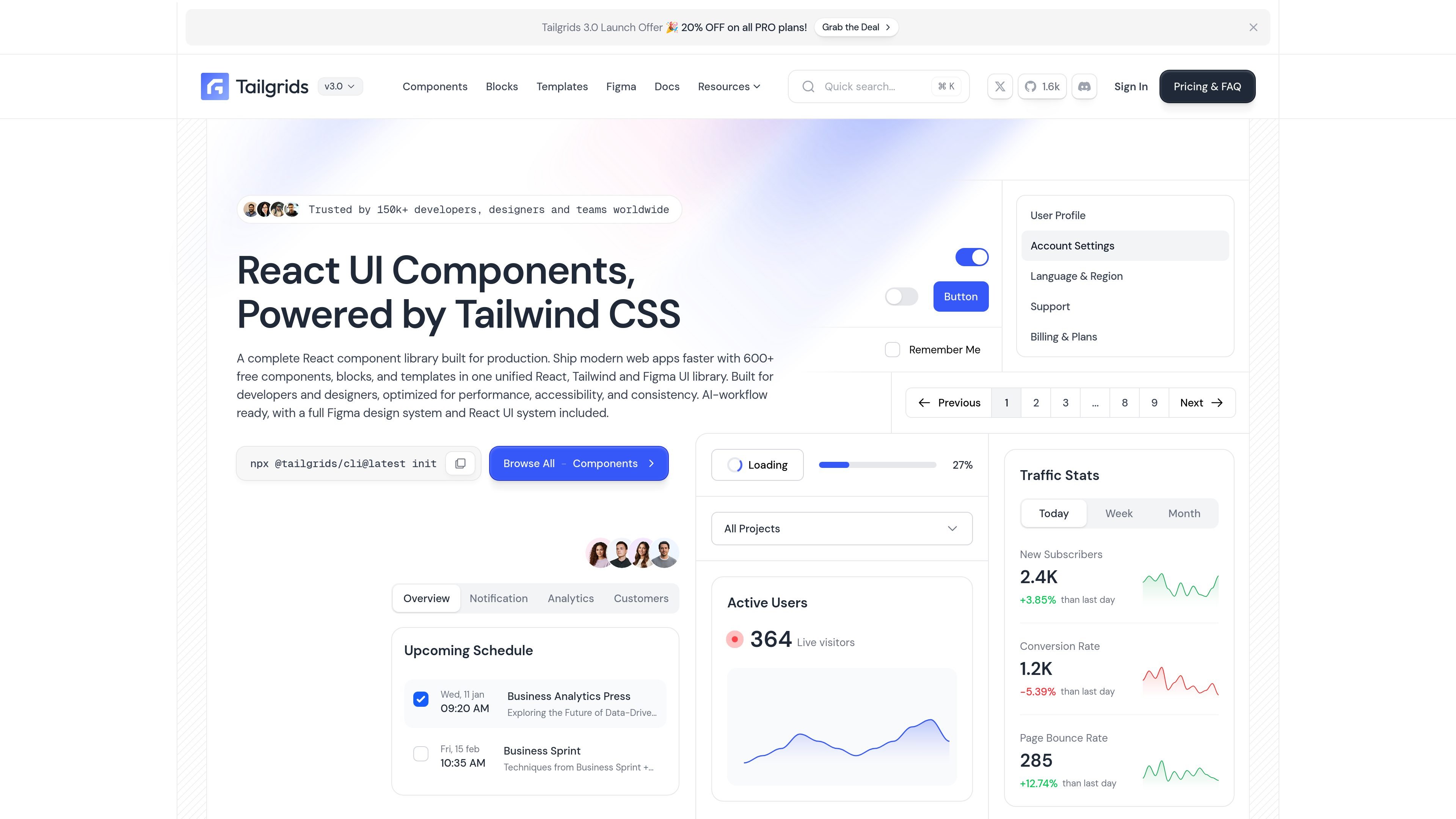
Tailgrids UI is a React component library and design system built with Tailwind CSS. It combines reusable components, UI blocks, templates, CLI tooling, theming, and a Figma design system for teams that want to move from design to implementation with fewer handoffs.
The product is positioned for production web apps and includes both open-source and paid options. The site highlights 600+ UI components and blocks, ready-to-launch templates, and Figma assets that support consistent work across applications, dashboards, marketing sites, e-commerce projects, and AI products.
A large set of reusable React UI components and blocks is available for production interfaces, with coverage across applications, marketing, e-commerce, dashboards, and AI products.
The library is built with Tailwind CSS and is described as usable with React frameworks, supporting predictable utility-first styling and flexible integration.
Built-in light and dark themes help keep interface behavior consistent across products and system preferences.
The included CLI can scaffold projects and add components, which supports repeatable setup across codebases.
The product includes a Figma design system with components, tokens, variables, and variants for design-to-development handoff.
Templates and blocks are packaged for real product workflows, including app, dashboard, marketing, e-commerce, and AI use cases.
Use the component library when building a new React interface and you need a consistent set of base UI elements that can be copied into an existing Tailwind project.
Use the block collections when you need larger precomposed sections for dashboards, e-commerce, marketing pages, or AI products instead of assembling each layout from scratch.
Use the templates when you want a starting point for a complete product or landing page, especially when the workflow includes common sections like pricing, features, testimonials, and FAQs.
Use the Figma design system when design and engineering need the same source structure, tokens, and variants before implementation begins.
Use the CLI when a team wants a repeatable setup process for adding components and keeping project structure consistent across multiple codebases.
Yes. The pricing page states that Tailgrids UI is suitable for commercial, client, and personal projects, and the open-source edition is free/MIT licensed.
The pricing page shows license-based plans by seat count, including a single-user commercial license and a team option for up to 5 members, so usage is organized around the plan you choose.
Yes. The site describes lifetime access with free updates for paid plans, and the open-source edition also mentions lifetime free access and updates via GitHub or NPM.
The home page says each component and block ships with a full Figma source, and the pricing page lists Figma design system access on paid plans.
The site presents Tailgrids UI as a React and Tailwind CSS library that also includes blocks, templates, CLI tooling, and a Figma design system for design-to-development workflows.

MakerLoft is a chat-first AI app builder for non-developers who want to create static sites or full-stack apps from a GitHub repository. It supports a free GitHub Pages path and a DigitalOcean-backed app path with sign-ins, payments, and an admin dashboard.

ByteAsk is a terminal-first AI coding agent for C and C++ that edits repositories and verifies changes with the real compiler, debugger, sanitizers, and tests before showing a diff. It offers a free tier plus paid plans, with editor connectors and zero-retention handling described in the source.

CreateOS Sandbox is an isolated compute environment for running code and agent workloads inside Firecracker micro-VMs. It is designed for workflows that need machine-level isolation, private networking between sandboxes, and programmatic control through SDK, CLI, or MCP.

hob is an independent workspace for coding agents that keeps agent sessions, terminals, history, and follow-up work organized around the tools and providers you already use. It is aimed at developers who want local control over routing, history, and workspace structure rather than a bundled model stack.

Ably Chat is a chat API platform for building custom realtime chat applications. It supports room-based messaging, typing indicators, presence, reactions, and message updates, with usage-based pricing options for different deployment stages.

Manta AI is an autonomous web app testing tool for teams that want to map application behavior, catch regressions, and generate tests without writing scripts or maintaining selectors. It works from a URL and supports plain-English test flows, run results with screenshots, and scheduled or deployment-triggered checks.