
Curated skill discovery
Browse a directory of released skills organized for discovery, including homepage listings, category pages, search, and sitemap coverage.

AI Agent Skills is an independent directory for discovering open-source AI agent skills for Claude Code, Codex CLI, and similar tools. It helps users browse released skills, review platform stats, and follow links back to the upstream repositories.
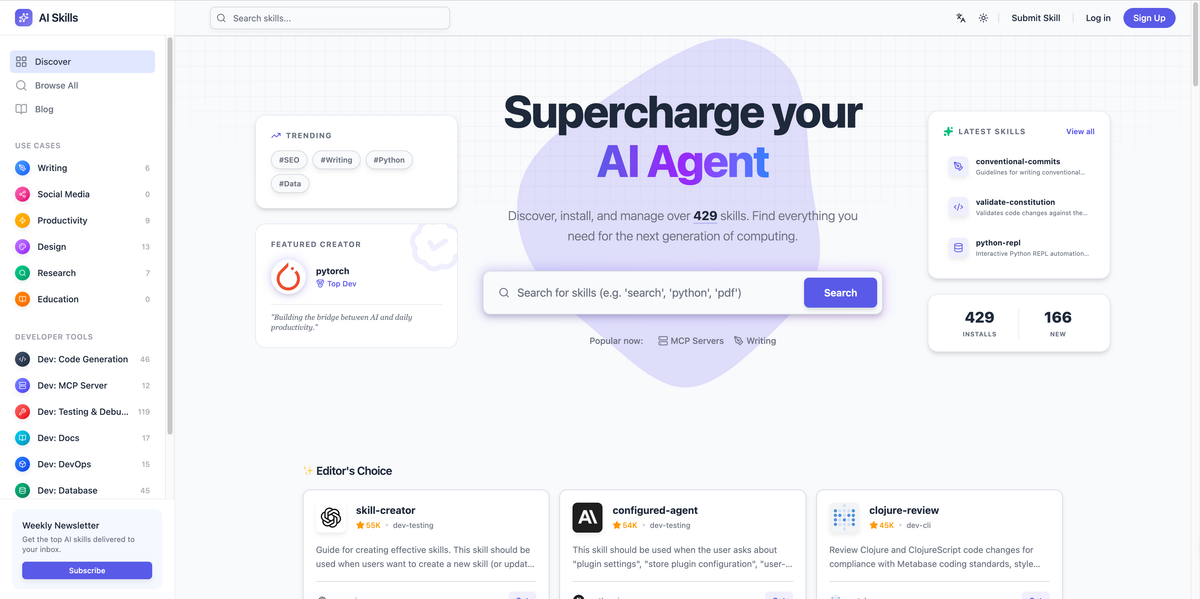
AI Agent Skills is an independent, community-oriented directory for discovering open-source AI agent skills. It indexes released skills for tools such as Claude Code and Codex CLI, then organizes them for browsing by category, search, and topical lists.
The site describes skills as reusable capability packages that extend agents with specific workflows such as writing, coding, automation, research, and productivity. Skills are sourced from public repositories and skill indexes, and maintainers keep ownership of the upstream source while the directory focuses on discovery and presentation.
Browse a directory of released skills organized for discovery, including homepage listings, category pages, search, and sitemap coverage.
Filter and explore skills across categories such as writing, code generation, backend and API, productivity, testing, and more.
View individual skill entries with short capability summaries, install-oriented context, and links back to upstream repositories when available.
Use the site’s stats page for snapshot metrics including total skills, authors, stars, weekly new releases, and refresh timing.
Access editorial guidance that distinguishes directory indexing from endorsement and encourages review of permissions, scripts, and network access before installing skills.
Find a released skill for a specific task such as writing, development, automation, or productivity instead of starting from scratch.
Compare skills within a category such as backend and API, testing and QA, or browser and web to narrow down the right workflow fit.
Check live directory stats when you want a quick read on catalog size, growth, and the shape of the ecosystem.
Use the directory as a starting point before installing a skill, then follow the linked upstream repository for docs and installation details.
AI Agent Skills is an independent directory for open-source AI agent skills published by their maintainers and indexed for discovery. The site says it is not affiliated with Anthropic or OpenAI.
The directory includes skills for Claude Code, Codex CLI, and similar AI agent tools. The home page also highlights skills for writing, coding, automation, productivity, and related workflows.
Skills are sourced from public repositories and skill indexes. The site says automated quality and safety checks run before a skill is marked released.
The pricing page at /pricing currently returns a page-not-found message, so the site does not provide a visible pricing model on the available pages.
The About page points users to /stats for live counts and methodology, and says the site refreshes counts and presents released skills in the directory, search, category pages, and sitemap.

AgentMail is an email inbox API for AI agents that lets developers create, send, receive, and search messages through REST APIs and SDKs. It supports agent workflows such as threaded replies, verification, customer support, scheduling, and inbox-based approvals.

Lasso is an ecommerce product data platform for enriching catalog records, processing supplier files, generating product content, and monitoring competitors. It combines a web app with a REST API, SDK, and MCP server for teams and developers.

CreateOS Sandbox is an isolated compute environment for running code and agent workloads inside Firecracker micro-VMs. It is designed for workflows that need machine-level isolation, private networking between sandboxes, and programmatic control through SDK, CLI, or MCP.

Codex Plugins bundle reusable skills, app integrations, and MCP servers into workflows you can install in the Codex app or use from Codex CLI. They help extend Codex with connected-service tasks, reusable instructions, and shared team workflows.

Botacts is a web directory for finding AI bots and agents you can contact by phone, email, SMS, WhatsApp, Telegram, or Signal. It also lets creators suggest bots for manual review before publication.

Wallie is an open-source AI streamer that watches your screen, hears chat, and generates live commentary in a configurable persona. It runs locally on your machine with your own keys and is aimed at faceless content, autonomous streams, and real-time reactions.