
Cited medical answers
AskMed searches a fixed set of journals, databases, guidelines, drug labels and medical references, then places a numbered citation after each claim so readers can inspect the underlying source.

AskMed is an AI medical reference for healthcare professionals, medical students and researchers. It generates source-linked answers from medical literature, guidelines, drug labels and references across web and mobile apps, for education and clinical reference rather than diagnosis or emergency care.
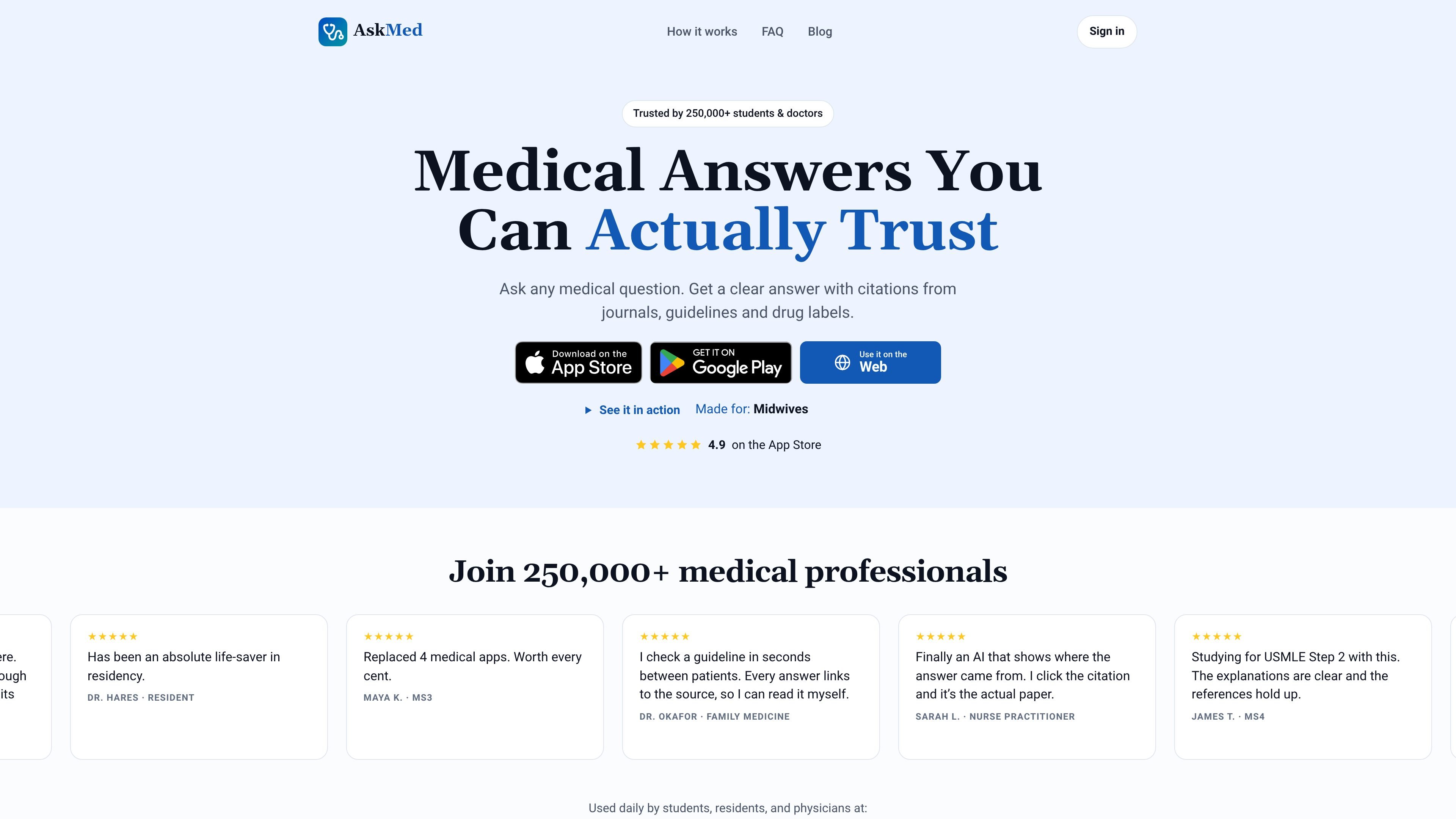
AskMed is an AI medical reference for healthcare professionals, medical students and researchers. It answers medical questions using material retrieved from journals, databases, clinical guidelines, drug labels and medical references, with citations attached to individual claims so users can check the source rather than relying only on the generated response.
The service is available through a web app, iPhone and iPad apps, and an Android app. It is designed for education and reference: it does not diagnose patients, is not intended for emergencies, and does not provide drug doses. AskMed explicitly advises users to verify citations and current guidance because AI-generated answers can contain errors or be incomplete.
Its workflow covers both quick reference and deeper evidence review. Users can ask focused questions, apply source filters, attach supporting documents, continue with follow-ups, or use Research Mode to examine studies. The product also includes history, saved answers, private mode, sharing, medical calculators on the website, and answer support in seven languages.
AskMed offers Pro and Max plans through its plan page. Max adds Deep Dive evidence reports with 20 or more sources and Exam Prep for named medical exams, while Pro features remain included; the available source does not establish a free tier or trial.
AskMed searches a fixed set of journals, databases, guidelines, drug labels and medical references, then places a numbered citation after each claim so readers can inspect the underlying source.
Research Mode finds relevant studies, reads the most relevant study in full and weighs the evidence for evidence-focused questions.
Source filters let users select evidence types such as journals, guidelines, drug labels, references or study types, and choose how many sources to cite.
Questions search clinical guidelines and FDA and DailyMed labels, with support for guidance outside the United States including NICE, ESC and WHO, plus local drug names from national registries.
Users can attach PDFs, images and notes so an answer can take supplied material into account, then continue with follow-up questions without repeating the original context.
History, Saved and Private Mode support reviewing previous answers, bookmarking useful material and keeping new questions out of History. Answers can also be shared as text with their sources.
Ask a focused question between patients, select relevant source types and open the cited guideline behind the recommendation before using it as a reference. The product's scenarios specifically describe checking NICE and other guidance by country and publication year.
Use a cited answer during a night shift or ward-round preparation to clarify a question, then escalate to a senior, rapid response team or local emergency service when the situation requires clinical intervention.
Turn a missed exam question into an explanation of why the options are right or wrong, using the cited material alongside formal study resources. Exam Prep is available in Max for named exams including USMLE and PLAB.
Use Research Mode to locate and weigh a relevant study, or investigate the paper behind a news headline before journal club or a case report. Each claim can be checked against its cited source.
Review an interaction by asking about its mechanism, label wording, alternatives and monitoring, without relying on an automatically supplied dose. This workflow is described for pharmacists and other clinicians counseling patients.
AskMed is intended for healthcare professionals, medical students, researchers, nurses and pharmacists. It is an education and reference tool, not a symptom checker, diagnostic service or substitute for clinical supervision or professional judgment.
Ask a specific medical question, ideally naming the patient group, setting and country when relevant. AskMed searches its medical sources, presents an AI-written answer with citations, and lets you open the sources behind individual claims.
AskMed searches journals and databases such as PubMed and the Cochrane Library, guidelines including NICE, WHO and CDC, FDA and DailyMed drug labels, and references such as StatPearls. Source filters can be used to choose evidence types and the number of sources.
No. AskMed states that it does not give drug doses, dose calculations or schedules. It can explain indications, mechanisms, side effects, interactions and monitoring, while prescribing information remains the authority for exact dosing.
AskMed answers are generated by an AI model without human review before display, so errors and outdated or incomplete information are possible. Users should open the citations, check publication dates and current official guidance, and use clinical judgment. Emergencies should be handled through the appropriate local clinical escalation process.

Hype is a web tool for finding trending YouTube topics by category, time range, and scoring mode. It helps creators spot emerging ideas, inspect source videos, and decide what to cover next.

Malyatko is a baby tracker for logging feeding, sleep, growth, teething, and milestones in one app. It works on iPhone, Apple Watch, and widgets, with no sign-up, offline use, and family sharing through iCloud.

MIRA vision develops synthetic-data-driven AI for pathology image analysis in medical diagnostics. Its website positions the product for teams that need privacy-compliant training data, automatic annotations, and controlled data generation.

Paperpal 是一款面向学术写作的 AI 工具,提供文献阅读、语言润色、引用、查重、AI 检测和投稿前检查。它适合需要在英文论文和学术材料上进行写作、修改与合规自检的学生、研究人员和教师。

VForms lets you place questionnaires directly inside YouTube videos so viewers answer in context instead of switching to a separate form. It is aimed at collecting feedback and insights through timestamped, embeddable video forms.

Scite è una piattaforma di ricerca AI per trovare articoli, verificare il contesto delle citazioni e ottenere risposte basate sulla letteratura scientifica.