
Plain-language research takeaways
Each study is summarized into a short answer that states the design takeaway in plain language, making the research easier to scan before reading deeper.

DesignDex is a design research library that turns peer-reviewed studies into practical takeaways for designers and teams making evidence-informed decisions. It helps users scan source-linked research, assess findings, and apply them in briefs, concepts, and reports.
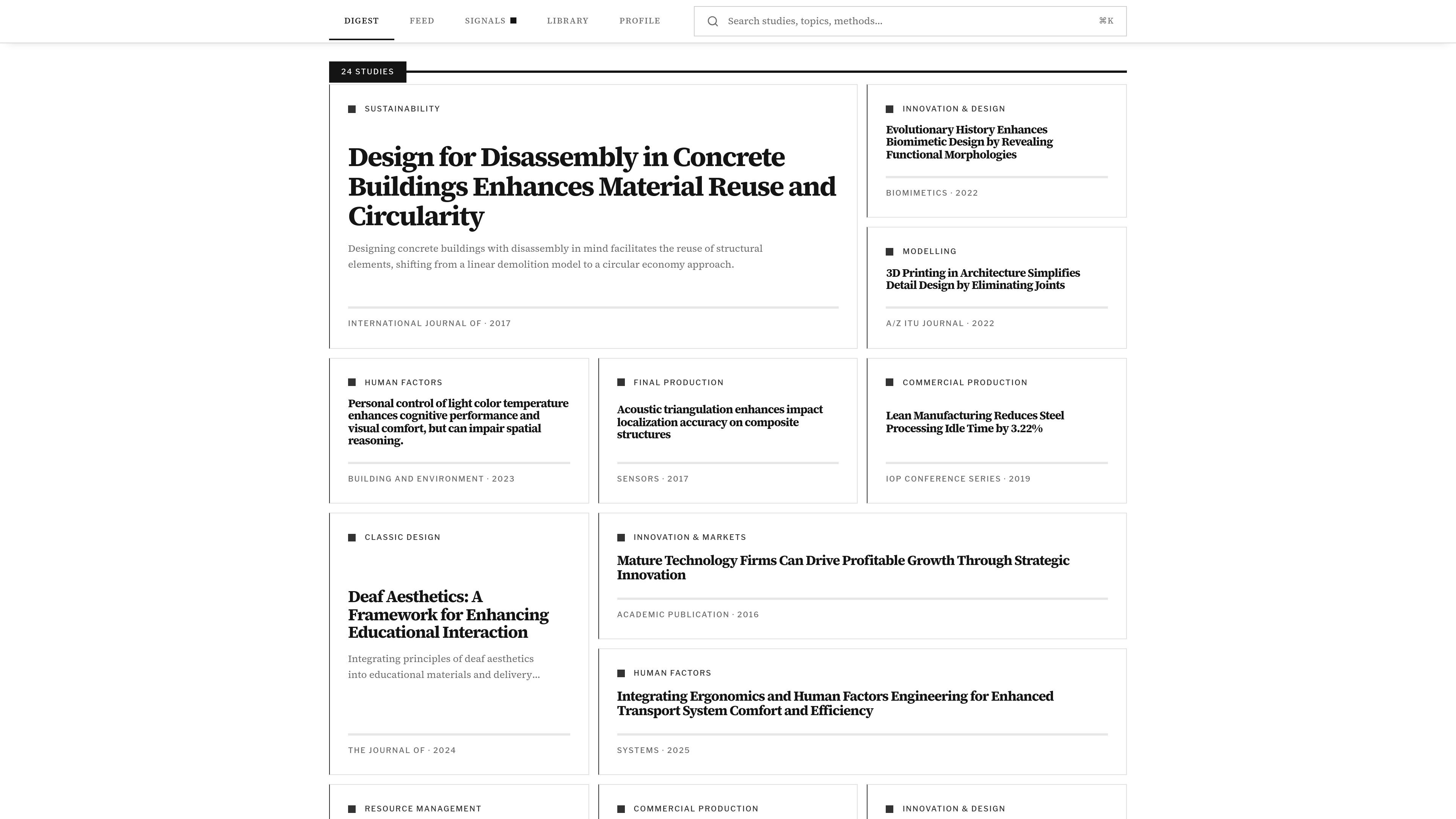
DesignDex is a design research library that turns peer-reviewed studies into short, usable takeaways for design decisions. The homepage positions it as a way to make evidence-based design research easier to scan and apply.
The site organizes a set of studies across topics such as Sustainability, Human Factors, User-Centred Design, Innovation & Design, and Commercial Production. Individual study pages summarize the research question, source, method, evidence strength, key findings, and a design takeaway, then add practical guidance on how to use the insight in a project.
DesignDex appears to function as a browsing and synthesis layer over published research rather than a general-purpose research database. The available pages emphasize interpretation, application, and quick citation support so designers can move from academic findings to project decisions more quickly.
The public site text also shows a library-style experience with study cards, topic labels, and a search prompt for studies and topics. A pricing page is not currently available from the provided evidence, and no integrations or account workflow are confirmed in the source material.
Each study is summarized into a short answer that states the design takeaway in plain language, making the research easier to scan before reading deeper.
Study pages show the source publication and date, helping readers understand where the evidence came from and how current it is.
Many study pages include method details such as qualitative studies or secondary data analysis, plus sample or procedure notes when available.
Pages surface key findings, strengths and limitations, and a short explanation of what the research means for design practice.
Each study includes an application section with practical project actions and a paragraph starter for citing the research in briefs or reports.
The site supports search across studies and topics, and the homepage indicates the library is updated daily from verified sources.
A designer can search for research relevant to a project topic, read the short answer first, and decide whether the study is worth deeper review.
A team working on a feature or service can use the key findings and application notes to translate academic evidence into concrete design decisions.
Researchers or designers writing internal documents can use the quick cite and paragraph starter to support a rationale with source-linked evidence.
Teams exploring topics like sustainability, human factors, or user-centred design can browse by category to find studies aligned with their domain.
Practitioners who want more than a headline can review the method, sample, strengths, and limitations to judge how much confidence to place in a finding.
DesignDex presents peer-reviewed design research as short, practical takeaways. Each study page includes a short answer, source, method, evidence level, key findings, and guidance on how to apply the insight.
The site organizes studies by broad design-related topics such as Sustainability, Human Factors, User-Centred Design, Innovation & Design, Innovation & Markets, Resource Management, Modelling, Commercial Production, and Classic Design.
Study pages are built around a research summary, including the source publication, method, sample or procedure when available, key findings, an application section, and a quick cite/paragraph starter.
The public source text does not show a working pricing page. The /pricing URL currently returns a not found page, so pricing details are not verified.
The source pages do not show documented integrations or API details, so connected tools and workflow integrations cannot be confirmed from the available evidence.

Goldfish is an AI memory app for macOS that helps you reply, write, summarize, and continue using the context already on your Mac. It stores memory locally and writes in your tone.

Lasso is an ecommerce product data platform for enriching catalog records, processing supplier files, generating product content, and monitoring competitors. It combines a web app with a REST API, SDK, and MCP server for teams and developers.

Hype is a web tool for finding trending YouTube topics by category, time range, and scoring mode. It helps creators spot emerging ideas, inspect source videos, and decide what to cover next.

ArtDeck is a visual reference board app for iPhone, iPad, and Mac that lets artists collect mixed reference material on one canvas and study it with ToolBox lenses. It works offline, supports optional iCloud sync, and is sold as a one-time purchase with no account required.

Struere is an AI-native platform for turning spreadsheet data into structured operational software with dashboards, alerts, and automations. It is aimed at teams that want to replace manual spreadsheet workflows without building custom tools from scratch.

garden-md is an open-source Node.js CLI that turns meeting transcripts into a local company wiki. It links entities across transcripts, keeps the original text intact, and renders the result as a browsable wiki.