
Search by product or competitor name
Enter an app, product, or competitor and FlawPulse returns a report based on real reviews rather than a manual summary. The homepage positions it as a fast way to turn complaints into a product opportunity.

FlawPulse is a pay-per-use research tool that scans real product reviews to surface pain points, a revenue range, and an opportunity score. It helps founders, product managers, and solo builders evaluate ideas and competitor gaps before building.
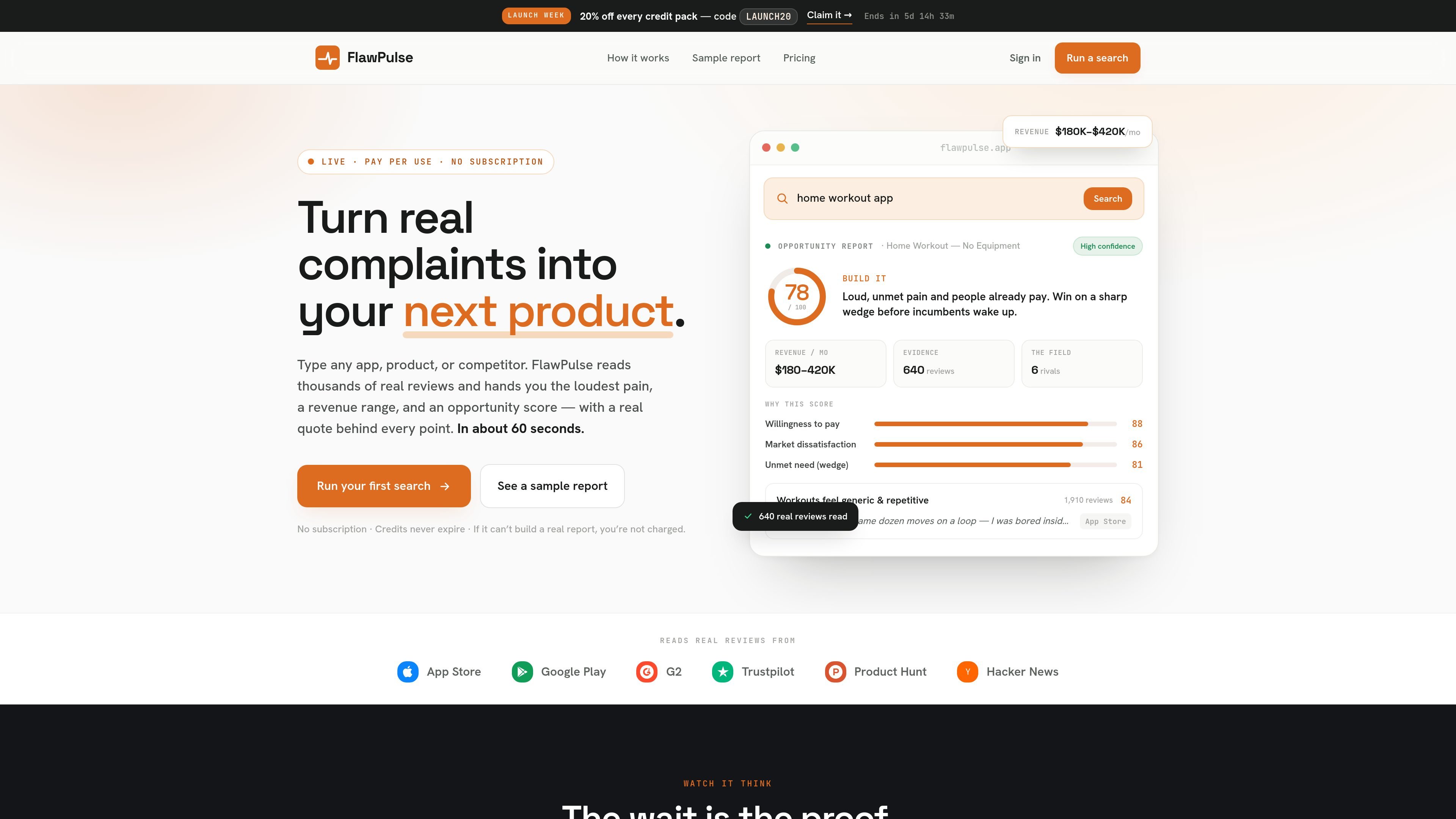
FlawPulse is a pay-per-use research tool that turns product complaints into an opportunity report. You type in an app, product, or competitor, and the service scans real reviews to pull out the most common pain points, a revenue range, and an opportunity score.
The product is aimed at people evaluating what to build next or checking whether a market problem is already obvious in user reviews. The homepage emphasizes that every claim is sourced, with real quotes attached to the findings and openable references for verification.
FlawPulse offers two report depths. A Quick search focuses on App Store, Google Play, and Hacker News; a Full report adds G2 and Trustpilot and expands into competitor maps, persona and feature-gap analysis, a build brief, and ready-to-ship landing copy.
The service is sold as credits rather than a subscription. The site says credits never expire, there is no monthly minimum, and if it cannot build a real report you are not charged.
Enter an app, product, or competitor and FlawPulse returns a report based on real reviews rather than a manual summary. The homepage positions it as a fast way to turn complaints into a product opportunity.
The product presents an opportunity score alongside a revenue range, so the output is not just sentiment but a prioritized read on whether the market looks worth pursuing.
Reports surface the main complaint themes and group them into clusters. The homepage shows examples such as generic workouts and paywalls arriving before value.
Each point in the report is backed by a real user quote and an openable source reference, which makes the output auditable instead of opaque.
The site shows both quick and full report formats. Quick uses App Store, Google Play, and Hacker News; Full adds G2 and Trustpilot plus competitor mapping, personas, feature gaps, a build brief, and landing copy.
The homepage shows a narrated run sequence with exact counts and source names, including cases where a source has no matches. The product also says it will not charge if it cannot build a real report.
A founder can search a prospective product idea and use the complaint clusters, revenue range, and opportunity score to decide whether the problem looks worth exploring before building.
A product manager can compare several competitors, then read the review-backed pain points to identify gaps that users keep naming across the market.
A solo builder can use the build brief and landing copy from a Full report to turn review language into an initial spec and a first-page message.
A researcher can run a Quick search when they only need a faster read on the main pains, without paying for the broader competitor and persona analysis in a Full report.
Users can enter the name of an app, product, or competitor. The homepage says the service then reads real reviews and returns a report with the loudest pain points, a revenue range, and an opportunity score.
The pricing copy says Quick searches use 2 credits and Full reports use 5 credits. Credits are sold in packs, there is no subscription or monthly minimum, and credits never expire.
The homepage says each report includes a revenue range, pain clusters, ranked issues, and real quotes tied to sources that can be opened. Full reports also include a competitor map, persona and feature-gap notes, a build brief, and landing copy.
The site says it reads real reviews from App Store, Google Play, G2, Trustpilot, Product Hunt, and Hacker News. The homepage also shows examples where some sources have no matches and are reported as such.

Hype is a web tool for finding trending YouTube topics by category, time range, and scoring mode. It helps creators spot emerging ideas, inspect source videos, and decide what to cover next.

Radar is a self-hostable media intelligence and social listening app for monitoring public sources, analyzing mentions, and generating briefs or content outputs with optional Claude AI. It is aimed at individuals and small teams that want an enterprise-style workflow without a cloud account.

PromptScout tracks how ChatGPT, Gemini, Google AI Overviews, and Perplexity mention your brand or competitors, then pairs those results with source analysis and website audits. It helps teams decide what to fix in content, positioning, or site readiness next.

SaveMRR is a Stripe retention tool for SaaS teams that scans billing data for churn and MRR leaks, then automates recovery through dunning, cancel-save offers, win-back emails, and onboarding nudges. It is built for founders and bootstrapped teams using Stripe.

Sleek Analytics is a privacy-friendly web analytics tool with real-time visitor tracking, Core Web Vitals, and revenue attribution. It helps site owners understand traffic and conversions without cookie banners or a heavy setup.

Struere is an AI-native platform for turning spreadsheet data into structured operational software with dashboards, alerts, and automations. It is aimed at teams that want to replace manual spreadsheet workflows without building custom tools from scratch.