
Connects the existing growth stack
Connects websites, CRMs, email, stores, ad accounts, analytics, warehouses, spreadsheets, and outbound tools, with the site describing more than 200 sources and governed two-way data flows.

Growth Brain is an AI growth-operations platform that connects a team’s existing data, marketing, and customer tools to identify audiences, activate approved workflows, and measure results. It is designed for growth and go-to-market teams that want an always-on decision loop without replacing their current stack.
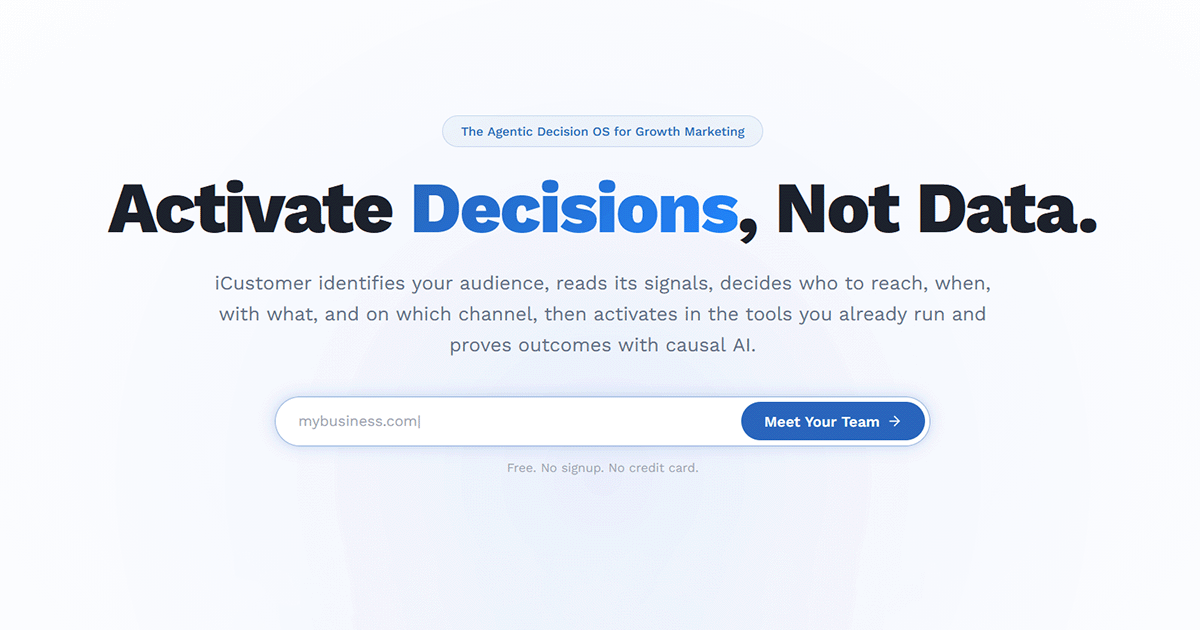
Growth Brain is an autonomous growth-operations product from iCustomer for teams that want to connect their existing customer, marketing, and analytics systems around a defined business goal. It combines audience analysis, activation, and measurement in a repeating loop rather than treating campaign execution as a one-time task.
A team connects its stack, states a primary goal and optional additional goals, and sets KPIs, targets, and operational guardrails. Growth Brain then keeps audiences updated, runs approved moves in connected tools, reports results, and feeds those results into later decisions. The product is designed to work with existing systems rather than requiring a migration, while actions outside configured permissions remain subject to human review.
The documented goals include pipeline growth, product-led growth, retention and expansion, partner and ecosystem development, brand and community engagement, and go-to-market efficiency. The pricing site positions Audience Loop as the self-serve entry point and describes a separate Platform offering for enterprise teams that want decisioning on their own data cloud or warehouse.
Connects websites, CRMs, email, stores, ad accounts, analytics, warehouses, spreadsheets, and outbound tools, with the site describing more than 200 sources and governed two-way data flows.
Maintains a shared context for the brand, systems, audience, and previous results so subsequent decisions use information written back by earlier actions.
Uses fit, intent, readiness, and engagement signals to keep audiences current and determine who is ready to be reached.
Runs approved activation workflows across channels such as LinkedIn, Meta, email, ads, and CRM systems, while queuing unapproved actions for review.
Measures outcomes against a holdout and records targeting, activation, and result information so teams can assess what contributed to revenue rather than relying only on last-click attribution.
Can be orchestrated through the web app, Slack, CLI, API, MCP, or a team’s own agents, according to the site.
Identify members of the wider buying committee, prioritize accounts showing relevant signals, and activate outreach through approved channels instead of relying only on the person who submitted a form.
Find signups that have stalled before a meaningful product action, then use current behavioral signals to decide who should receive follow-up while the opportunity is still active.
Monitor usage and engagement for signs of customer risk, prioritize accounts before renewal, and coordinate retention or expansion actions through the team’s connected systems.
Use existing partner relationships and account signals to identify potential ecosystem opportunities, then route activation through approved CRM, email, advertising, or outbound workflows.
Reduce wasted outreach and advertising by distinguishing current customers, engaged audiences, and people showing intent, with holdout-based measurement to evaluate the resulting activity.
Growth Brain connects to a website, CRM, email, store, advertising accounts, analytics tools, warehouses, spreadsheets, and outbound tools. The site says it supports more than 200 sources and writes data and decisions back to connected tools.
You provide a primary goal, optionally add up to two more goals, and define KPIs, time-bound targets, and guardrails. The system acts only within the permissions you approve; other actions wait for human review with evidence and a recommended next move.
No tool migration is required. Growth Brain is designed to work with an existing stack, with the site describing connections across web, CRM, email, store, advertising, analytics, warehouse, spreadsheet, and outbound systems.
Growth Brain is presented as self-serve and says no data team or GTM engineer is required for normal use. Teams can also use a CLI, and the company offers certified operators or partners for teams that want additional implementation support.
The product has a free starting option, with paid plans from $99 per month and a Team plan listed at $499 per month on the pricing page. The pricing page also describes usage-based credits for Audience Loop and a separate custom-annual Platform offering.

Topple.lol is a public pay-to-rank leaderboard where listings start at $1 and their bid balance decays over time and with clicks. It helps makers and marketers buy short-term visibility for product sites or X profiles while tracking live board stats.

PromptScout tracks how ChatGPT, Gemini, Google AI Overviews, and Perplexity mention your brand or competitors, then pairs those results with source analysis and website audits. It helps teams decide what to fix in content, positioning, or site readiness next.

SaveMRR is a Stripe retention tool for SaaS teams that scans billing data for churn and MRR leaks, then automates recovery through dunning, cancel-save offers, win-back emails, and onboarding nudges. It is built for founders and bootstrapped teams using Stripe.

Hype is a web tool for finding trending YouTube topics by category, time range, and scoring mode. It helps creators spot emerging ideas, inspect source videos, and decide what to cover next.

DailyPlay.ai is a behavioral growth platform that uses AI site scanning and micro-games to help brands improve engagement and conversion. It supports web, mobile, and other digital touchpoints, with a one-line script setup and a free engagement scan.

Sleek Analytics is a privacy-friendly web analytics tool with real-time visitor tracking, Core Web Vitals, and revenue attribution. It helps site owners understand traffic and conversions without cookie banners or a heavy setup.