
Bring your own key
Bring your own Anthropic, OpenAI, and Google keys. The site says keys are encrypted at rest and never leave your infrastructure.

Lettertrace is an open-source, bring-your-own-key tool for monitoring how AI assistants mention a brand or topic. It helps teams track visibility, share of voice, sentiment, and competitor presence across AI answers.
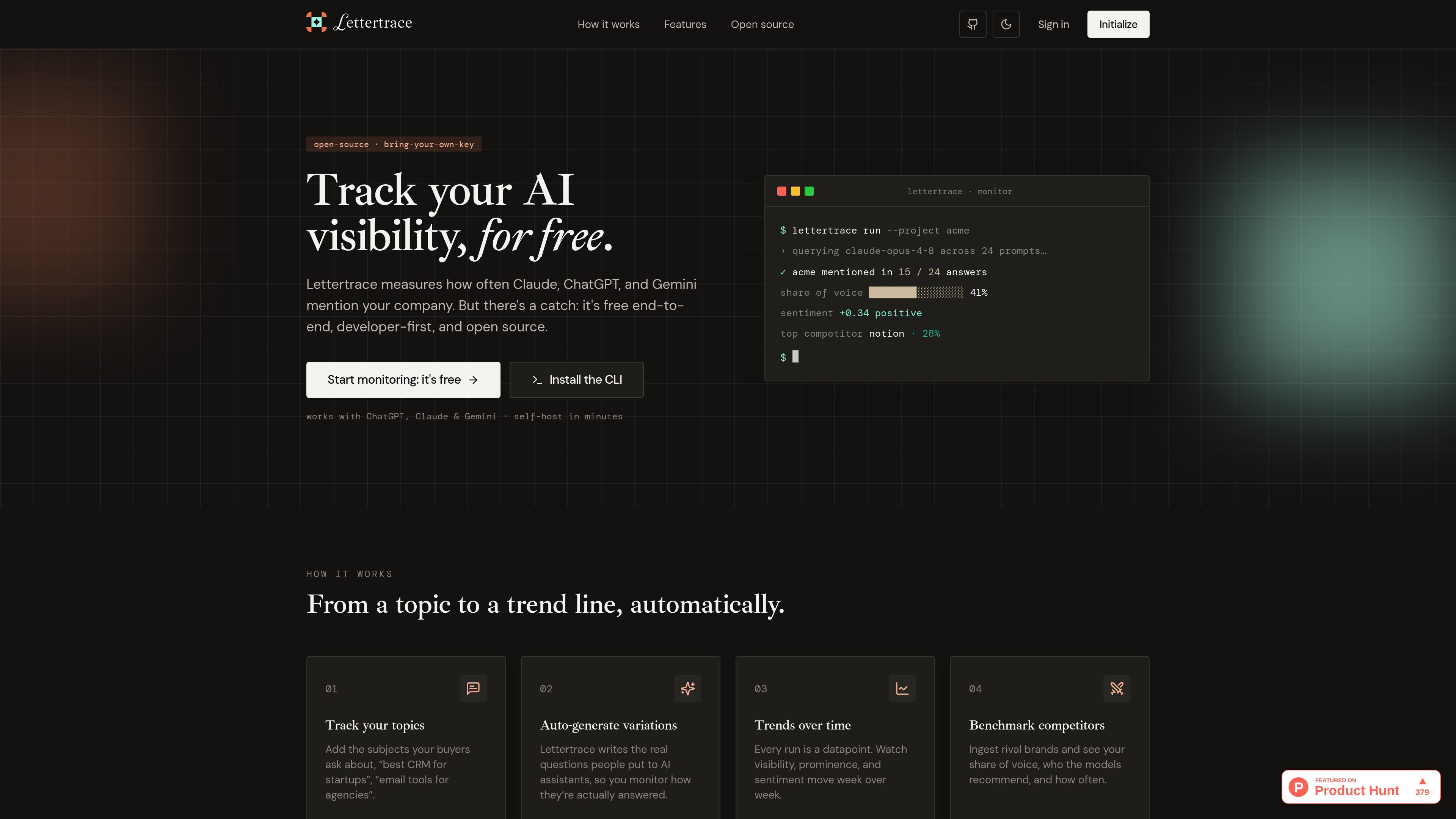
Lettertrace is an open-source, bring-your-own-key tool for monitoring how AI assistants mention a brand or topic. It is designed for teams that want to measure AI visibility across Claude, ChatGPT, Gemini, and Google AI Overviews without relying on a vendor middleman.
The workflow starts with a topic, generates realistic prompt variations, and then runs those prompts on a schedule so users can track mention rate, share of voice, sentiment, and competitor presence over time. The product is positioned as developer-first and self-hostable, with setup centered on your own API keys and Supabase-backed data.
Bring your own Anthropic, OpenAI, and Google keys. The site says keys are encrypted at rest and never leave your infrastructure.
Run prompts against Claude, ChatGPT, Gemini, and Google AI Overviews side by side, with room to add more answer engines as needed.
Start with a topic and let Lettertrace generate natural prompt variations automatically, reducing manual prompt writing.
Track visibility, share of voice, prominence, sentiment, and recommendations for each topic, model, and time period.
Schedule daily or weekly monitoring jobs to create a trend line and compare how results change over time.
Fork, inspect, and self-host the open-source code under an MIT license with your own Supabase data store.
Track whether your company appears when users ask AI assistants for recommendations in your category, then watch how often it is mentioned and whether it is recommended positively.
Compare your brand with named competitors and review share of voice, competitor frequency, and model-specific mention patterns across different answer engines.
Turn a single topic into many realistic prompts, then run them on a schedule to see how answers shift as models change.
Use the tool to inspect the quality of AI answers, including sentiment and recommendations, when you are planning AEO or GEO work.
Run the open-source stack locally or self-host it with your own keys and Supabase-backed data if you want control over infrastructure and stored data.
Lettertrace is set up to monitor brand mentions in AI assistant answers. The source copy points to a flow where you add your brand, add a key, and run a first monitor in minutes.
The site shows sign-in options for Google, GitHub, or email and says it creates your workspace automatically for new users.
Lettertrace runs prompts against Claude, ChatGPT, and Gemini with your own API keys, and the site also mentions Google AI Overviews in its feature list.
The product focuses on visibility, share of voice, prominence, sentiment, and competitor benchmarking across topics and over time.
The source material does not document paid plan pricing, and the pricing URL currently returns a 404 page.

PromptScout tracks how ChatGPT, Gemini, Google AI Overviews, and Perplexity mention your brand or competitors, then pairs those results with source analysis and website audits. It helps teams decide what to fix in content, positioning, or site readiness next.

ClayHog è una piattaforma di visibilità nella ricerca AI per monitorare come i brand appaiono in ChatGPT, Gemini, Perplexity, Claude e Google AI Overviews. Un’unica dashboard per agenzie, marketing e SEO.

beehiiv is a newsletter platform for creators, publishers, and brands that want to build, grow, and monetize email newsletters and websites from one place. It offers a free Launch plan, plus paid tiers for more advanced growth, monetization, and support features.

Skayle is a content and AI search visibility platform that researches topics before writing, publishes structured content to a CMS, and tracks whether brands are cited in AI search. It is aimed at teams that want one system for publishing, schema-rich content, and visibility monitoring.

Radar is a self-hostable media intelligence and social listening app for monitoring public sources, analyzing mentions, and generating briefs or content outputs with optional Claude AI. It is aimed at individuals and small teams that want an enterprise-style workflow without a cloud account.

SaveMRR is a Stripe retention tool for SaaS teams that scans billing data for churn and MRR leaks, then automates recovery through dunning, cancel-save offers, win-back emails, and onboarding nudges. It is built for founders and bootstrapped teams using Stripe.