
Multi-source feed connections
Connect RSS, Telegram—including private channels—YouTube, and additional one-click sources such as Substack, Bluesky, Mastodon, Product Hunt, GitHub, and arXiv. Twitter/X account parsing is available on Pro.

Radaric is an AI-powered content curation system that filters and groups posts from sources such as RSS, Telegram, YouTube, and social platforms. It is designed for editors, researchers, and feed-heavy readers who want a shorter, personalized reading queue without losing access to original sources.
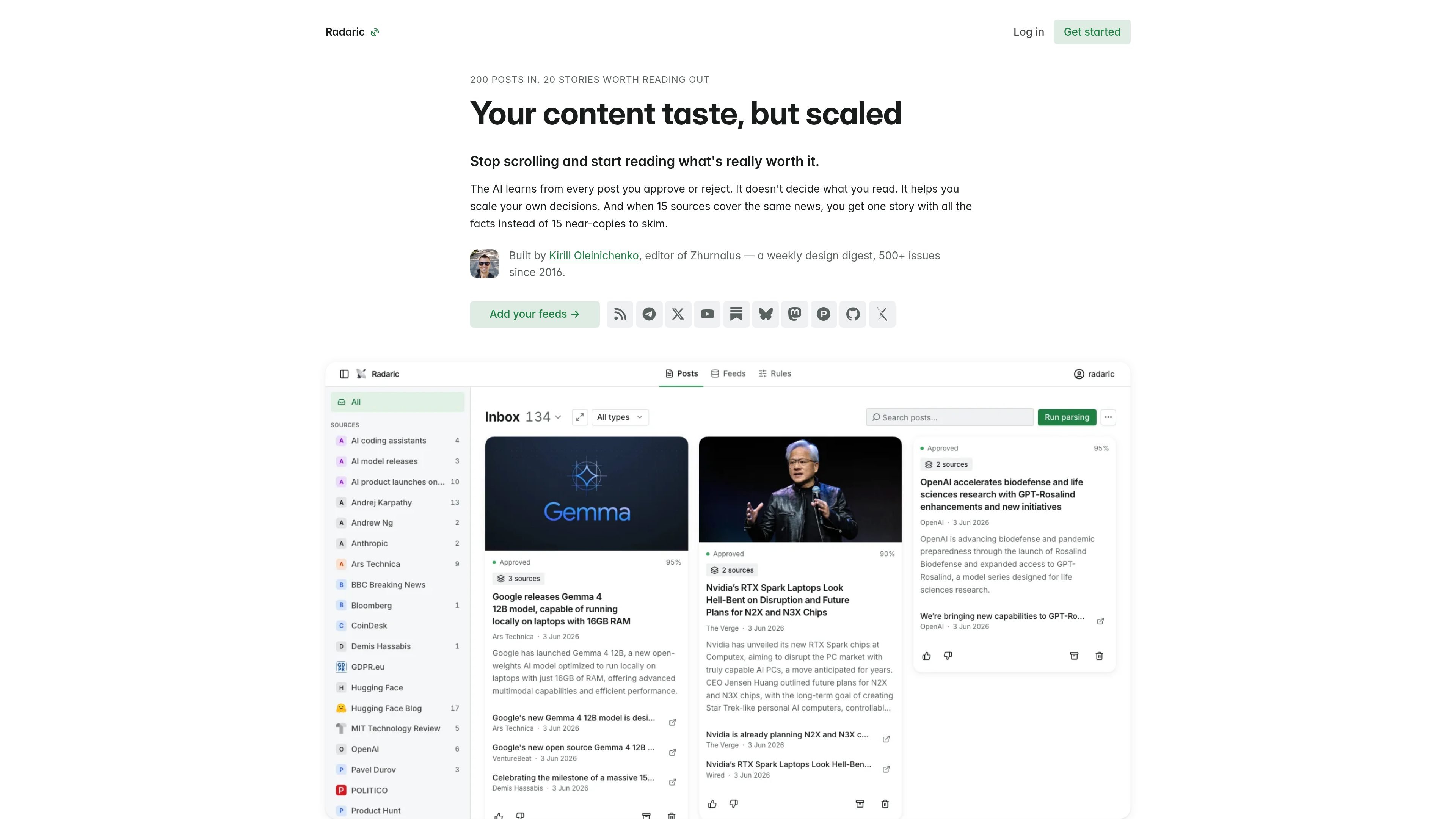
Radaric is an AI-powered content curation system for people who monitor many feeds and want a shorter reading queue based on their own editorial preferences. It connects sources including RSS, Telegram, YouTube, and several publishing, social, research, and developer platforms, then evaluates new posts against criteria the user writes in plain language.
The system keeps rejected items accessible, explains its filtering decisions, and learns from approvals, rejections, saves, and opens. It also groups posts about the same event into a single story with links to the original sources, reducing duplicate coverage while preserving access to the underlying material.
Connect RSS, Telegram—including private channels—YouTube, and additional one-click sources such as Substack, Bluesky, Mastodon, Product Hunt, GitHub, and arXiv. Twitter/X account parsing is available on Pro.
Write what matters to you in plain language. Radaric evaluates each incoming post, assigns a confidence score, and provides a short explanation for the decision.
Approve, reject, explain, save, and open posts to provide feedback. The filter adapts to these decisions over time instead of applying one identical model to every reader.
Posts covering the same event can be combined into one story across sources and languages, while links to the original posts remain available.
For YouTube sources, Radaric uses the video transcript to assess the content, allowing the feed to be filtered without requiring the user to watch every video.
Import many existing feeds at once from Feedly or Inoreader with an OPML file, or add supported sources individually.
Connect a large set of industry, publication, and social feeds, then use approvals and rejections to narrow the daily queue to items aligned with a personal editorial brief.
Combine Telegram channels, RSS feeds, YouTube sources, and social posts in one monitoring workflow, with related coverage consolidated into a single story for review.
Import an existing Feedly or Inoreader collection through OPML and reduce repetitive triage when moving to a more personalized filtering workflow.
Review developments across languages and source types without opening every duplicate post; grouped stories retain the original links for source checking.
Radaric connects RSS, Telegram, YouTube, and other supported sources, then checks new posts against criteria written in plain language. You can add feeds individually or import a hundred at once from Feedly or Inoreader using an OPML file.
No. Radaric keeps rejected posts available one click away and shows the AI's reason for each filtering decision.
Yes. Radaric's Telegram connection is read-only: it reads messages but does not send, modify, or delete them. The site states that Telegram credentials are stored encrypted.
Radaric groups posts about the same event across connected sources by comparing titles, content, mentioned names and entities, and publication times. Each grouped story retains links to the original posts.
The site describes a paid Lite plan and a paid Pro plan, with a 30-day money-back guarantee. It also states that there is no free tier; the pricing page itself is an account sign-in or registration screen rather than a detailed plan listing.