
Foundations for AI-assisted coding
Covers prompting basics, prompt anatomy, tool selection, trust levels, and editor setup so readers can work with AI more deliberately.

Vibe Coding Bible is a 459-page AI coding guide for developers, tech leads, founders, and non-coders who want practical workflows for prompting, refactoring, and shipping software with tools like ChatGPT, Claude, and Copilot. It is sold as an instant-download PDF and EPUB with lifetime updates.
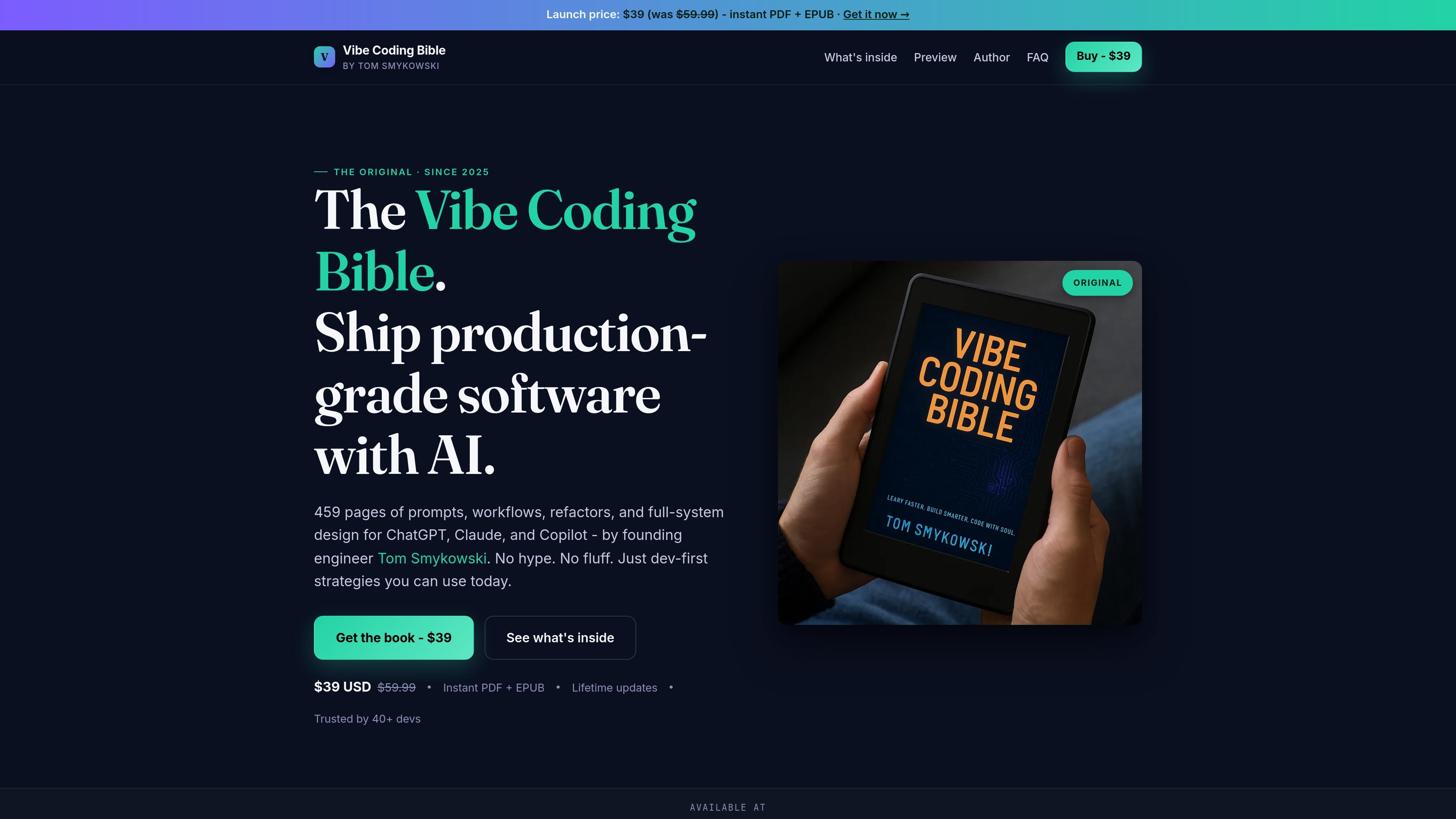
Vibe Coding Bible is a 459-page guide to shipping production-grade software with AI. It is positioned as a structured playbook for working with ChatGPT, Claude, and Copilot across prompting, refactoring, workflow design, and full-system planning.
The book is written by Tom Smykowski, a founding engineer with 15+ years of frontend and system design experience. It is sold as an instant-download PDF plus EPUB, with lifetime updates included and a focus on practical, dev-first guidance rather than general AI commentary.
Covers prompting basics, prompt anatomy, tool selection, trust levels, and editor setup so readers can work with AI more deliberately.
Includes copy-paste-ready production prompts for refactoring, documentation, testing, and debugging, with explanations of why each pattern works.
Shows repeatable workflows for greenfield features, legacy refactors, PRDs, pair-programming, and review checklists.
Explains how to move from sketches to working MVPs using AI across data models, APIs, UI, tests, deploys, and observability.
Provides reusable templates, cheatsheets, meta-prompts, token-economy tips, and editor or CLI setup notes.
Includes a chapter of mistakes, warnings about AI-specific pitfalls, and guidance on where human judgment should stay in the loop.
For developers who want prompt patterns that produce cleaner code, better refactors, and more useful AI output in everyday work.
For engineers handling existing codebases who need a safer way to debug, refactor, and document without breaking behavior.
For founders and indie hackers turning ideas into MVPs, with guidance on data models, APIs, UI, tests, and deploys.
For tech leads who want a clearer way to review AI-assisted changes, mentor teammates, and keep teams moving without adding avoidable tech debt.
For non-coders or career switchers who need plain-English explanations and prompts they can use to brief AI tools and review the results.
Yes. The book says it is the original Vibe Coding Bible, written by Tom Smykowski, first published in 2025 on Summon The JSON and continuously updated since.
You get a 459-page PDF in B5 format and an EPUB for Kindle, Kobo, iPad, and phones. Both are delivered as an instant download after checkout.
The purchase happens through Summon The JSON’s secure checkout. The site says you can pay by card or supported wallet, with a one-time payment and no subscription.
Yes. Lifetime updates are included, so buyers receive future revisions at no extra cost as the tooling and best practices evolve.
The book is language-agnostic. It uses short Python and JavaScript examples for readability, but the prompts and workflows are meant to apply across languages.

ByteAsk is a terminal-first AI coding agent for C and C++ that edits repositories and verifies changes with the real compiler, debugger, sanitizers, and tests before showing a diff. It offers a free tier plus paid plans, with editor connectors and zero-retention handling described in the source.

Ghost è un assistente AI da terminale per chattare, generare codice ed eseguire task da riga di comando. Include modelli gratuiti, supporta Linux, macOS e Windows, ed è open source.

Vi3ecode is a maintained development environment for working with AI coding agents. It keeps project context, terminal, Git, memory, flows, review, and communication connected around the agent you already use.

Lucid Train is a local-first AI coding harness that turns repository code into architecture diagrams and uses those diagrams as specifications for coding agents. It is available as a desktop app and a lightweight Rust CLI, and it can run with local models or your own API keys.

Devin is an AI coding agent and software engineer that helps developers and engineering teams plan and execute complex software tasks. It is available through desktop, cloud, JetBrains, and CLI surfaces, with plans for individuals, teams, and enterprises.

CreateOS Sandbox is an isolated compute environment for running code and agent workloads inside Firecracker micro-VMs. It is designed for workflows that need machine-level isolation, private networking between sandboxes, and programmatic control through SDK, CLI, or MCP.