
Credit delegation for agents
Lets an agent borrow against a delegator’s Aave position so debt lands on the delegator’s account instead of requiring manual transfers.

Agent Credit is an open-source credit-delegation workflow for AI agents built on Aave. It lets an agent borrow against a delegator’s Aave position, with the debt recorded on the delegator’s account.
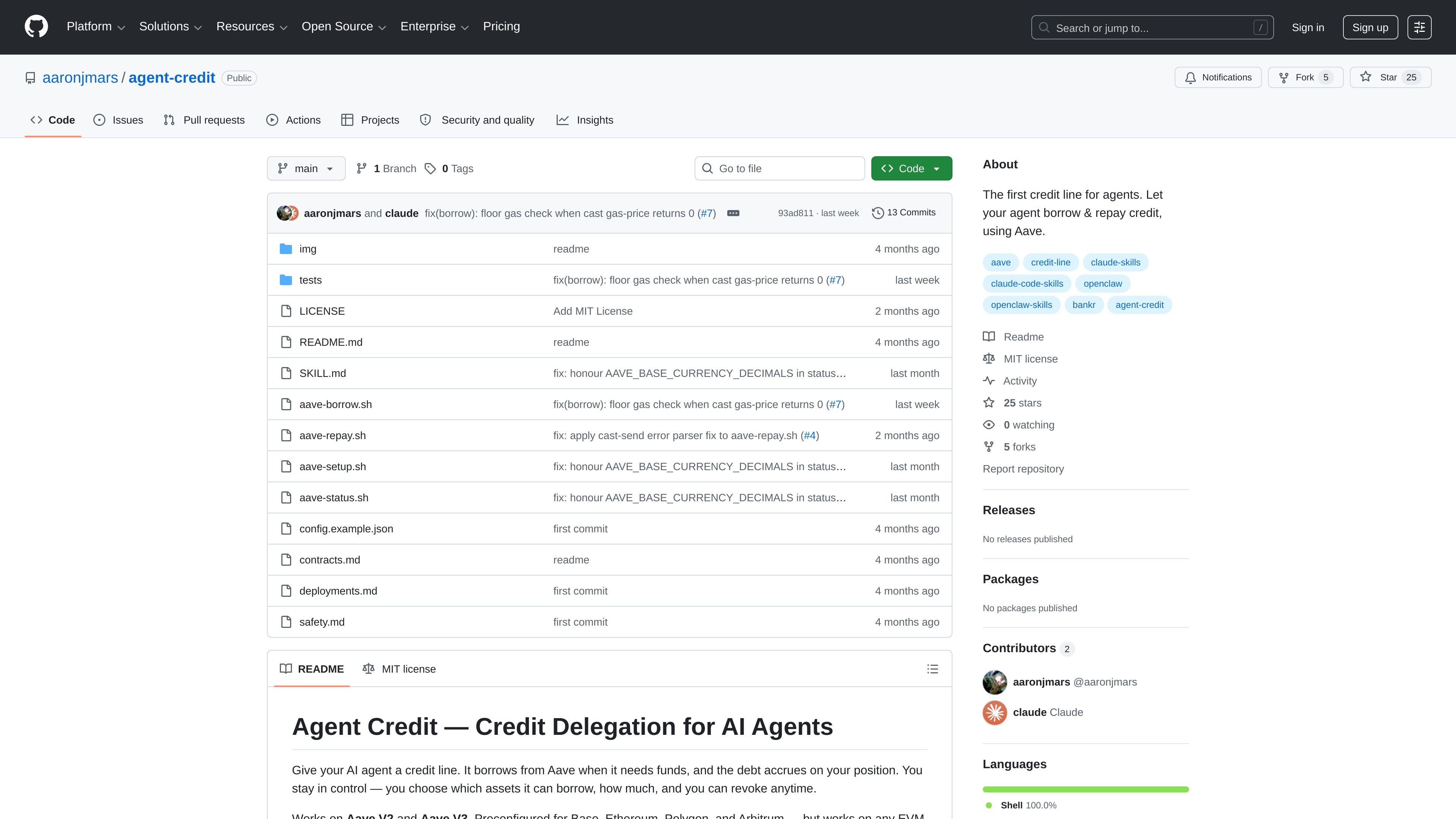
Agent Credit is a credit-delegation workflow for AI agents built around Aave. It lets an agent borrow funds against a delegator’s Aave position, with the debt recorded on the delegator’s account, so the agent can access capital without the owner manually transferring funds each time.
The repository ships shell scripts for setup, borrowing, repaying, and status checks, plus guidance for configuring delegation at the asset level through Aave’s VariableDebtToken contracts. It is positioned for EVM chains where Aave is deployed and is preconfigured for Base, Ethereum, Polygon, and Arbitrum.
Lets an agent borrow against a delegator’s Aave position so debt lands on the delegator’s account instead of requiring manual transfers.
Supports Aave V2 and Aave V3, with preconfigured coverage for Base, Ethereum, Polygon, and Arbitrum, plus other EVM chains where Aave is deployed.
Includes shell scripts for setup, borrowing, repaying, and status checks, with the borrow flow performing four safety checks before execution.
Checks per-tx cap, delegation allowance, health factor, and gas balance before borrowing; aborts the transaction if any check fails.
Supports delegation by asset through individual VariableDebtToken approvals, so the delegator can set separate borrowing limits for USDC, WETH, cbETH, and other assets.
Works from a shell-based agent workflow and is described as compatible with OpenClaw, Claude Code, and other agent frameworks that can run bash scripts.
An agent borrows stablecoins or tokens against an existing Aave position to cover operational spending without the owner manually funding each action.
An agent borrows USDC on a schedule and uses Bankr to swap into ETH, enabling recurring dollar-cost-averaging workflows.
An agent borrows a small amount of WETH to keep enough ETH available for transaction gas when its balance runs low.
An agent borrows only when it needs capital, instead of keeping idle funds in a wallet, so liquidity is available on demand.
An agent borrows USDC through delegation and then uses Bankr to swap, bridge, or deploy it as part of a larger shell-based workflow.
It provides a credit line for AI agents using Aave credit delegation. The agent borrows against a delegator’s Aave position, and the debt accrues on the delegator’s account.
Yes. The source says it is preconfigured for Base, Ethereum, Polygon, and Arbitrum, and it also works on other EVM chains where Aave is deployed.
The scripts are plain bash plus Foundry’s cast, so they can run from a shell, including a Claude Code session. The repository also says it is compatible with OpenClaw and any agent framework that can use shell scripts.
The delegator supplies collateral in Aave, identifies the relevant VariableDebtToken for each asset, and then calls approveDelegation() to authorize a delegatee address for a chosen amount.
Borrowing is checked before execution. The repository lists a per-transaction cap, delegation allowance, health factor, and gas balance checks, and says a borrow is aborted if any check fails.

CreateOS Sandbox is an isolated compute environment for running code and agent workloads inside Firecracker micro-VMs. It is designed for workflows that need machine-level isolation, private networking between sandboxes, and programmatic control through SDK, CLI, or MCP.

GitBot is a local browser-based workspace for creating reusable coding bots powered by Claude Code, Codex, or OpenCode. It helps developers run those agents across repository folders with persistent threads and configurable permissions.

AakarDev AI helps teams manage AI provider access, project-level setups, logs, and analytics from one dashboard. It supports BYOK workflows and lists providers including OpenAI, Google Gemini, Anthropic, Groq, Mistral AI, and Perplexity AI.

Trigger.dev chat agent is a durable AI chat backend for developers building stateful conversations that can survive refreshes, crashes, and long-running turns. It connects with the AI SDK `useChat` flow and runs on managed infrastructure with no timeout on a turn.

ByteAsk is a terminal-first AI coding agent for C and C++ that edits repositories and verifies changes with the real compiler, debugger, sanitizers, and tests before showing a diff. It offers a free tier plus paid plans, with editor connectors and zero-retention handling described in the source.

Epherem is a static security scanner for web apps built with AI coding tools such as Lovable, Bolt, v0, Replit, Cursor, and Claude Code. It checks source files and dependencies for common security mistakes, then provides categorized findings and suggested fixes without running the app.