

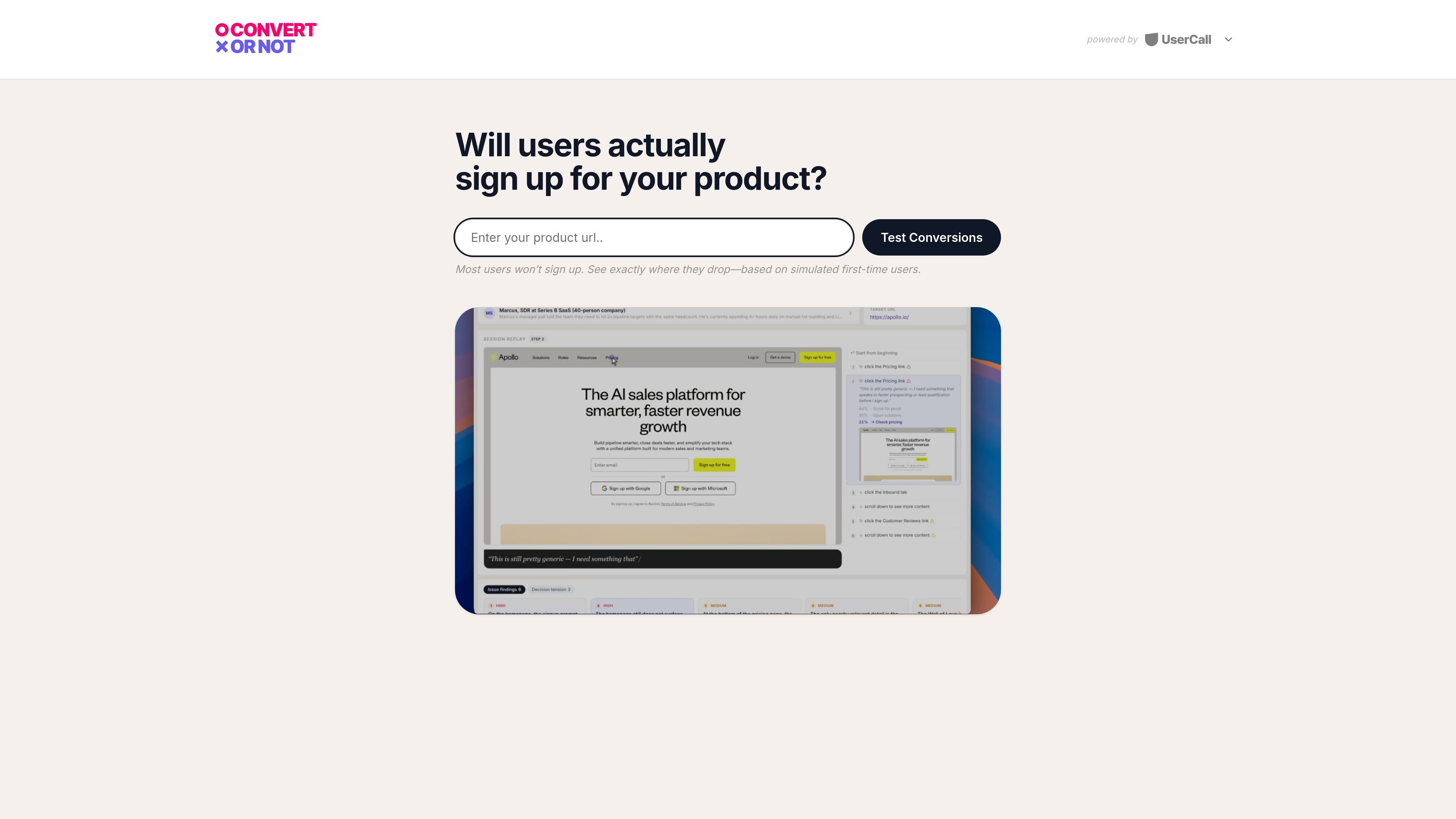
First-time visitor simulation
Frames the product around a simulated first-time visitor journey so teams can inspect the path to signup from the user’s point of view.
ConvertOrNot by Usercall is a product conversion analysis page that simulates how a first-time visitor moves through a product and highlights friction points along the way. The page is positioned around testing whether users will sign up and showing where they drop off.
The surrounding UserCall site describes the broader product as an AI-moderated user interview and qualitative analysis platform. Taken together, ConvertOrNot appears to be one workflow or page within that ecosystem, aimed at helping teams examine signup behavior from a simulated visitor’s perspective.
Frames the product around a simulated first-time visitor journey so teams can inspect the path to signup from the user’s point of view.
Focuses analysis on friction points that may stop a visitor from converting, rather than only reporting aggregate metrics.
Centers the workflow on conversion testing, with the page explicitly positioned as a way to test whether users will sign up.
Surfaces where simulated users drop off, helping teams narrow attention to the stages that need review or redesign.
Uses the same UserCall product context as the rest of the site, which suggests it sits within a broader qualitative research platform.
Pairs product-specific conversion simulation with a broader research positioning on AI-moderated user interviews and qualitative analysis.
Review a signup flow from the perspective of someone seeing the product for the first time, then inspect where the path becomes confusing or incomplete.
Compare different parts of a product page or onboarding sequence to see which section appears to create the most friction before conversion.
Use the simulated visitor framing to prepare for a landing-page or onboarding redesign by identifying what needs clearer messaging or a shorter path.
Give product, growth, or UX teams a common reference for discussing conversion problems without relying only on raw sign-up counts.
It is presented as a tool for simulating how a first-time visitor navigates a product and identifying where users drop off before signing up.
The source does not describe a detailed setup flow. The product page frames it around testing conversions and simulating first-time visitor behavior.
The available source does not list integrations or platform support, so those details are not confirmed here.
The pricing page shows sign-in and account creation flows for UserCall, which indicates account access is required, but no specific plan names or prices are provided in the source.

PromptScout tracks how ChatGPT, Gemini, Google AI Overviews, and Perplexity mention your brand or competitors, then pairs those results with source analysis and website audits. It helps teams decide what to fix in content, positioning, or site readiness next.

SaveMRR is a Stripe retention tool for SaaS teams that scans billing data for churn and MRR leaks, then automates recovery through dunning, cancel-save offers, win-back emails, and onboarding nudges. It is built for founders and bootstrapped teams using Stripe.

Hype is a web tool for finding trending YouTube topics by category, time range, and scoring mode. It helps creators spot emerging ideas, inspect source videos, and decide what to cover next.

Sleek Analytics is a privacy-friendly web analytics tool with real-time visitor tracking, Core Web Vitals, and revenue attribution. It helps site owners understand traffic and conversions without cookie banners or a heavy setup.

Struere is an AI-native platform for turning spreadsheet data into structured operational software with dashboards, alerts, and automations. It is aimed at teams that want to replace manual spreadsheet workflows without building custom tools from scratch.

ClayHog은 ChatGPT, Gemini, Perplexity, Claude, Google AI Overviews에서 브랜드 노출을 추적하는 AI 검색 가시성 플랫폼입니다. 에이전시와 마케팅·SEO 팀을 위한 단일 대시보드 제공.