
Minimal CLI harness
fx is a minimal CLI and agent runtime written in Zig, with a small core and a shell-like interface rather than a heavy terminal TUI.

fx is a tiny, open coding agent and CLI written in Zig. It can run natively, connect to editors over Agent Client Protocol, or load from JavaScript as WebAssembly.
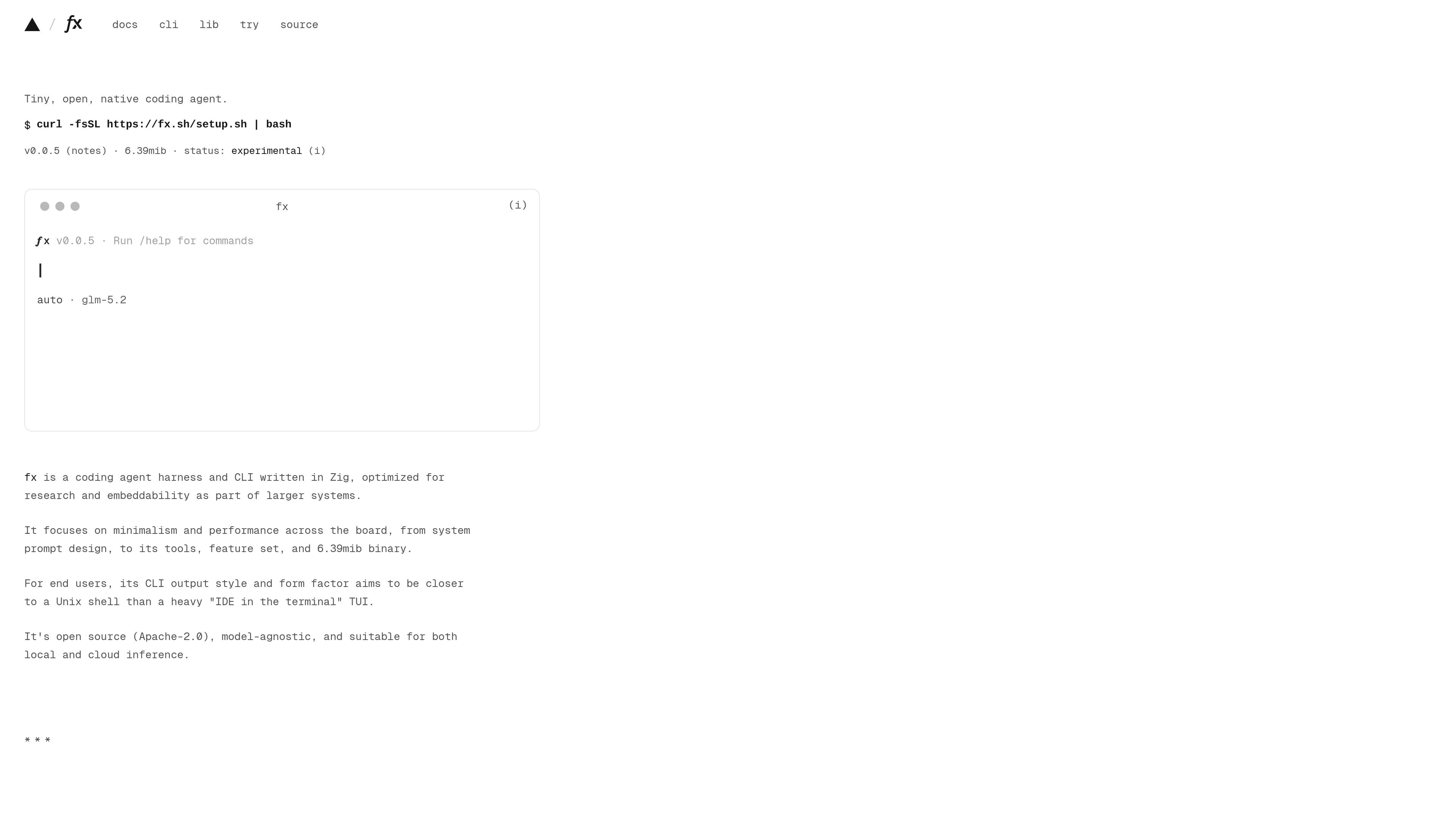
fx is a tiny, open coding agent and CLI written in Zig. It is positioned as a minimal agent harness for developers who want a compact, embeddable tool rather than a terminal-heavy IDE experience.
The product can run natively in a shell, act as an ACP server for editors and applications, or load from JavaScript through a WebAssembly build. The documentation frames it as suitable for research, resource-constrained environments, and larger systems that need a configurable agent runtime.
fx is a minimal CLI and agent runtime written in Zig, with a small core and a shell-like interface rather than a heavy terminal TUI.
The product is designed for fast startup and low overhead, with documentation describing instant time to prompt, no unnecessary work before input, and a small binary footprint.
fx can run natively in a terminal, serve as an ACP server for editors and other clients, or load as WebAssembly through the JavaScript SDK.
The docs describe browser adapters for storage, authentication, command execution, and network requests, with separate adapters for terminal and agent use.
fx is model-agnostic and can work with local models, gateways, direct provider APIs, or subscriptions.
The runtime is built to be extended through skills, plugins, and MCPs, and the docs emphasize embeddability as part of larger systems.
Run fx in a project directory as a terminal-based coding agent when you want a small CLI that treats the current folder as the main workspace.
Connect fx through Agent Client Protocol when building or using an editor that wants an agent running as a native process over standard input and output.
Load the WebAssembly build from JavaScript when you need an embeddable agent runtime or an interactive terminal inside a browser or app.
Use the browser adapter model to persist session state, restore config, complete device login, or proxy network requests in a custom app.
Choose fx when you need a compact, extensible harness for research, sandboxed environments, or systems that need multiple instances with modest resource use.
fx supports macOS and Linux on x86_64 and arm64. The installation guide also notes that the installer needs curl or wget and tar.
Yes. The docs describe fx as open source under the Apache-2.0 license.
You can run the native CLI in a terminal, connect an editor or another application over Agent Client Protocol (ACP), or load the WebAssembly build from JavaScript.
The installation docs say the installer downloads a release archive over HTTPS from Vercel's release storage and does not check a signature or published checksum. They recommend reviewing the script and verifying artifacts yourself if your policy requires an audited install.
The docs describe fx as model-agnostic and suitable for local models, gateways, direct provider API access, or subscriptions.

ByteAsk is a terminal-first AI coding agent for C and C++ that edits repositories and verifies changes with the real compiler, debugger, sanitizers, and tests before showing a diff. It offers a free tier plus paid plans, with editor connectors and zero-retention handling described in the source.

Ghost는 채팅, 코드 생성, 터미널 작업 실행을 지원하는 터미널 기반 AI assistant입니다. 무료 모델을 제공하며 Linux, macOS, Windows를 지원하는 오픈 소스입니다.

Vi3ecode is a maintained development environment for working with AI coding agents. It keeps project context, terminal, Git, memory, flows, review, and communication connected around the agent you already use.

CreateOS Sandbox is an isolated compute environment for running code and agent workloads inside Firecracker micro-VMs. It is designed for workflows that need machine-level isolation, private networking between sandboxes, and programmatic control through SDK, CLI, or MCP.

hob is an independent workspace for coding agents that keeps agent sessions, terminals, history, and follow-up work organized around the tools and providers you already use. It is aimed at developers who want local control over routing, history, and workspace structure rather than a bundled model stack.

Manta AI is an autonomous web app testing tool for teams that want to map application behavior, catch regressions, and generate tests without writing scripts or maintaining selectors. It works from a URL and supports plain-English test flows, run results with screenshots, and scheduled or deployment-triggered checks.