
Model-based turn-end detection
The service detects when a caller has finished a turn rather than relying only on a fixed pause threshold, helping reduce premature cut-offs during spoken input.

Kugel Ear 1 is a speech-to-text service for voice agents that flags uncertain words and returns candidate spellings with probabilities. It also detects when a caller’s turn ends, helping conversational applications clarify names, addresses, codes, and other error-sensitive inputs.
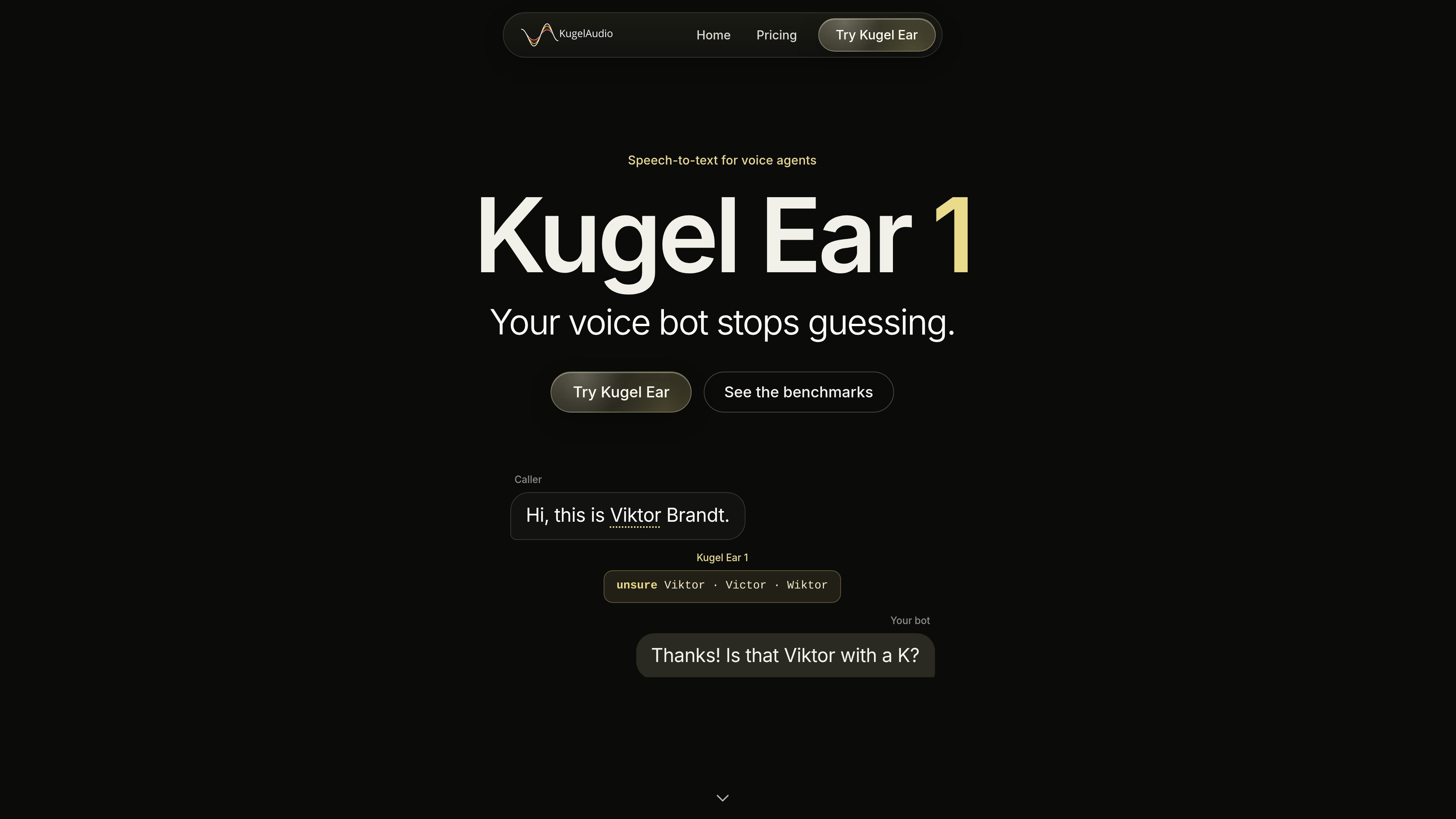
Kugel Ear 1 is a speech-to-text service for voice agents. Its main distinction is that it reports words it is unsure about instead of forcing the application to treat every transcript token as certain. For an uncertain word, the response can include alternative spellings and their probabilities, giving the agent enough information to ask the caller for clarification.
The service also determines when a caller’s turn has ended. An application streams the call audio, including pauses, and receives a final transcript when Kugel Ear 1 detects the end of the turn. This is intended for conversational systems handling names, addresses, codes, customer numbers, and phone calls where both transcription errors and talking over the caller can affect the interaction.
The service detects when a caller has finished a turn rather than relying only on a fixed pause threshold, helping reduce premature cut-offs during spoken input.
When recognition is uncertain, the output includes the original word position, candidate spellings, and probabilities—for example, Viktor, Victor, and Wiktor.
The application can stream call audio as it arrives, with pauses included, and receive a final transcript when the model determines that the turn has ended.
The documented output separates a final transcript from a subsequent alternatives message, allowing a voice bot to decide when clarification is needed.
The published examples and tests cover conversational speech, phone-line audio, names, addresses, codes, customer numbers, and other spoken inputs where spelling accuracy matters.
When a caller dictates a person’s name or street address, the agent can use alternative spellings to confirm the ambiguous part instead of repeating the entire request.
For customer numbers, codes, phone numbers, and similar values, the application can identify uncertain words or digits and request a targeted correction before continuing.
During a phone conversation, turn-end detection can help the agent wait through meaningful pauses and reduce interruptions while a caller is still reading or speaking.
Developers building voice bots can use the final transcript and uncertainty message as separate inputs to decide whether to continue automatically or ask a clarification question.
Kugel Ear 1 processes streaming call audio and determines when each speaker turn ends. It then returns a final transcript and identifies words it is unsure about, including the spellings considered and their probabilities.
The source shows an example WebSocket-style stream in which the application sends a 16 kHz audio configuration and audio chunks, including pauses. The product page does not document a complete integration guide or all supported interfaces.
It is designed for voice-agent workflows in which an application can use uncertainty information to ask a caller for clarification instead of silently choosing a potentially incorrect spelling.
The published benchmark results cover support calls, simulated phone-line audio, names and addresses, codes and numbers, earnings calls, and end-of-turn detection. Results vary by dataset and should not be treated as a guarantee for every deployment.

SpeakoFlow is a free, open-source desktop voice-to-text app for Windows, macOS, and Linux. It supports dictation into any app, voice-driven writing with Flow, cleanup, translation, and a screen-aware assistant.

Sanota is an app that turns spoken memories, reflections, and interviews into clear written stories. It supports personal storytelling, family history, and shared memories, with guided prompts and subscription pricing.

Carbon Voice is an asynchronous voice messaging app for teams and individuals, with transcripts, AI catch-up, and cross-device access. It helps people and agents communicate without needing a live call.

QuickQuill is a macOS dictation and transcription app that runs locally on the device. It helps users record meetings, transcribe audio, generate summaries, and export notes without using a cloud service.

Zen Whisper is a local-first dictation and transcription app for Apple Silicon Macs running macOS 14 or later. It lets users dictate into most Mac text fields, transcribe media or supported public links, and work across 110 spoken language options.

Speech to Text Converter is a browser-based transcription tool for live dictation and uploaded audio or video files. It offers a free tier for short tasks and a Pro plan for unlimited transcription, AI summaries, translation, speaker identification, and advanced exports.