
Daily X performance snapshots
Once connected, LinkIntel reads recent original X posts and metrics once a day and stores snapshots that the assistant can cite.

LinkIntel is an MCP server for people who want an AI assistant to use their own X post performance, selected public references, and X's published ranking context when preparing content briefs. It connects to compatible assistants and does not publish, schedule, or independently search X.
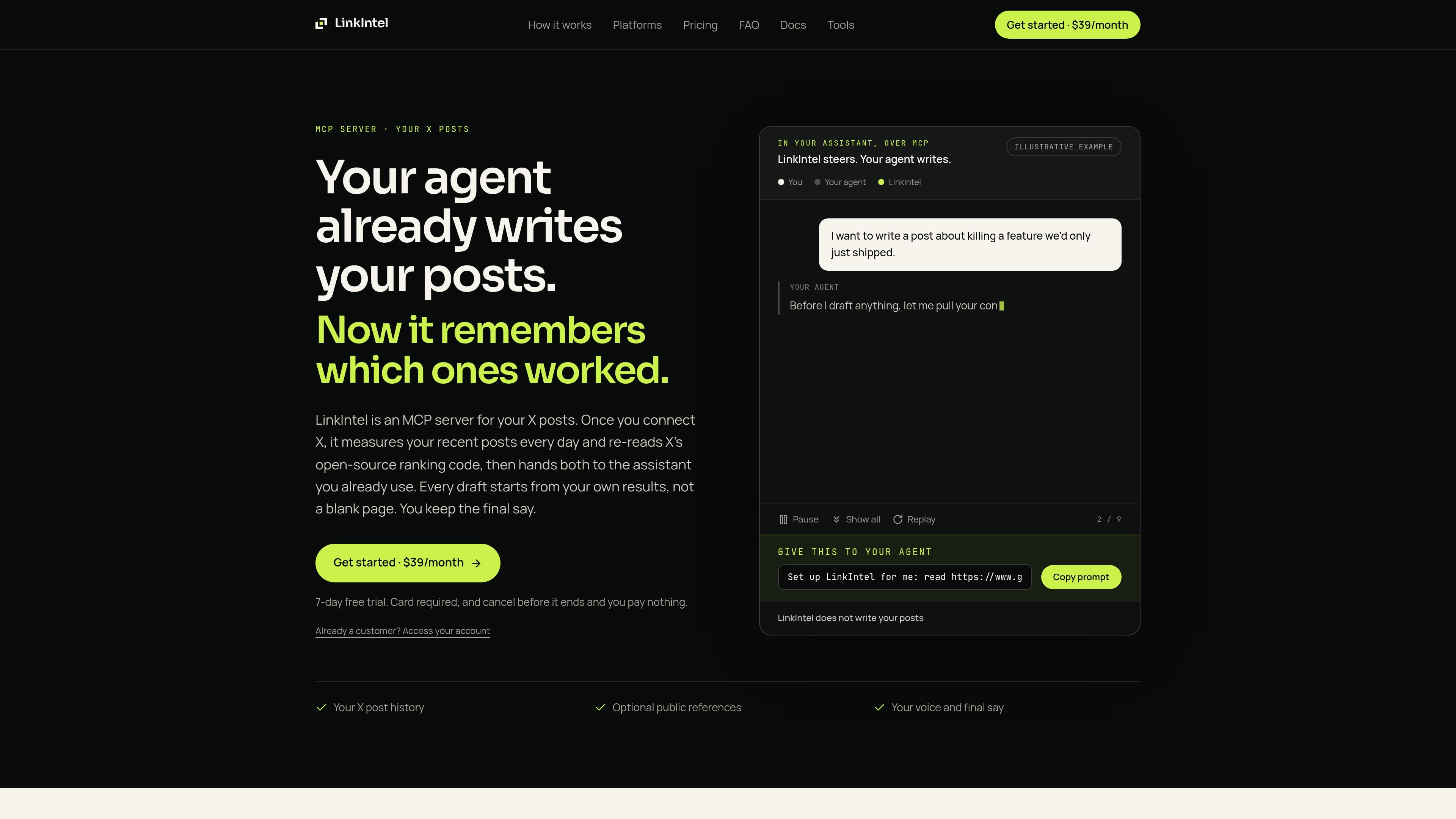
LinkIntel is an MCP server that gives an AI assistant structured evidence about a user's X content. After X is connected, it records recent original posts and their metrics once a day, while also maintaining stored copies of X's published ranking weights and related commit information. The assistant can use this material instead of relying only on generic platform advice.
The main workflow is to request a cited content brief for a topic and reference cohort. The brief can combine the user's own post performance with selected public X posts and the stored ranking context, while identifying freshness and limitations. LinkIntel does not write, publish, or schedule posts; it supplies evidence to the MCP-compatible assistant the user already uses, and the user keeps final control over the resulting draft.
Once connected, LinkIntel reads recent original X posts and metrics once a day and stores snapshots that the assistant can cite.
The assistant can access X's published default ranking weights, their source commits, recent material changes, and stated limitations from stored data.
Selected public X posts can be stored under a topic and reference group, with source URLs and capture times, to add context without treating them as your own results.
The `prepare_content_brief` workflow combines the selected topic and cohort with owned performance, references, ranking weights, citations, freshness, and limitations.
LinkIntel exposes an MCP endpoint for Claude Code, Claude.ai, Claude Desktop, and other compatible clients, using OAuth 2.1 or a bearer-token fallback.
The service is read-only with respect to publishing: it does not publish or schedule posts, and it does not search X on its own. Reference collection reads only URLs supplied by the user.
Review recent impressions, replies, reposts, and bookmarks in the context of a topic, then ask an assistant to identify patterns before drafting another post.
Add a small set of public X URLs under a named topic and cohort to compare chosen examples with your stored performance without mixing the two evidence sources.
Ask the assistant what informed a draft, request alternative opening angles, and separate supported observations from ideas that still need testing.
Use the stored ranking weights and commit-backed changes as a final check on whether a proposed approach aligns with X's documented default ranking signals.
Connect the MCP endpoint to a compatible assistant and keep the drafting process in that existing environment instead of moving content between separate tools.
Add `https://www.getlinkintel.com/api/mcp` as a remote MCP server. OAuth 2.1 handles sign-in and checkout in a supported client; clients without OAuth can use a bearer token from the setup page. The documentation lists Claude Code, Claude.ai, Claude Desktop, and MCP clients that support the authorization specification.
LinkIntel costs $39 USD per month, billed monthly in advance after a seven-day free trial. A card is required to start the trial, and canceling before it ends avoids a charge. The subscription includes content briefs and reference lookups without a per-post fee, subject to fair-use limits of up to 100 post lookups per day and 1,000 per month per account.
After you choose to connect X, LinkIntel reads your recent original posts and their metrics once a day and stores snapshots that the assistant can cite. It does not ask for your X password, publish, schedule, or search X on its own. Disconnecting X deletes the stored snapshots.
The assistant can use your stored X performance, selected public X references, and X's stored ranking weights to prepare a cited content brief. The brief includes citations, freshness information, and limitations, while the assistant remains responsible for drafting and you retain final approval.
LinkIntel is currently focused on X for new accounts. LinkedIn is in closed beta and is not open to new accounts, although existing LinkedIn analytics connections remain available on the account page.

Topple.lol is a public pay-to-rank leaderboard where listings start at $1 and their bid balance decays over time and with clicks. It helps makers and marketers buy short-term visibility for product sites or X profiles while tracking live board stats.

Tweetmonk는 AI로 트위터 스레드(스레드형 트윗)를 작성하고, 게시·예약하며 계정 분석과 성과 지표를 확인하는 도구입니다.

Vetta X is an AI growth workspace for X that helps users find reply opportunities, draft posts in their voice, and approve publishing with one tap. It is built around read-only X access, creator tracking, reply alerts, and post or thread drafting.

Nuvio automates X profile updates using live Stripe, Google Analytics 4, and Search Console data. It helps indie hackers and other people building in public keep their bio and banner current without manual edits.

Xeder is a Chrome extension that reads your X/Twitter feed aloud so you can listen instead of scrolling. The homepage presents it as a one-time $19 purchase for passive feed consumption while you work or handle other tasks.

RentMyHeader is a creator marketing platform for Twitter/X that lets brands find creators in plain English, launch template-based campaigns, and release payment after proof is approved. Creators can use the platform to monetize header and profile placements with rates they set themselves.