
Vendor and block lookup
Resolve a MAC address or OUI to the registered organization, matched prefix, block range, and IEEE block type.

MAC Address Lookup is a web tool and JSON API for identifying the vendor, IEEE assignment, and related technical details for a MAC address or OUI. It includes a free browser lookup, a free API tier, batch requests, and a self-hosted option for private-network use.
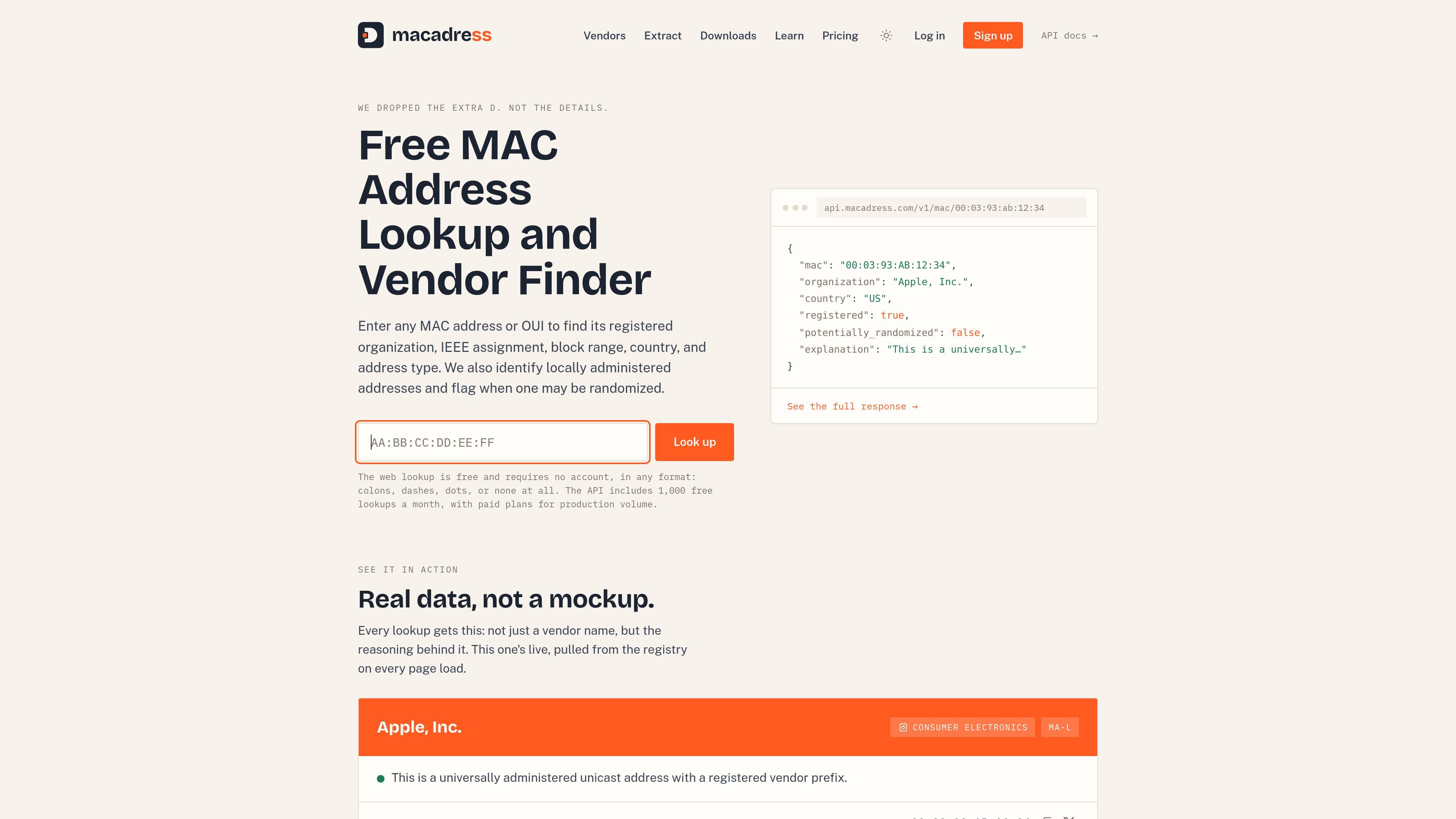
MAC Address Lookup is a web tool and JSON API for resolving a MAC address or OUI into vendor and IEEE registry data. It is designed for quick browser lookups as well as programmatic use through the API at api.macadress.com.
The service returns the registered organization, assignment type, matched block range, country, and address type when available, and it also flags locally administered or potentially randomized addresses. The pricing page adds a self-hosted license for teams that need the API and sync engine to run on their own infrastructure.
Resolve a MAC address or OUI to the registered organization, matched prefix, block range, and IEEE block type.
Detect whether an address is universally or locally administered, whether it is unicast or multicast, and whether it may be randomized.
Show derived technical fields such as EUI-64 and IPv6 link-local values when they can be inferred from the input.
Accept single lookups through GET /v1/mac/:mac and up to 100 addresses through POST /v1/mac/batch.
Return the same full response on every plan, with paid plans changing request volume and rate limits rather than hiding fields.
Offer a hosted API plus a self-hosted license for teams that need lookups to stay on their own network.
Paste a MAC address or OUI into the web lookup to identify the vendor, block type, and whether the address appears randomized.
Call the JSON API from scripts or backend services when you need MAC vendor data inside an application workflow.
Submit a batch request with up to 100 addresses when you need to process a list rather than a single device.
Use the self-hosted license when lookup traffic cannot leave your network and the API must run on your own infrastructure.
Inspect classification details such as administration type, transmission type, and derived IPv6 or EUI-64 values for deeper analysis.
Yes. The site offers a free web lookup with no account required, and the API includes 1,000 free lookups per month on the Free plan. The docs also say you can call the API with a free key after signing up.
The API and web tool accept common MAC formats, including colon-separated, dash-separated, dotted, spaced, and bare hexadecimal strings. The docs also note that case does not matter.
Yes. The batch endpoint accepts up to 100 addresses per request and returns a result for each input, including invalid ones. According to the docs, batch requests count by the number of addresses looked up.
The lookup returns the registered organization or vendor, the IEEE assignment type and matched block, address range, country and vendor address when available, transmission and administration type, randomization indicators, and EUI-64 or IPv6 link-local derivation when applicable.
The self-hosted option is for teams that want to run the API and IEEE sync engine on their own infrastructure so lookups stay inside their network. The pricing page says it is licensed for your own servers and starts at $999/year per deployment.