

Repeated-question archive
The site preserves answers from many AI models responding to the same question, making the responses directly inspectable in one place.
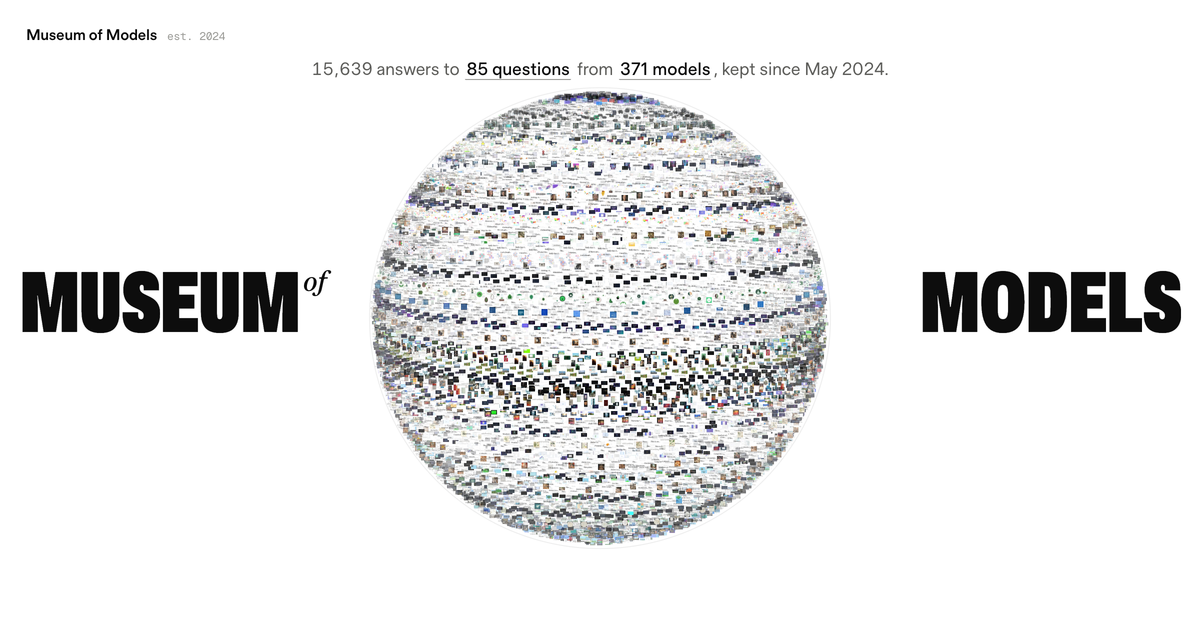
Museum of Models is a public archive of AI model responses. It asks multiple models the same questions and keeps the resulting answers after the models are gone, allowing readers to inspect how different models respond to comparable prompts.
The collection covers visual, interactive, code, text, and audio-oriented questions. Individual question pages group the answers together and identify the responding model, provider, date, and output type; the homepage states that the collection has been gathered since May 2024.
The site preserves answers from many AI models responding to the same question, making the responses directly inspectable in one place.
The homepage organizes prompts by output form, including drawing, image, website, code, text, and audio questions.
Dedicated question pages show the full response count and list individual answers newest first.
Each listed response identifies its model and provider, and includes a date for the response.
Historical entries remain visible with a retired label when the associated model is no longer served.
The collection spans a broad catalog of questions, from interface and code generation to writing, reasoning, and creative tasks.
Review how different models interpret the same creative or technical brief, such as an SVG Xbox controller or a generated web page, without changing the prompt between examples.
Study the evolution of model behavior by inspecting dated answers and contrasting current entries with responses from models marked retired.
Use the collection as a reference when evaluating model performance on writing and reasoning tasks, including investment memos, recipes, explanations, and other text prompts.
Browse examples across media types to understand what model-generated drawings, websites, code, text, and audio outputs look like in practice.
Museum of Models presents recurring questions and the answers collected from multiple AI models. The homepage lists question titles with answer counts, while individual question pages show model-by-model responses.
The collection includes visual prompts such as an Xbox controller drawing, interactive or web prompts such as a self-contained web app, and text prompts such as an investment memo. The displayed output type depends on the question.
Individual question pages list responses newest first and identify the model, provider, date, and output type. Some entries are marked as retired when the model is no longer served.
The homepage states that the collection has been gathered since May 2024. Counts and model availability can vary by question, and the site includes historical responses from retired models.

Hype is a web tool for finding trending YouTube topics by category, time range, and scoring mode. It helps creators spot emerging ideas, inspect source videos, and decide what to cover next.

Paperpal 是一款面向学术写作的 AI 工具,提供文献阅读、语言润色、引用、查重、AI 检测和投稿前检查。它适合需要在英文论文和学术材料上进行写作、修改与合规自检的学生、研究人员和教师。

VForms lets you place questionnaires directly inside YouTube videos so viewers answer in context instead of switching to a separate form. It is aimed at collecting feedback and insights through timestamped, embeddable video forms.

Scite는 논문 검색, 인용 문맥 확인, 학술 문헌에 근거한 답변을 제공하는 AI 연구 플랫폼입니다. 연구자, 학생, 팀의 근거 평가를 돕습니다.

Radar is a self-hostable media intelligence and social listening app for monitoring public sources, analyzing mentions, and generating briefs or content outputs with optional Claude AI. It is aimed at individuals and small teams that want an enterprise-style workflow without a cloud account.

Shodh is an AI-powered research and strategy platform for business questions that need structured investigation, source-backed evidence, and auditable recommendations. It is aimed at founders, operators, consultants, investors, and corporate development teams.