

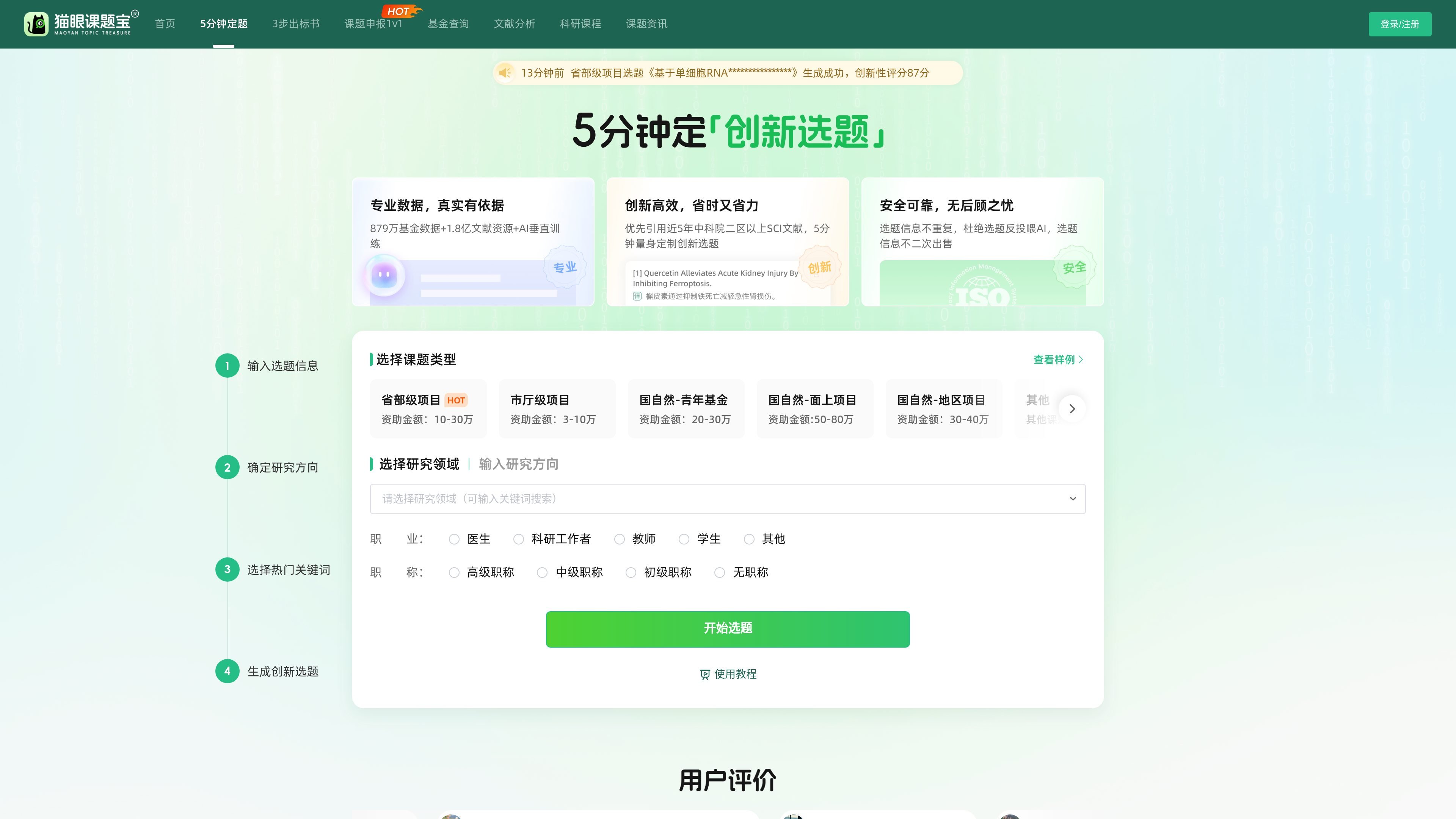
5-Minute Topic Selection
Generate innovative topic directions for project selection based on the entered research direction, project type, department/discipline, research type, subject attributes, profession, and professional title.
猫眼课题宝 is a tool for research topic selection and application scenarios. Its homepage highlights “topic selection in 5 minutes.” The page information shows that it combines 8.79 million funding records, 180 million literature resources, and a specialized AI research large model to help users generate topic suggestions around a specific research direction, along with novelty scores and keyword combination suggestions.
The product page shows a step-by-step process from entering research information to generating a topic, adapted for provincial and ministerial projects, municipal and bureau-level projects, as well as NSFC Youth Fund, General Program, and Regional Program applications. The homepage also clearly states that the reference literature for topic selection cites real literature from the past 5 years from Chinese Academy of Sciences Zone 2 or above, aiming to make the topic selection more evidence-based and more aligned with research grant application scenarios.
Generate innovative topic directions for project selection based on the entered research direction, project type, department/discipline, research type, subject attributes, profession, and professional title.
Break the topic selection process into four steps: entering information, determining the research direction, selecting popular keywords, and generating an innovative topic, reducing manual sorting effort.
Supports provincial and ministerial projects, municipal and bureau-level projects, NSFC Youth Fund, NSFC General Program, NSFC Regional Program, and other project types.
The homepage shows that the topic references cite real literature from the past 5 years from Chinese Academy of Sciences Zone 2 or above, used to support the topic basis.
The NSFC funding query page supports searching by approval number, project leader, application code, project abstract, approval year, completion year, project status, and host institution.
The product also provides related entry points such as 3-step bid document generation, one-on-one project application support, literature analysis, global funding queries, and project trend analysis.
When preparing for an NSFC or provincial/ministerial project, users can first enter the research direction and basic information, then get topic directions and innovation hints that can be further refined.
When a proposal structure needs to be built quickly, users can enter the “3-step bid document generation” flow, generate a framework first, and then continue improving the main text.
When looking up funding approval information or validating the basis for a topic, users can use the funding query function to search by approval number, project leader, application code, project abstract, and more.
When a paper, project, or application direction is broad, users can narrow the scope through conditions such as department, discipline, research type, profession, and professional title to get suggestions closer to their own situation.
When professional guidance is needed during the application process, users can also go to the one-on-one project application page for topic selection, proposal guidance, and polishing support.
The page information shows that this product can help complete a research topic selection in 5 minutes, and generate topic suggestions based on the entered research direction, project type, department/discipline, research type, subject attributes, profession, and professional title.
The homepage provides a flow of “enter topic information—determine the research direction—select popular keywords—generate an innovative topic”; the page also shows “usage guide” and “history” entry points.
The homepage lists project types including provincial and ministerial projects, municipal and bureau-level projects, NSFC Youth Fund, NSFC General Program, NSFC Regional Program, and other project types.
The homepage states that the topic reference literature uses real literature from the past 5 years from Chinese Academy of Sciences Zone 2 or above; the NSFC funding query page supports searching funding data by approval number, project leader, application code, project abstract, and other information.
The pricing page currently shows 404 Not Found, so the public pages do not confirm the exact pricing or plan structure.

GameGrad turns PDF study material into quiz questions that appear inside arcade games, so users can practice active recall while they play. It offers a free tier with one PDF and a Pro plan with more uploads, more questions, and answer explanations.

Hype is a web tool for finding trending YouTube topics by category, time range, and scoring mode. It helps creators spot emerging ideas, inspect source videos, and decide what to cover next.

LangPanda is a browser extension for learning languages from streaming video and other supported sites. It combines instant subtitle lookup, flashcard creation, vocabulary tracking, and spaced-repetition review for 36 languages.

Paperpal 是一款面向学术写作的 AI 工具,提供文献阅读、语言润色、引用、查重、AI 检测和投稿前检查。它适合需要在英文论文和学术材料上进行写作、修改与合规自检的学生、研究人员和教师。

recall is an AI flashcard app that turns reading and notes into study cards through Claude, ChatGPT, or another MCP client. It uses one-time lifetime access pricing and spaced repetition review.

VForms lets you place questionnaires directly inside YouTube videos so viewers answer in context instead of switching to a separate form. It is aimed at collecting feedback and insights through timestamped, embeddable video forms.