

OpenAI-compatible API
Access frontier and open-source models through an API designed to work with OpenAI-style SDKs, reducing migration effort for teams that already use that interface.
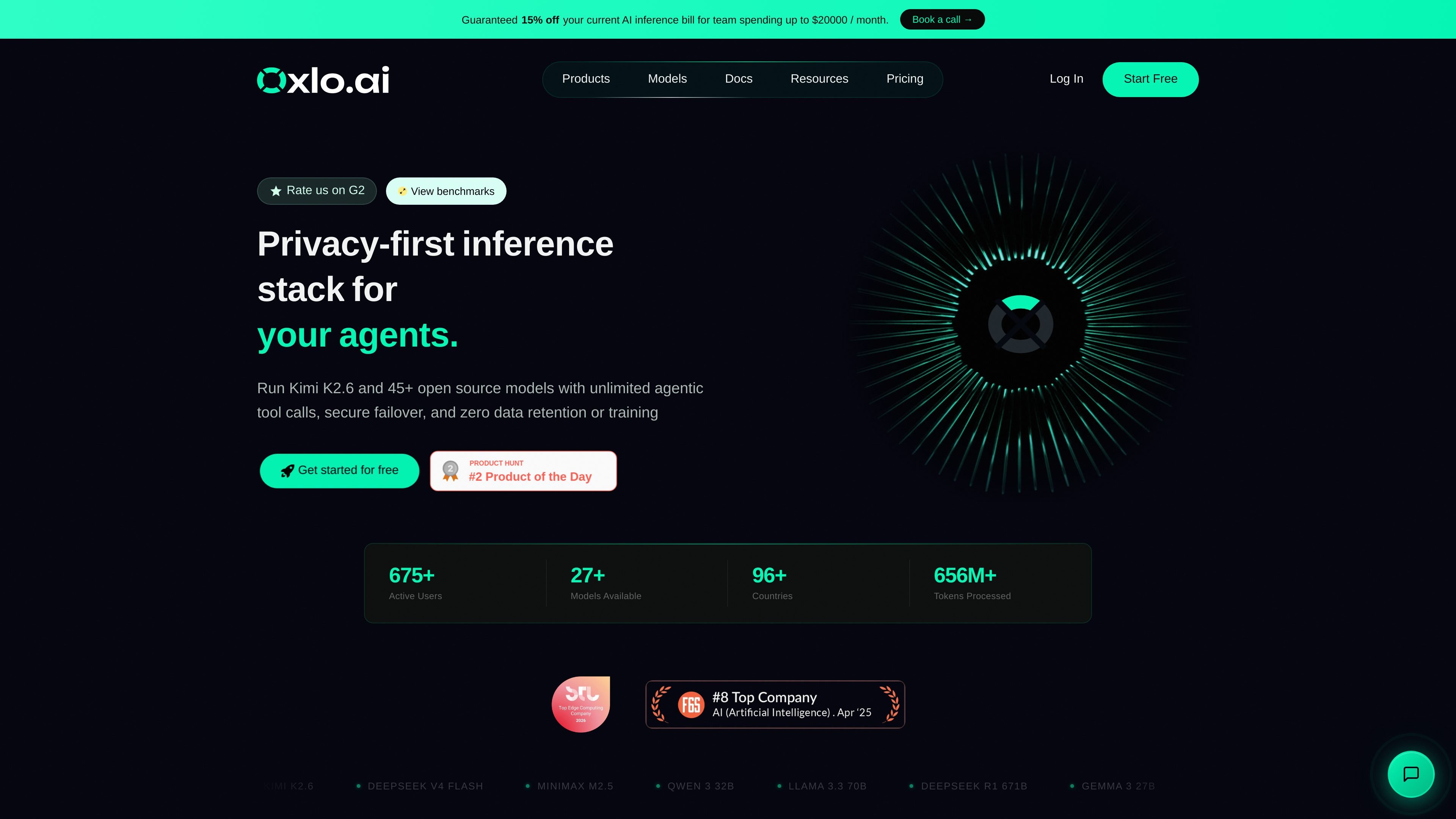
Oxlo.ai is an AI inference API that offers frontier and open-source models through an OpenAI-compatible interface. Its main distinction is request-based pricing: customers pay a flat monthly rate tied to API requests instead of token counts, which makes costs predictable for long prompts and higher-volume workloads.
The service is aimed at developers and AI teams building assistants, document workflows, text generation, image analysis, and speech or batch-processing pipelines. The site also emphasizes production readiness, with plan-based request limits, priority handling on higher tiers, and a privacy posture that says it does not train on user prompts.
Access frontier and open-source models through an API designed to work with OpenAI-style SDKs, reducing migration effort for teams that already use that interface.
Plans are priced by request rather than by token, so a call costs the same whether the prompt is short or long. The pricing page says there are no token calculations or surprise overage bills.
The platform advertises traffic prioritization, burst limits, and different request quotas by plan, which helps teams match throughput to workload needs.
The homepage and pricing pages describe production-ready inference, priority execution on higher tiers, and support for asynchronous or batch-friendly workloads.
Oxlo.ai lists zero data retention or training on prompts on the homepage and says it does not sell personal data in its privacy policy.
The site includes a public pricing comparison and cost calculator to estimate how flat pricing compares with token-based providers for specific workloads.
Build customer-facing or internal assistants using OpenAI-style integrations while keeping request costs predictable across short and long prompts.
Run retrieval-augmented generation on documents, PDFs, and knowledge bases where prompt length can vary significantly from request to request.
Generate, rewrite, or summarize text for application features and internal workflows that need a fixed monthly budget rather than token-based billing.
Analyze images or visual inputs for classification, detection, or other vision tasks using the models the site lists for image understanding.
Process large volumes of AI calls with async or batch-friendly workflows when the workload is less interactive and more throughput-oriented.
Oxlo.ai uses request-based pricing: each API call is charged as part of a flat monthly plan, so the cost does not change based on prompt or response token count.
Yes. The homepage states that Oxlo.ai is compatible with the OpenAI Python and Node.js SDKs, so developers can adapt existing OpenAI-style integrations with minimal changes.
Yes. The pricing page says the Pro plan includes a 1-day free trial, and the Free plan is available without a credit card.
When a daily request limit is reached, additional requests are queued until the next day or the account can be upgraded to a higher plan.
The site states that plans can be upgraded or downgraded at any time and that billing is monthly with no long-term contracts required.

AakarDev AI helps teams manage AI provider access, project-level setups, logs, and analytics from one dashboard. It supports BYOK workflows and lists providers including OpenAI, Google Gemini, Anthropic, Groq, Mistral AI, and Perplexity AI.

ByteAsk is a terminal-first AI coding agent for C and C++ that edits repositories and verifies changes with the real compiler, debugger, sanitizers, and tests before showing a diff. It offers a free tier plus paid plans, with editor connectors and zero-retention handling described in the source.

CreateOS Sandbox is an isolated compute environment for running code and agent workloads inside Firecracker micro-VMs. It is designed for workflows that need machine-level isolation, private networking between sandboxes, and programmatic control through SDK, CLI, or MCP.

hob is an independent workspace for coding agents that keeps agent sessions, terminals, history, and follow-up work organized around the tools and providers you already use. It is aimed at developers who want local control over routing, history, and workspace structure rather than a bundled model stack.

Ably Chat is a chat API platform for building custom realtime chat applications. It supports room-based messaging, typing indicators, presence, reactions, and message updates, with usage-based pricing options for different deployment stages.

Manta AI is an autonomous web app testing tool for teams that want to map application behavior, catch regressions, and generate tests without writing scripts or maintaining selectors. It works from a URL and supports plain-English test flows, run results with screenshots, and scheduled or deployment-triggered checks.