
Project-isolated backend stack
Each project gets its own Postgres database with RLS, plus auth, object storage, and realtime services exposed through PostgREST, a REST/GraphQL-style API, or a direct database connection.

Powabase is a backend platform for AI apps that combines per-project Postgres, auth, storage, realtime, retrieval, agents, and workflows. It supports managed cloud and self-hosted deployment, plus bring-your-own LLM keys.
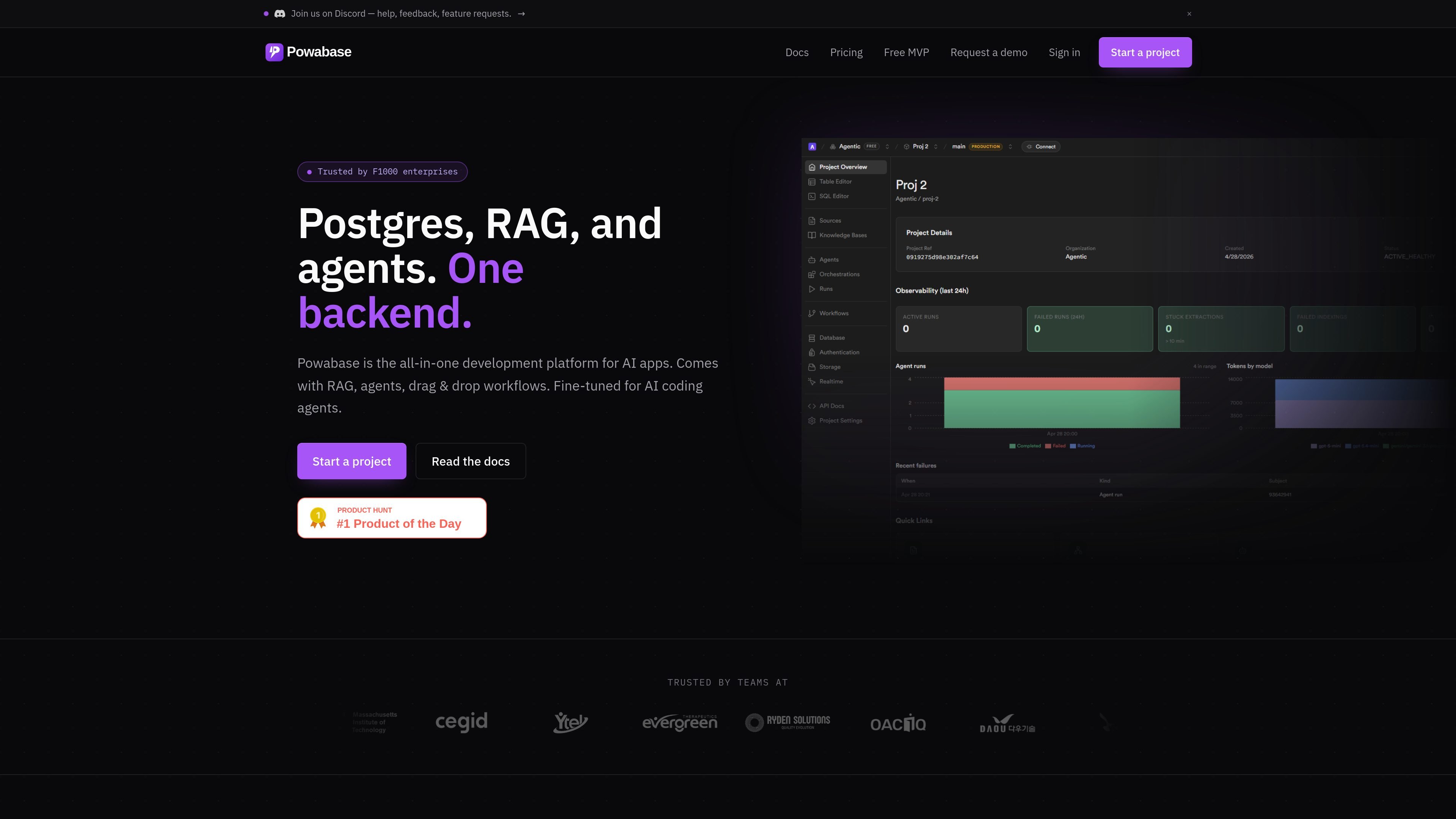
Powabase is an all-in-one backend platform for AI applications. It combines project-isolated Postgres with auth, storage, realtime, retrieval, agent runtime, and visual workflows so teams can build AI-native products without stitching together separate infrastructure.
The site positions Powabase as a single backend for apps that need RAG and agents, not just a database. It supports uploading source content for indexing, running agent loops with tools and citations, and deploying workflows as HTTP endpoints, while also offering managed cloud and self-hosted deployment options.
Each project gets its own Postgres database with RLS, plus auth, object storage, and realtime services exposed through PostgREST, a REST/GraphQL-style API, or a direct database connection.
Powabase can ingest PDFs, images, office files, and URLs, then extract, chunk, embed, and index them for retrieval. The site says it includes OCR, BM25, pgvector, hybrid search, and reranking.
Agents run ReAct orchestrations with multiple LLMs, knowledge bases, and tools. The runtime supports streaming over SSE with logged retrieval events, tool calls, token deltas, and citations.
Workflows can be built visually by connecting triggers, conditions, agents, HTTP calls, and code blocks. A natural-language copilot can also design the flow, and deployed workflows can become HTTP endpoints.
The platform supports managed cloud, self-hosted Docker or Kubernetes deployments, and bring-your-own LLM keys. It lists OpenAI, Anthropic, Google, and OpenRouter as supported key providers.
Use Powabase when you want to launch an AI product on a single backend that covers database, auth, storage, retrieval, and runtime instead of assembling each layer separately.
Use the RAG pipeline to turn documents, images, office files, or URLs into searchable project knowledge with chunking, embeddings, OCR, hybrid search, and reranking.
Use the agent runtime for workflows that need tool use, multi-step reasoning, streamed outputs, and citations, including custom tools over HTTP or MCP.
Use the visual workflow builder when you need to connect triggers, conditions, agents, HTTP calls, and code into an endpoint your app can call.
Use the deployment options when you need managed hosting, self-hosting, or private infrastructure with your own LLM keys and stricter security posture.
Yes. The pricing page includes a Free plan, and paid plans add monthly credits that can be spent on compute hours, per-call costs, MAU overages, and storage. The site also says unused credits roll over month to month.
The site presents Powabase as a backend for AI apps that combines per-project Postgres, auth, storage, realtime, a RAG pipeline, agent runtime, and drag-and-drop workflows.
Yes. The site says it supports managed cloud deployment, self-hosting with Docker or Kubernetes, and bringing your own LLM keys. The pricing page also mentions private hosting in a VPC or on-prem for Enterprise.
The site says Powabase works with Claude Code, Codex, and Cursor when used with its agent skill, and that it supports bring-your-own keys for OpenAI, Anthropic, Google, and OpenRouter.
The site says workflows can be deployed as HTTP endpoints, and agents can use built-in tools such as web search and code execution or custom tools over HTTP or MCP.

AakarDev AI helps teams manage AI provider access, project-level setups, logs, and analytics from one dashboard. It supports BYOK workflows and lists providers including OpenAI, Google Gemini, Anthropic, Groq, Mistral AI, and Perplexity AI.

Arduino VENTUNO Q is an edge AI computer for AI and robotics applications. It combines AI inference and deterministic control on a single board and is designed to work with Arduino App Lab.

Devin is an AI coding agent and software engineer that helps developers and engineering teams plan and execute complex software tasks. It is available through desktop, cloud, JetBrains, and CLI surfaces, with plans for individuals, teams, and enterprises.

MakerLoft is a chat-first AI app builder for non-developers who want to create static sites or full-stack apps from a GitHub repository. It supports a free GitHub Pages path and a DigitalOcean-backed app path with sign-ins, payments, and an admin dashboard.

Open Computer Use is an open-source Computer Use service wrapped as MCP for macOS, Linux, and Windows. It helps AI agents and MCP clients run desktop automation workflows through client setup commands or manual MCP configuration.

Rork is an AI mobile app builder that turns a text description into a production-ready app using AI and Expo (React Native). It focuses on chat-based creation, browser previews, and Apple-platform publishing workflows.