

between.ventures
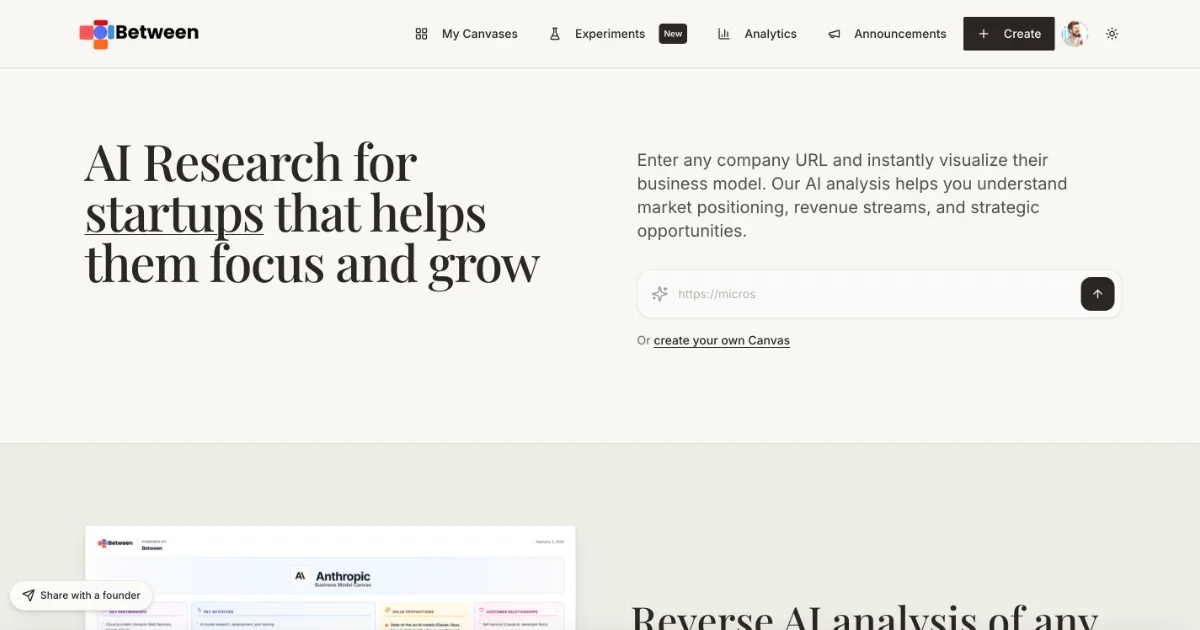
between.ventures is an AI research tool for startups that analyzes your business model and visualizes it as a complete Business Model Canvas.
What is between.ventures?
between.ventures is an AI research tool aimed at startups. Its purpose is to help teams focus on product-market-fit by analyzing a company’s business model and visualizing it as a complete Business Model Canvas.
Instead of requiring teams to manually map assumptions, the product uses AI to produce an at-a-glance canvas representation of a business model, supporting quicker understanding of how the pieces fit together.
Key Features
- Instant business model analysis: Enter or provide a company’s business model information and get an AI-generated analysis to help clarify key business-model components.
- Business Model Canvas visualization: Outputs a complete Business Model Canvas so you can review relationships across customer, value, channels, and other elements in one view.
- Focus on product-market-fit journey: Orients the workflow toward improving the path to product-market-fit by making business-model structure easier to evaluate.
How to Use between.ventures
- Provide the business information to analyze (based on what the tool accepts on the site).
- Run the AI analysis to generate a structured understanding of the business model.
- Review the resulting Business Model Canvas to identify what’s already coherent and what may need refinement.
- Use the canvas as a working document while iterating on strategy and product positioning.
Use Cases
- Pre-PMF business model review: Early-stage teams can analyze their current business model to better understand whether their value proposition, customer segments, and channels are aligned.
- Iterating after pivots: After a strategic change (e.g., new target users or altered offering), startups can re-run the analysis to see how the Business Model Canvas changes.
- Competitive or partner diligence (internal use): Teams can analyze another company’s business model to inform partnership discussions or competitive positioning (as long as they have the relevant business-model inputs).
- Strategy workshop facilitation: Product and business teams can use the canvas output as a shared reference during internal planning sessions to align on assumptions.
- Founder-led research: A founder can quickly generate a structured business model view to reduce time spent assembling a canvas manually.
FAQ
-
What does between.ventures produce? It generates an AI analysis of a company’s business model and visualizes it as a complete Business Model Canvas.
-
Is between.ventures limited to startups? The site positions the product for startups, but the core functionality described is business-model analysis and Business Model Canvas visualization.
-
What inputs does it require? The provided page content does not specify exact input formats or required fields. To proceed, users should follow the input flow presented on the website.
-
How does it help with product-market fit? The meta description indicates the tool supports the product-market-fit journey by analyzing and visualizing a business model to help teams focus on what matters.
Alternatives
- Manual Business Model Canvas workshops: Teams can create their own canvas using templates and internal expertise. This can be slower and more assumption-heavy, but it may better reflect team context when data is limited.
- AI business analysis tools (general-purpose): General AI assistants can summarize and structure business-model elements, often with less structured canvas output. These may require more prompting and manual formatting.
- Strategy/consulting frameworks: Other planning approaches (e.g., customer discovery frameworks or go-to-market frameworks) can guide PMF thinking without producing a Business Model Canvas view in the same standardized format.
- Business model diagramming tools: Diagramming and documentation tools can represent business models visually, but typically require manual creation rather than AI-generated analysis.
Alternatives

Paperpal
Paperpal is an academic writing AI tool for research workflows—smart literature reading, English editing, rewriting, writing components, and pre-submission checks.

VForms
VForms enables the creation of interactive questionnaires overlaid directly onto YouTube videos, allowing users to collect highly contextual feedback and deep user insights.

Scite
Scite is an AI-powered research tool that helps researchers understand research debates, ensure reliable citations, and improve their writing.

Shengsuanyun
Shengsuanyun offers cloud-based solutions for efficient data management and analytics.

Model Council
Model Council is a multi-model research feature by Perplexity that runs a single query across several top AI models simultaneously to generate a synthesized, comprehensive answer.

Ranpo AI
Ranpo AI offers automated risk assessment for rental listings, helping property managers and landlords identify potential issues before they arise. It streamlines the screening process by analyzing various data points to ensure tenant suitability and property safety.