
No-code portfolio construction
Build rule-based stock portfolios using a no-code portfolio builder, strategy logic, filters, ranking, and weighting rules.

Kalpi is a rule-based investing platform for building, backtesting, and managing stock portfolios.
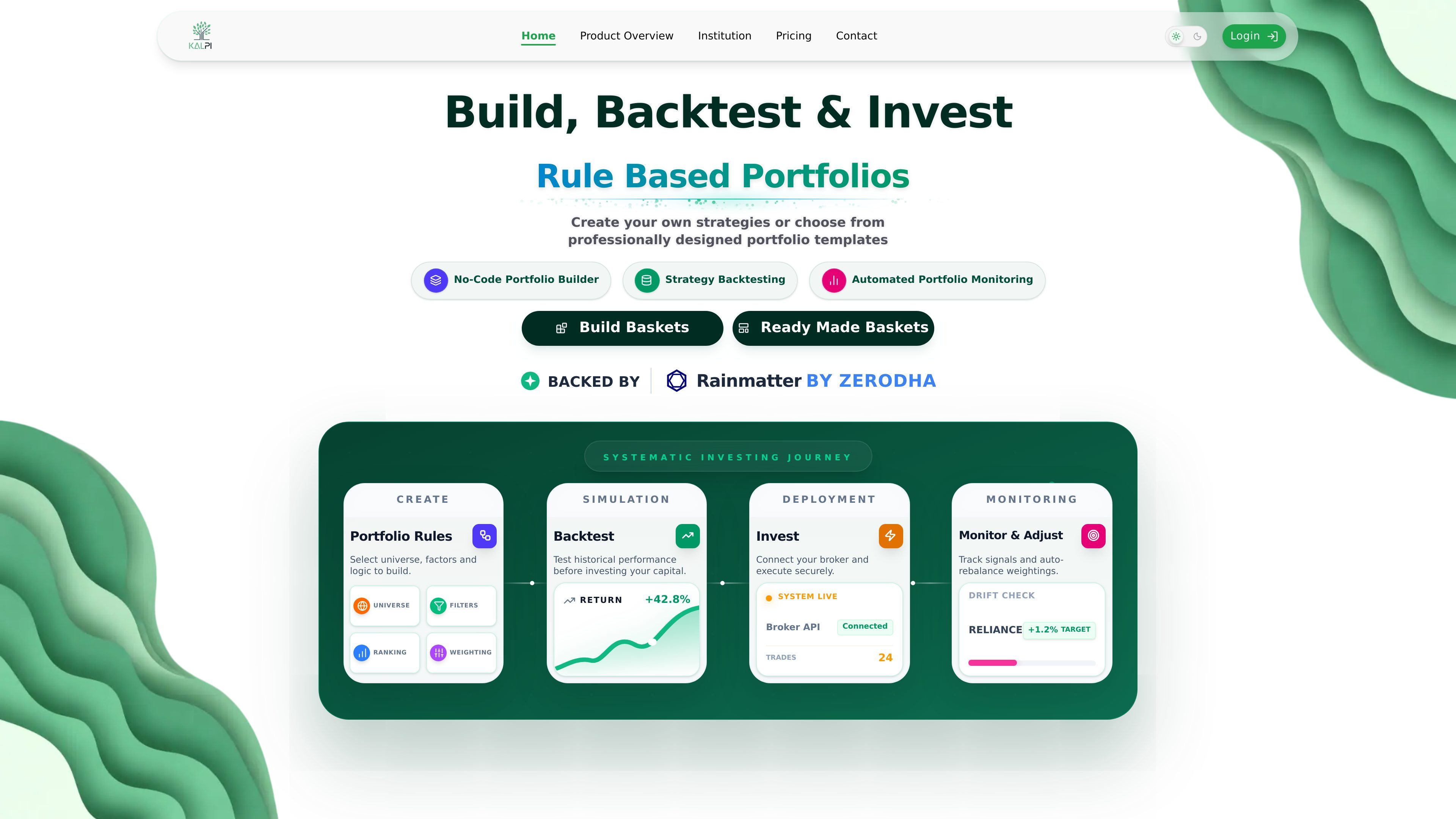
Kalpi is a rule-based investing platform for building, backtesting, and managing stock portfolios. It is designed for investors who want to move from ad hoc stock picking to a more systematic workflow based on rules, factors, and portfolio logic.
The product combines a no-code portfolio builder, strategy backtesting, portfolio monitoring, and broker connectivity in one place. Its public pages also show research tools for portfolio analysis, stock research, alerts, and market analytics, along with a free plan, a paid Pro tier, and an Enterprise offering for institutions and organizations.
Build rule-based stock portfolios using a no-code portfolio builder, strategy logic, filters, ranking, and weighting rules.
Test portfolio ideas against historical data before investing so you can evaluate how a strategy may have performed over time.
Connect a broker to analyze holdings, review portfolio risk and returns, and execute curated baskets directly from the platform.
Track signals, drift, and allocation changes so portfolios can be monitored and adjusted after deployment.
Use pre-built portfolio templates and baskets as starting points, including model strategies such as momentum, quality, low volatility, and multi-factor approaches.
Access stock research, alerts, and market analytics for fundamentals, technicals, sectors, indices, and event-driven monitoring.
Design a portfolio strategy with filters, ranking rules, and weighting logic, then run historical tests before committing capital.
Review an existing brokerage account to understand risk, sector concentration, returns, and factor exposure in one place.
Start from a pre-built basket or model template, customize the rules, and deploy it as a working portfolio.
Use ongoing alerts, drift checks, and monitoring tools to track signals and rebalance after a portfolio is live.
Use market analytics and stock research to track indices, sectors, earnings-related events, and technical signals during ongoing research.
Kalpi is a systematic investing platform for building, backtesting, and managing rule-based stock portfolios. The source also shows research features for portfolio analysis, stock research, and broker-connected portfolio review.
The pricing page says there is a fully functional Free plan, and Pro is a paid tier with advanced features. Enterprise is available for institutions and organizations that need custom onboarding, private cloud deployment, and bespoke solutions.
Yes. Kalpi says you can connect your brokerage account to analyze your portfolio, get a health check, and directly execute curated baskets of stocks, ETFs, and other assets.
The pricing page says you can cancel anytime from your dashboard, and your plan remains active until the end of the billing cycle.
Kalpi positions itself as broader than a stock screener: it supports building rule-based portfolios, scoring stocks across quantitative factors, applying custom weighting strategies, and tracking portfolios in one place.
SimplyPortfolio is a manual portfolio tracker for stocks, ETFs, gold, and silver, with one dashboard, multi-currency reporting, cost-basis tracking, and CSV export.

金灵 is an AI Agent product specifically designed for the financial sector, having learned a vast amount of financial expertise and capable of proficiently using various financial tools.

TickerSignals provides Bullish, Bearish, or Neutral stock signals for 4,500+ US and Indian stocks using 39 technical indicators, with post-market daily updates.

CatchBack is a trading-card platform for digital pack openings, flat-fee trading, vault storage, and U.S. card shipping.

Coil is a long-only AI trading agent for your own machine and brokerage account. It scans major U.S. markets and places rule-based trades when leaders qualify.

Orus is Farao’s chat-based trading analyst for researching markets and placing trades from WhatsApp, Telegram, Claude, ChatGPT, or Grok. One Farao connection keeps research, sizing, confirmation, and tracking in chat.