
Interest-based story selection
Choose from story categories such as fantasy, thriller, romance, and more so the reading material fits your interests as well as your language level.

Lingofable is a story-based language learning app for reading at your level and reviewing new vocabulary in context. Spanish available; Android coming soon.
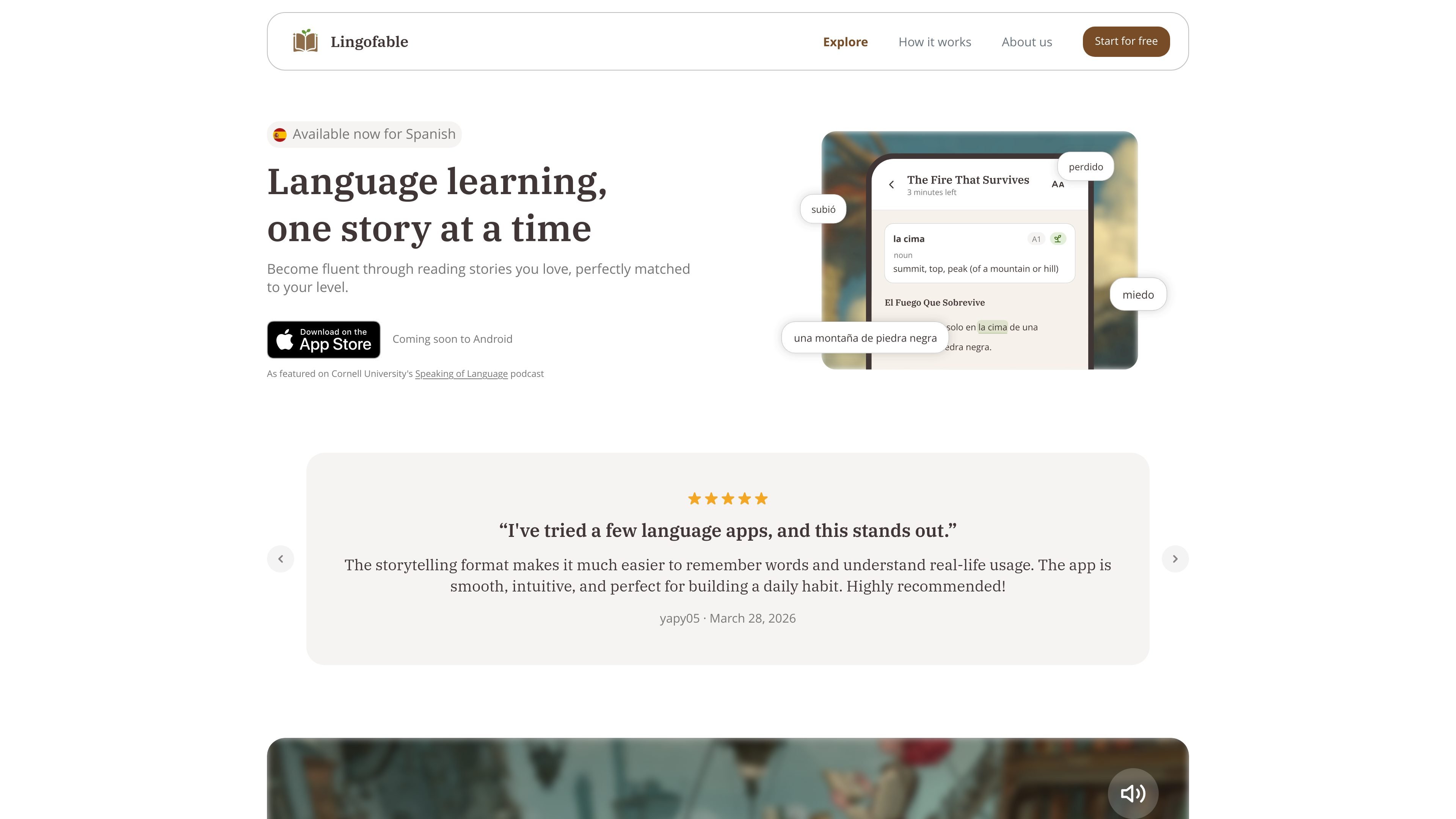
Lingofable is a language-learning reading app built around short stories and comprehensible input. It helps learners practice by reading content tailored to their level and interests, instead of relying on textbooks or isolated vocabulary lists.
The product says it targets about 98% comprehensibility for most recommended stories, so the text is meant to be understandable with only occasional new words. Users can tap unknown words for definitions and native sentence translations, then review and export vocabulary for later study.
Choose from story categories such as fantasy, thriller, romance, and more so the reading material fits your interests as well as your language level.
Stories are matched to your vocabulary in real time with a target of about 98% comprehensibility, so the reading stays challenging without becoming overwhelming.
Tap any word to see definitions and native sentence translations without leaving the story, which keeps the reading flow intact.
Review vocabulary with example sentences and export new words in bulk to external spaced-repetition systems, making it easier to turn reading into review.
Track your reading streak, words learned, and overall progress to see how much you have read over time.
A learner who wants to read in the target language without constantly switching between a story and a separate dictionary can use Lingofable to stay in context while checking unfamiliar words.
Someone trying to build a steady language habit can return daily, track a streak, and measure words learned as they work through stories at a manageable difficulty.
A learner who already uses spaced-repetition software can read stories, collect new vocabulary, and export it in bulk for review elsewhere.
A reader who prefers certain genres can choose stories that match personal interests, which the app positions as part of keeping reading engaging enough to continue.
A learner who wants material closer to their current ability can use the app’s level-matching approach instead of guessing whether a book is too hard or too easy.
Lingofable is built for language learners who want to practice through reading stories instead of textbooks or isolated word drills. The homepage frames it as useful for both beginners and more advanced learners, with stories adjusted to the reader’s level.
The site says every story is analyzed against your vocabulary in real time and that the library targets about 98% comprehension, which it describes as the sweet spot for extensive reading. That means the app uses your reading progress and selected interests to surface appropriately leveled stories.
The homepage says you can explore different story genres and that the team is expanding to more languages soon. It does not publish a fixed count of available stories on the page, so the safest answer is that the catalog is designed to keep growing.
The site says stories are backed by 40+ years of language acquisition research, including Stephen Krashen’s i+1 theory, and the about page notes the founders built the product around comprehensible input. It does not provide a formal quality-control process beyond that positioning.
The homepage and about page mention Spanish today, and the site says more languages are coming soon. It also invites users to request another language for a future launch.

GameGrad turns PDF study material into quiz questions inside arcade games for active recall. Free tier for one PDF; Pro adds more uploads, questions, and explanations.
LangPanda is a browser extension for learning languages from streaming video with instant subtitle lookup, flashcards, vocabulary tracking, and SRS for 36 languages.

Talkpal is an AI language learning app for web and mobile with speaking, listening, writing, pronunciation practice, guided courses, roleplays, and 130+ languages.

NerdSip is an AI microlearning app that creates custom 7-lesson courses on almost any topic, with quizzes, key takeaways and visual summaries.

Yokoso is a Japanese-learning app for life in Japan, with practical daily language, adaptive lessons, and offline learning from real-world content.

recall is an AI flashcard app that turns reading and notes into study cards with Claude, ChatGPT, or another MCP client. One-time lifetime access with spaced repetition review.