

Stats For Hats
Stats For Hats is a recipe-data tool to find ingredient pairings and related dishes, cuisines, and cooking methods by searching ingredients together.
What is Stats For Hats?
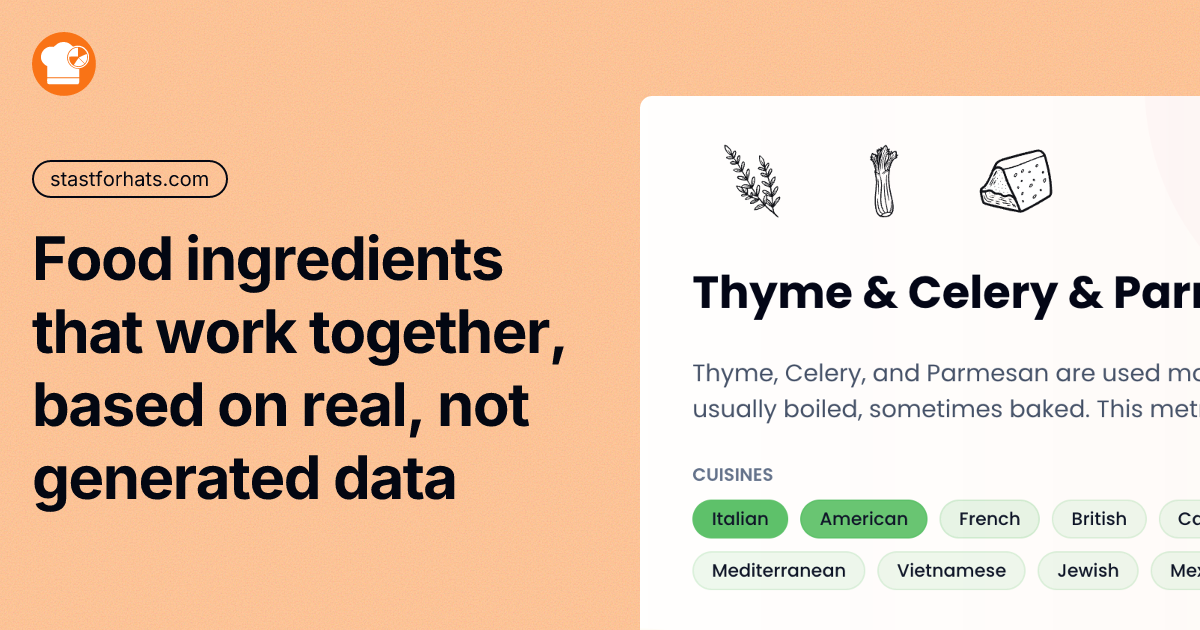
Stats For Hats is a web tool for exploring food ingredient pairings using real recipe data. It helps you discover which ingredients tend to appear together, and it also surfaces related context such as companion ingredients, cuisines, and cooking methods.
The site lets you browse ingredient relationships and dish patterns, including “ultimate recipes” that merge steps and ingredients from multiple sources into a single view of a dish.
Key Features
- Ingredient pairings from real recipe data: Search or browse combinations to see how often two ingredients appear together.
- Context around pairings: For ingredient relationships, the tool lists companion ingredients, cuisines, and cooking methods associated with those recipes.
- “Most used ingredients” views: Example pages show ingredients and their usage frequency within a referenced dish or context.
- Ingredient Composer: Combine multiple ingredients to explore likely companions, relevant cuisines, and cooking methods.
- Dish Composer and “ultimate recipe” merging: For a dish, view a merged recipe sourced from multiple recipe entries (including an “ultimate” view) and see related ingredient and instruction details.
- Explore by dishes and ingredients: Browse popular dishes, then connect them back to ingredient usage and pairing information.
How to Use Stats For Hats
- Start by browsing the pairing explorer or entering two ingredients you want to combine.
- Review the results for how often the ingredients appear together, plus the related companion ingredients, cuisines, and cooking methods.
- Use Ingredient Composer or Dish Composer to add more ingredients or to build toward a specific dish.
- If you need a concrete starting point, open Ultimate Recipe views to see a merged recipe description and an instructions preview.
Use Cases
- Plan a sauce or marinade around a flavor pair: Look up ingredients like cilantro and lime juice to see what other ingredients commonly show up alongside them, and which cuisines and cooking methods are most associated.
- Build a dish from a partial ingredient list: Start with one “anchor” ingredient (e.g., onion) and use the pairing and composer tools to find likely companions and cooking approaches.
- Compare cuisines and techniques for the same ingredient relationship: Use the pairing results to identify which cuisines and cooking methods frequently accompany a particular ingredient pair.
- Refine a familiar dish using a merged “best-of” view: Open the Ultimate Recipe for a dish (for example, French onion soup) to view a general/common merged version compiled from multiple recipe sources.
- Generate ideas for new variations: Browse popular dishes, then use the ingredient and dish browsing flows to identify ingredient swaps or complementary additions.
FAQ
Where does the pairing information come from?
The site states that it analyzes recipe data and extracts metrics helpful for creating dishes based on real (not generated) recipe information.
Can I search for ingredients other than the examples shown?
Yes. The site description indicates you can “search for any two ingredients” to see how often they appear together, along with related dishes and context.
What do “Ultimate Recipe” and merged recipes mean?
For dishes, the site describes an “ultimate” view that merges recipes and shares ingredients and instructions that appear across multiple source recipes, and it also provides an instructions preview.
What kinds of results will I see for an ingredient pair?
The results shown include how often the ingredients appear together and additional context such as companion ingredients, cuisines, and cooking methods.
Does the site provide instruction steps?
Yes. Example dish pages show an instructions preview and a path to view the full recipe.
Alternatives
- Ingredient/dish databases and recipe search engines: These help you browse recipes by ingredient but may not provide pairing metrics or the same structured companion cues (cuisines, methods) based on co-occurrence.
- Recipe “recommendation” tools within cooking apps: Many focus on personalization or tags; they may not explicitly show ingredient pair frequencies or merged “ultimate” recipe views.
- General food pairing guides (non-data-driven): Classic pairing resources can suggest combinations, but they typically don’t use the kind of recipe-data co-occurrence metrics described by Stats For Hats.
- Analytics for recipe datasets (custom research approach): If you have a dataset and skills, you can run co-occurrence analysis yourself, but you would need to set up the data and queries rather than using a ready-made interface.
Alternatives

FounderStackHub
FounderStackHub uses an always-on AI agent to scan, verify, and match startup perks like cloud credits, AI-tool credits, and SaaS discounts to your stack.

Elvixs
Elvixs is an AI job outreach tool for freshers and students—find HR contacts, generate AI cold emails, send from Gmail, and track opens.

Gossipic
Gossipic tracks how often your brand is mentioned in AI answers, analyzes sentiment, benchmarks competitors, and creates daily action plans. Start 7-day free trial.

SnapSub: Subscriptions Hub
SnapSub: Subscriptions Hub centralizes recurring services so you can track what you pay, upcoming billing dates, and get reports to review spending.

Abakada
Abakada is the Philippines’ curated directory of free, open-source tools—1,000+ verified listings across 45+ categories for students & educators.

Been There Global
Been There Global shares real stories from real travellers to help you “know before you go” and plan trips with more confidence.