
Pre-execution interception
Agentinel hooks into the AI agent’s pre-tool or pre-execution event so install commands are intercepted before they reach npm or another package manager.

Agentinel is a local security layer for autonomous coding agents that intercepts package install decisions before they run. It helps block hallucinated or malicious npm packages without requiring a cloud service or account.
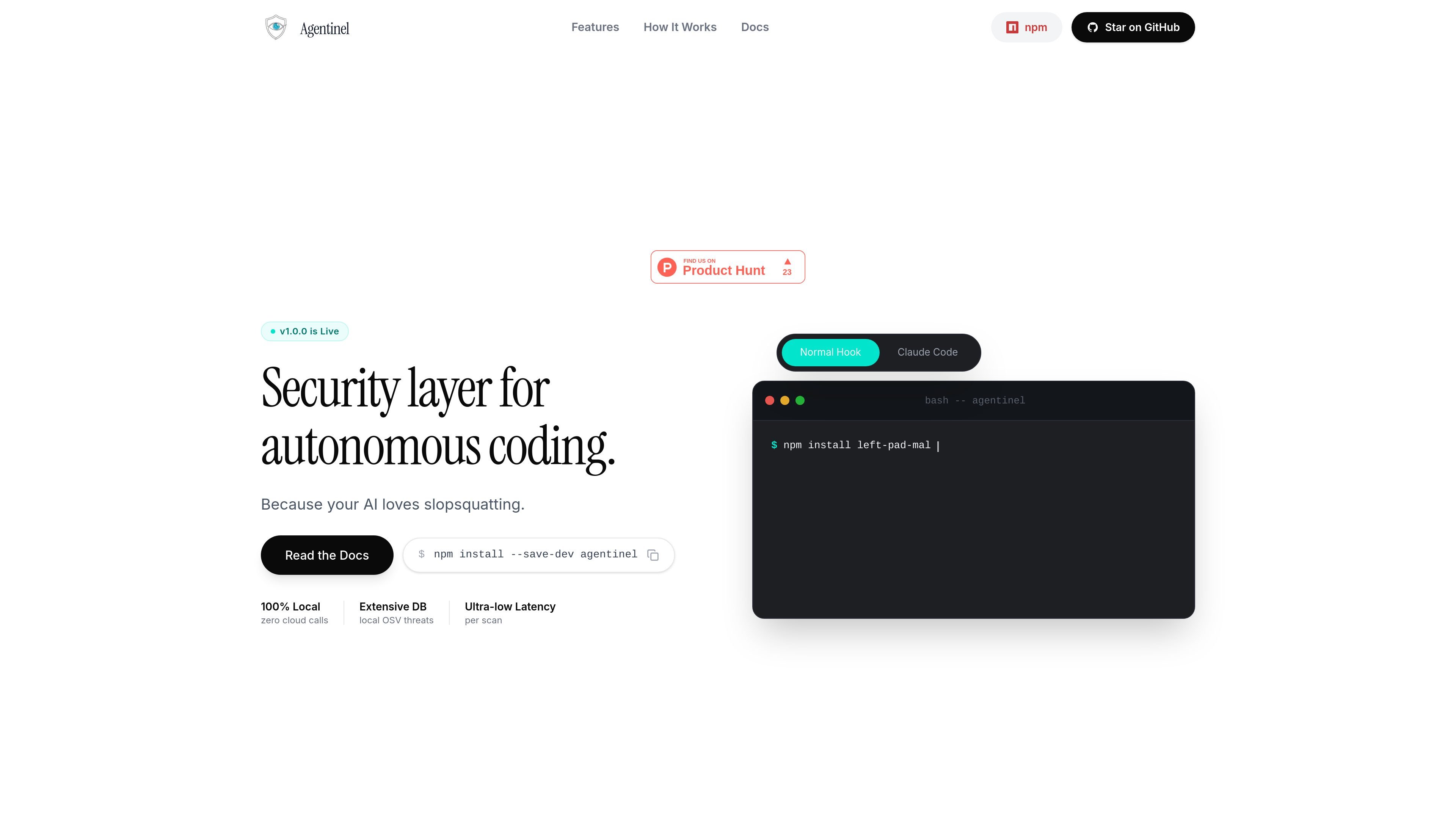
Agentinel is a locally run security layer for autonomous coding agents that intercepts npm install decisions before they execute. Its purpose is to stop hallucinated or malicious package installs in agentic workflows, where there may be no human reviewing each command.
The product works entirely offline on the developer’s machine. It uses a bundled OSV database plus heuristic checks to flag suspicious packages, then blocks or warns and sends a structured explanation back to the agent so it can correct itself.
Agentinel hooks into the AI agent’s pre-tool or pre-execution event so install commands are intercepted before they reach npm or another package manager.
The scanner checks requested packages against a bundled local copy of the Open Source Vulnerabilities database, which the docs describe as covering 216,000+ malicious or vulnerable packages.
Heuristic rules supplement database lookups to catch slopsquatting, hallucinated package names, and suspicious cases that may not yet appear in the database.
When a package is blocked, Agentinel returns a structured JSON reason back into the agent context so the model can self-correct without human intervention.
The tool resolves and scans dependency trees locally, allowing it to examine transitive packages rather than only the top-level install target.
A fail-open mode is documented for scan failures: if the scanner errors internally, it allows the install to continue and logs a warning instead of silently breaking the workflow.
Use Agentinel when an AI coding assistant can run install commands on its own and you want a local check before any package lands on disk.
Use it to reduce risk from slopsquatting, where an attacker pre-registers a package name that an LLM is likely to hallucinate.
Use it in CI or CD pipelines to scan manifests and gate deployments before a suspicious package reaches review or execution.
Use it when you want the agent itself to understand why an install was blocked, rather than leaving a plain terminal error for a person to interpret.
Use it in environments that cannot or should not send package checks to a cloud service, since the product is designed to run fully offline.
Agentinel runs locally on the developer’s machine and does not use network calls at scan time. It sits between the AI agent and the package manager, scans the requested package, and either blocks or allows the install based on the result.
The docs list Claude Code, GitHub Copilot CLI, OpenAI Codex CLI, and Gemini CLI as supported examples. Agentinel hooks into their pre-execution events so it can intercept install decisions before the command runs.
Yes. The docs describe a fail-open design: if scanning cannot complete because of an internal error, the install is allowed to proceed and a warning is logged. This is intended to avoid silently breaking workflows.
Agentinel checks a package against a bundled local copy of the OSV database and heuristic rules. The homepage also says it can scan the full dependency tree, not only the top-level package.
The source describes Agentinel as a locally run, open-source guardrail with no account, no API key, no telemetry, and no server. It is presented as a zero-config drop-in installed with npm.

ByteAsk is a terminal-first AI coding agent for C and C++ that edits repositories and verifies changes with the real compiler, debugger, sanitizers, and tests before showing a diff. It offers a free tier plus paid plans, with editor connectors and zero-retention handling described in the source.

Ghost é um assistente de IA para terminal, para conversar, gerar código e executar tarefas no prompt. Traz modelos gratuitos, funciona no Linux, macOS e Windows e é open source.

hob is an independent workspace for coding agents that keeps agent sessions, terminals, history, and follow-up work organized around the tools and providers you already use. It is aimed at developers who want local control over routing, history, and workspace structure rather than a bundled model stack.

Manta AI is an autonomous web app testing tool for teams that want to map application behavior, catch regressions, and generate tests without writing scripts or maintaining selectors. It works from a URL and supports plain-English test flows, run results with screenshots, and scheduled or deployment-triggered checks.

SonOf connects to your repo and PM tool, audits the codebase and surrounding product context, and turns approved work into shipped tickets with senior engineering review. It is aimed at founders and engineering leaders who need backlog help without hiring a full team immediately.

Devin is an AI coding agent and software engineer that helps developers and engineering teams plan and execute complex software tasks. It is available through desktop, cloud, JetBrains, and CLI surfaces, with plans for individuals, teams, and enterprises.