
Native Apple Silicon runtime
The homepage positions BaseRT as an LLM runtime built for Apple Silicon, with research material describing it as a native Metal inference runtime.

BaseRT is an LLM runtime for Apple Silicon Macs that runs local models on your own device. It is positioned for on-device inference and a local coding-agent workflow, with public materials emphasizing speed and privacy by keeping execution on-machine.
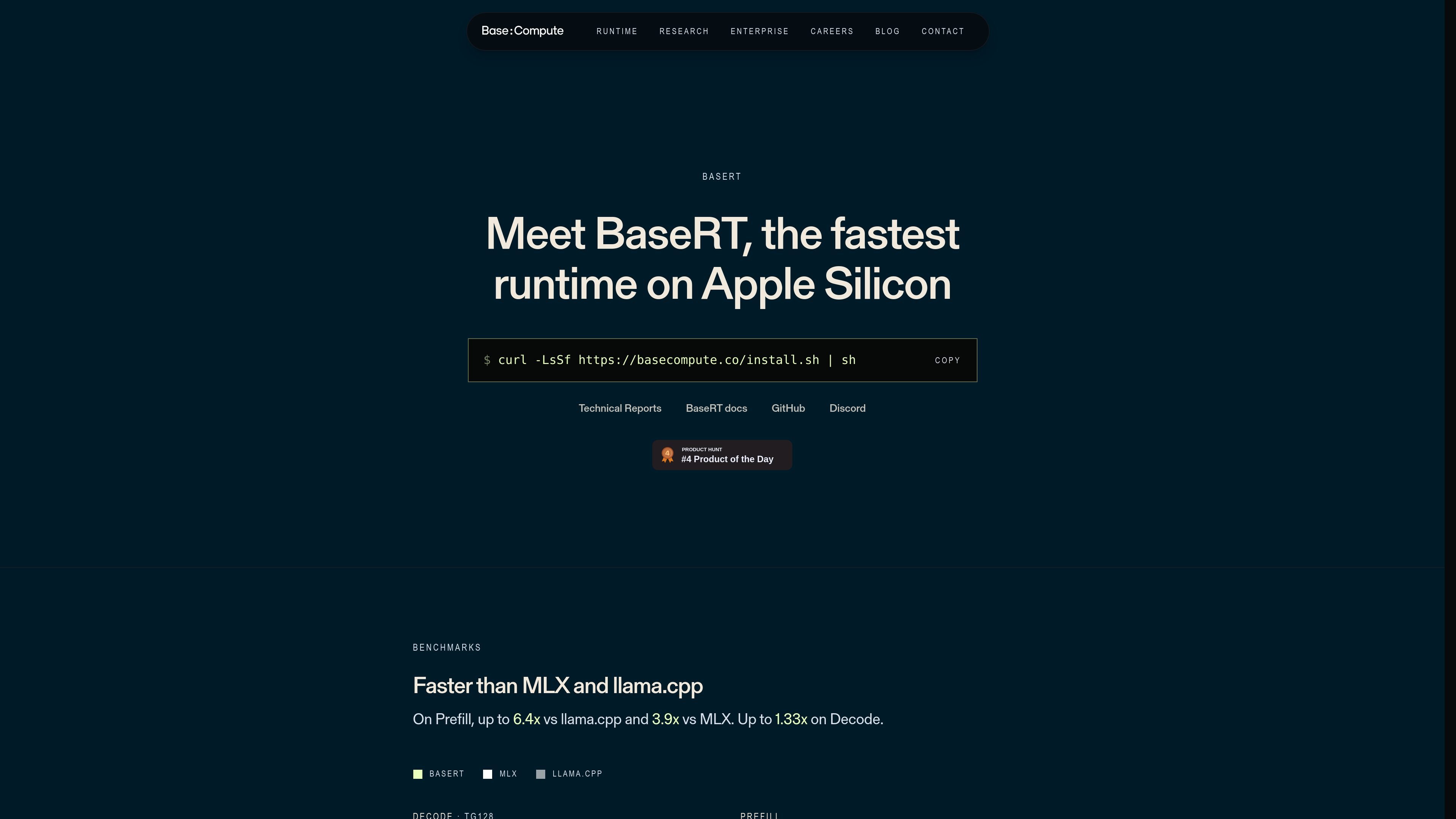
BaseRT is Base Compute’s LLM runtime for Apple Silicon. The product page describes it as the fastest runtime on Apple Silicon and shows a one-command install flow for running local models on your own device.
The public materials frame BaseRT around on-device inference: serving models locally, using them with a coding-agent plugin, and keeping model execution on your machine rather than sending requests to an external API. The research pages describe BaseRT as a native Metal runtime designed to improve throughput on Apple hardware.
The site’s research papers claim BaseRT supports a wide range of model families and multiple quantisation formats, but the product page itself is intentionally narrower and mainly highlights the Apple Silicon runtime and local-agent workflow. That makes BaseRT most clearly suited to developers and teams who want local LLM execution on Mac hardware.
Base Compute’s enterprise material places BaseRT inside a broader on-device AI stack that includes apps, control, routing, policy, and monitoring for organisations running AI on their own devices. The public page does not provide pricing details or a complete product guide, so the best-supported view is that BaseRT is the inference engine at the core of a local-first LLM setup.
The homepage positions BaseRT as an LLM runtime built for Apple Silicon, with research material describing it as a native Metal inference runtime.
A research report says BaseRT uses chip-specific kernel fusion, unified memory-aware optimisation, and custom dispatch logic to improve throughput on Apple hardware.
The homepage provides a local coding-agent flow: serve a model, install the plugin, and keep the agent running on your machine without API keys or data leaving the device.
The source lists supported model families including Qwen, Llama, Gemma, Mistral, Phi-3, and Nomic BERT, indicating use across several open model lines.
The enterprise page says the broader Base Compute stack includes model distribution, local/cloud routing, role-based access, policy enforcement, and monitoring, though not all of these are documented specifically for BaseRT on the public product page.
Run an LLM on a Mac so prompts and outputs stay on the local machine, which is the core workflow the homepage highlights.
Serve a local model and point a coding agent at it, using the plugin flow shown on the product page for on-device coding assistance.
Use BaseRT in a team or organisational context where the enterprise page emphasizes local-by-default deployment, no external API dependency, and data staying on owned devices.
Evaluate BaseRT as an inference engine for open models when comparing it against other Apple Silicon runtimes, using the research pages and benchmark claims as the main evidence.
BaseRT is presented as an LLM runtime for Apple Silicon. The site positions it for running local models on your own device, including with a local coding agent workflow.
The homepage shows an install command using curl and a shell script, but the site does not provide fuller setup documentation in the collected text beyond that one-command install example.
The source says BaseRT supports model families including Qwen3, Qwen3.5, Qwen3.6, Llama 3.1, Llama 3.2, Gemma 3, Gemma 4, Mistral, Phi-3, and Nomic BERT.
The enterprise page describes BaseRT as local by default, with cloud only where you choose. The public pages do not provide pricing details, and the pricing page returned a 404 in the collected sources.
The collected sources show BaseRT, technical reports, GitHub, Discord, and a coding-agent plugin example. They do not document broader third-party integrations or API details in depth.

ByteAsk is a terminal-first AI coding agent for C and C++ that edits repositories and verifies changes with the real compiler, debugger, sanitizers, and tests before showing a diff. It offers a free tier plus paid plans, with editor connectors and zero-retention handling described in the source.

CreateOS Sandbox is an isolated compute environment for running code and agent workloads inside Firecracker micro-VMs. It is designed for workflows that need machine-level isolation, private networking between sandboxes, and programmatic control through SDK, CLI, or MCP.

hob is an independent workspace for coding agents that keeps agent sessions, terminals, history, and follow-up work organized around the tools and providers you already use. It is aimed at developers who want local control over routing, history, and workspace structure rather than a bundled model stack.

Manta AI is an autonomous web app testing tool for teams that want to map application behavior, catch regressions, and generate tests without writing scripts or maintaining selectors. It works from a URL and supports plain-English test flows, run results with screenshots, and scheduled or deployment-triggered checks.

SonOf connects to your repo and PM tool, audits the codebase and surrounding product context, and turns approved work into shipped tickets with senior engineering review. It is aimed at founders and engineering leaders who need backlog help without hiring a full team immediately.

Ghost é um assistente de IA para terminal, para conversar, gerar código e executar tarefas no prompt. Traz modelos gratuitos, funciona no Linux, macOS e Windows e é open source.