
Big-picture controller-first UI
ConsoleMini is built for a living-room setup where the Mac mini connects to a TV and a controller. Its interface is designed around large, controller-friendly navigation rather than mouse-first desktop use.

ConsoleMini is a macOS launcher that turns a Mac mini into a TV-friendly retro and PlayStation console interface. It helps users start supported emulators from a controller-first big-picture UI and inspect emulator save-state folders without modifying them.
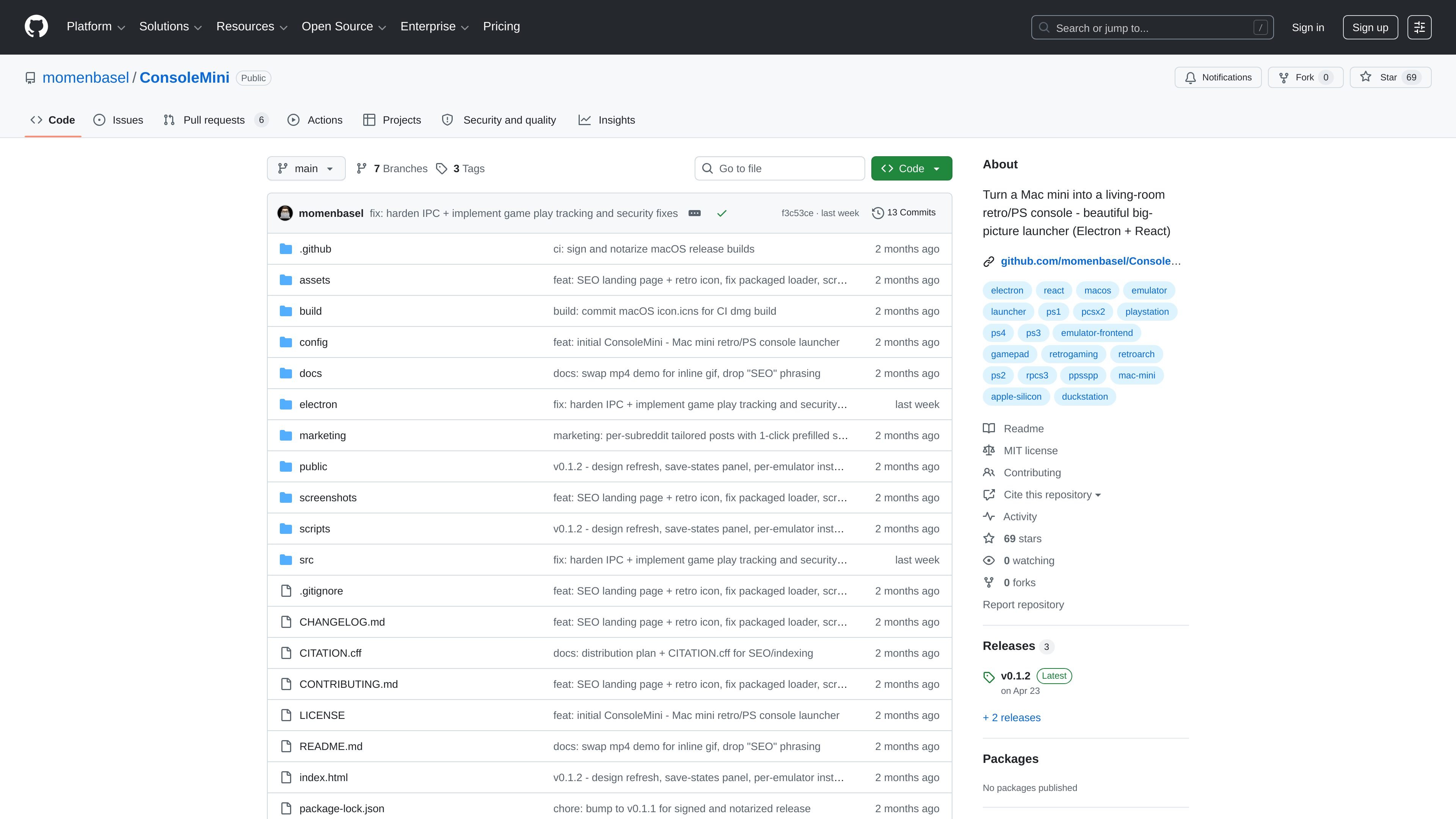
ConsoleMini is a macOS launcher that turns a Mac mini into a TV-friendly retro and PlayStation console interface. It is built with Electron and React and is positioned around a simple loop: plug in a controller, choose a system, and launch the emulator with your ROM.
The project focuses on a controller-first, big-picture UI for the Mac mini living-room setup. Rather than trying to replace emulators, it wraps supported macOS emulators, provides install and setup guidance, and offers a read-only view of save-state folders so users can see what is already on disk.
ConsoleMini is built for a living-room setup where the Mac mini connects to a TV and a controller. Its interface is designed around large, controller-friendly navigation rather than mouse-first desktop use.
The launcher covers ten systems across retro and PlayStation-era emulation, including PS1, PS2, PS3, PS4, PSP, N64, SNES/NES, GBA, and Dreamcast. Each system maps to a specific emulator and install path.
The app shows live install status in the Settings tab and can install supported emulators through the bundled `scripts/install-emulators.sh` flow. The README also lists exact Homebrew commands for each emulator.
Controller navigation uses the HTML5 Gamepad API for menu actions such as navigation, confirm, back, menu, and search. The README notes that in-game input is then handled by the emulator itself.
A kiosk script can auto-launch the app at login, disable sleep, and hide the Dock so a Mac mini can boot straight into the launcher. This supports a console-like living-room workflow.
The app includes a Save states panel that lists each emulator’s vault, counts files, shows last-modified times, and offers a Reveal button to open the folder in Finder. ConsoleMini reads the data but does not modify it.
Set up a Mac mini beside a TV and use it as a console-like gaming machine. ConsoleMini provides the front-end so you can boot into a controller-driven launcher instead of a desktop environment.
Browse supported systems and launch the matching emulator for a selected ROM. The app is meant to get you from controller input to gameplay with as little UI friction as possible.
Install and configure supported emulators from one place. The Settings tab shows install status and points to the scripts that automate emulator setup for the systems ConsoleMini supports.
Check save-state folders across emulators without opening each app individually. The save-state panel gives a consolidated, read-only view that helps you inspect what is stored on disk and open it in Finder when needed.
Use the launcher with common Bluetooth controllers such as DualShock, DualSense, Xbox, or 8BitDo pads. Menu navigation works through the Gamepad API, while each emulator handles the in-game controller mapping.
No. ConsoleMini is a launcher only; the README says it does not ship ROMs or BIOS and asks users to bring their own legally.
The README says controller navigation works with any controller exposed through the HTML5 Gamepad API, including DualShock 4, DualSense, Xbox, and 8BitDo controllers. In-game input is handled by each emulator directly.
ConsoleMini is designed for the Mac mini to TV setup. The README describes Apple Silicon native builds, but also says both arm64 and x64 builds are shipped, with M-series recommended for PS3 and PS4 use.
You can install it from Homebrew using the ConsoleMini cask, download the latest release .dmg, or build from source with the provided setup script and Electron dev command.
The app is centered on launching supported emulators and showing their save-state vaults. It does not replace the emulator’s own save-state system; instead, it indexes those files and lets you reveal them in Finder.

Cascadeur is a standalone 3D keyframe animation tool for humanoid and other character work. It combines AI-assisted posing and physics-based tools to help animators create, edit, and clean up motion in existing pipelines.

GameGrad turns PDF study material into quiz questions that appear inside arcade games, so users can practice active recall while they play. It offers a free tier with one PDF and a Pro plan with more uploads, more questions, and answer explanations.

DailyPlay.ai is a behavioral growth platform that uses AI site scanning and micro-games to help brands improve engagement and conversion. It supports web, mobile, and other digital touchpoints, with a one-line script setup and a free engagement scan.

MacSpoof é um alterador de MAC no macOS que permite trocar ou randomizar o endereço Wi‑Fi para reconectar e reduzir o registro da identidade.

NomNak é um app gratuito para iPhone que ajuda a descobrir restaurantes com recomendações de amigos, spots salvos, passaporte gastronómico e busca por cidade.

TyeGit é um cliente Git nativo em Rust e Tauri para controle rápido e preciso de staging, commits, branches e remotes no Windows, macOS e Linux.