
Warehouse exploration
Dex profiles warehouse tables, infers relationships, flags PII, and builds a draft map cached locally so an agent can explore a schema without manually sampling tables one by one.

Exmergo Dex is an open-source, agent-native analytics engineering toolkit for exploring data warehouses, authoring dbt and semantic models, and maintaining them when schemas drift. It is designed to run through coding agents such as Claude Code rather than as a separate analytics UI.
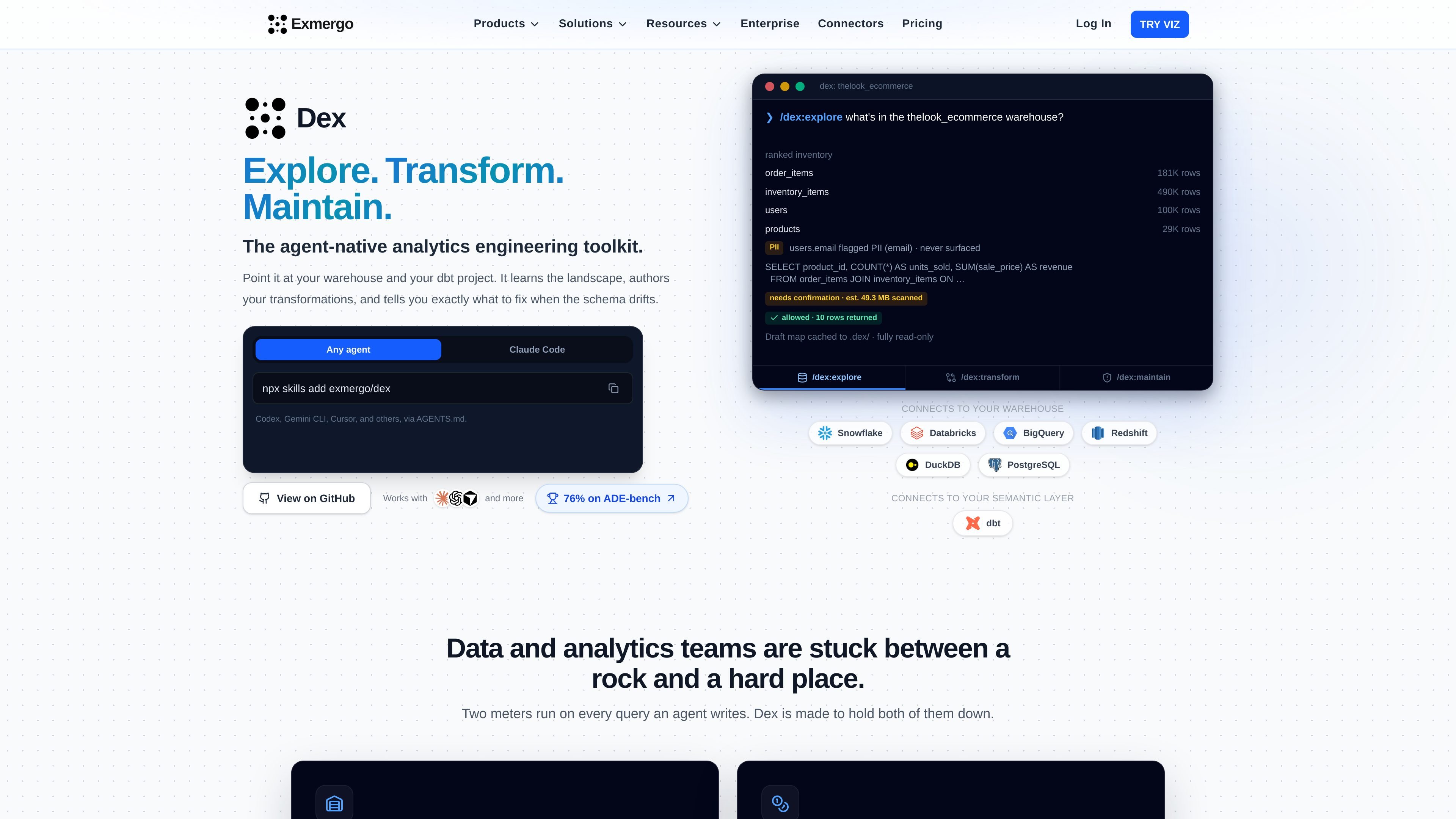
Exmergo Dex is an agent-native analytics engineering toolkit for working with data warehouses and dbt projects through coding agents. The site positions it as a tool for exploring a warehouse, transforming data into dbt and semantic models, and maintaining those models when schemas or business definitions drift.
Dex is designed to run through your own agent workflow rather than as a separate BI application. Exmergo says it works with Claude Code and other agents, supports warehouses such as Snowflake, Databricks, BigQuery, Redshift, DuckDB, and PostgreSQL, and keeps data read-only so exploration and maintenance happen without routing raw data through Exmergo.
Dex profiles warehouse tables, infers relationships, flags PII, and builds a draft map cached locally so an agent can explore a schema without manually sampling tables one by one.
The toolkit can author dbt SQL models, schema tests, and MetricFlow YAML for semantic modeling, then validate against dev targets with cost guards before execution.
Running /dex:maintain on a .dex snapshot detects schema drift, volume drift, and grain drift, then proposes concrete edits to reconcile the project.
Dex is built to enforce spend controls: it uses dry runs, confirms estimated cost before running, and records activity in a local ledger.
The product is distributed as an open-source toolkit under Apache 2.0 and is presented with command-based workflows for Claude Code and other agents.
Use Dex to inspect a warehouse schema, profile columns, infer relationships, and create a cached draft map before writing analytics logic.
Use Dex to turn a metric request into reviewable dbt SQL models, schema tests, and MetricFlow YAML, with validation against dev targets before changes are merged.
Use Dex to run maintenance checks against a .dex snapshot when upstream schemas or row volumes change, then review the proposed reconciliation edits.
Use Dex through Claude Code or another supported coding agent when you want analytics engineering tasks to happen in the same workflow as other development work.
Dex is designed to work through coding agents such as Claude Code, and the pricing page says the single-player developer version is free forever. The home page also shows it as an open-source toolkit released under Apache 2.0.
Dex is presented as an analytics engineering toolkit for exploration, transformation, and maintenance. The home page shows the workflow as /dex:explore, /dex:transform, and /dex:maintain.
The home page says Dex connects to warehouses including Snowflake, Databricks, BigQuery, Redshift, DuckDB, and PostgreSQL, and also connects to dbt for semantic-layer work.
Dex is positioned for use through your own coding agent and runs with your own API key or subscription. The site says it is read-only against your data and that raw data and credentials do not enter the model context.
The site says Dex can be used via Claude Code, npx skills, AGENTS.md, and other agent workflows such as Codex, Gemini CLI, and Cursor. The benchmark page also frames it as a plugin/skill for agents rather than a standalone BI app.

ByteAsk is a terminal-first AI coding agent for C and C++ that edits repositories and verifies changes with the real compiler, debugger, sanitizers, and tests before showing a diff. It offers a free tier plus paid plans, with editor connectors and zero-retention handling described in the source.

CreateOS Sandbox is an isolated compute environment for running code and agent workloads inside Firecracker micro-VMs. It is designed for workflows that need machine-level isolation, private networking between sandboxes, and programmatic control through SDK, CLI, or MCP.

hob is an independent workspace for coding agents that keeps agent sessions, terminals, history, and follow-up work organized around the tools and providers you already use. It is aimed at developers who want local control over routing, history, and workspace structure rather than a bundled model stack.

Manta AI is an autonomous web app testing tool for teams that want to map application behavior, catch regressions, and generate tests without writing scripts or maintaining selectors. It works from a URL and supports plain-English test flows, run results with screenshots, and scheduled or deployment-triggered checks.

SonOf connects to your repo and PM tool, audits the codebase and surrounding product context, and turns approved work into shipped tickets with senior engineering review. It is aimed at founders and engineering leaders who need backlog help without hiring a full team immediately.

Ghost é um assistente de IA para terminal, para conversar, gerar código e executar tarefas no prompt. Traz modelos gratuitos, funciona no Linux, macOS e Windows e é open source.