
AI plant identification
Take or upload a photo to identify plants, flowers, trees, weeds, vegetables, and succulents. The app returns the common name, scientific name, and essential care information.

Liveplant is an AI plant care app that identifies plants, diagnoses common problems from photos, and checks toxicity for pets and children. It also includes care reminders and a free tier with limited use.
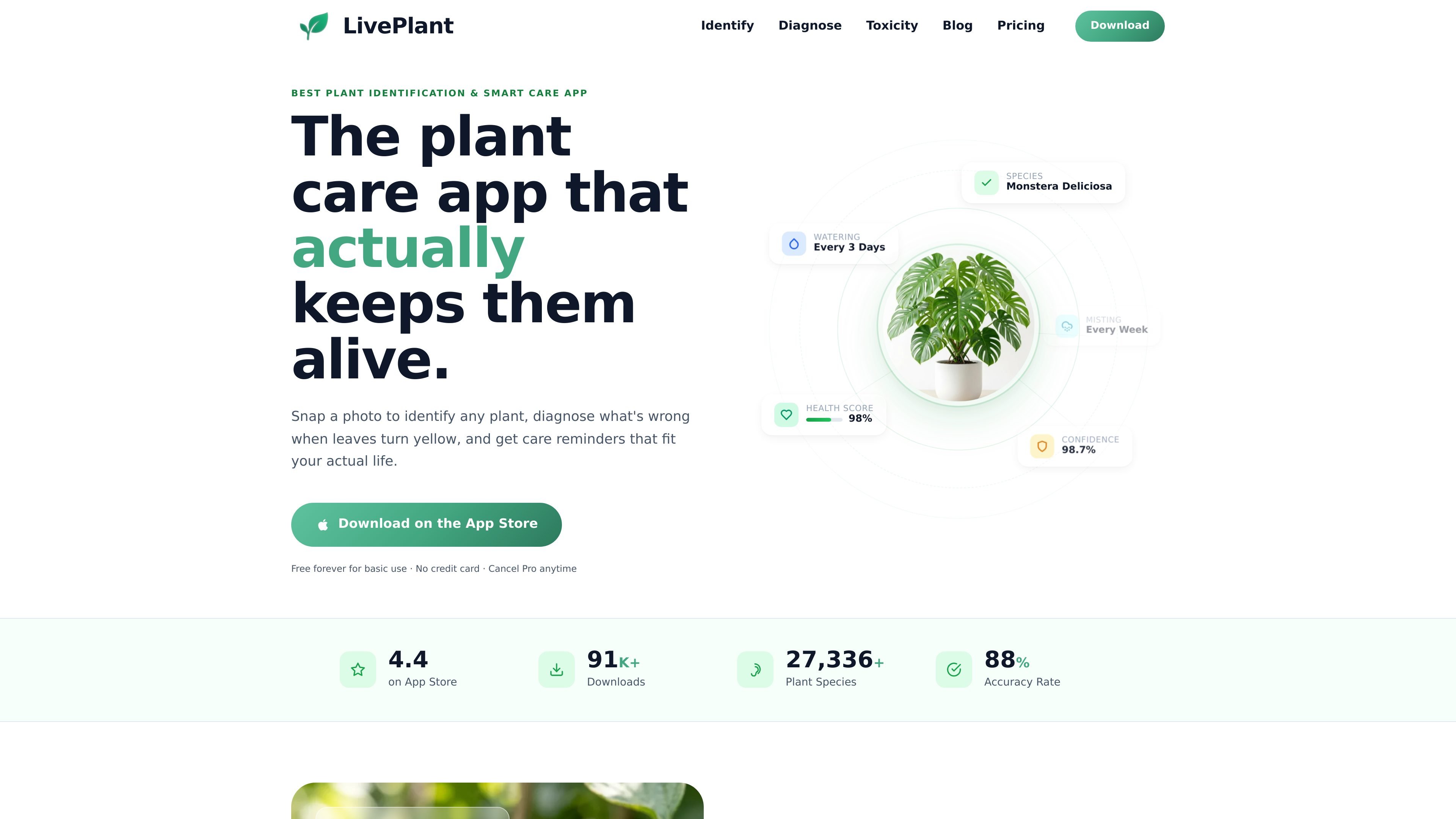
Liveplant is a plant-care app built around three main tasks: identifying plants, diagnosing problems from photos, and checking whether a plant is toxic to pets or children. The website positions it as a practical tool for plant owners who want quick answers without needing separate apps for each task.
The homepage and dedicated plant tools show a workflow that starts with a photo or plant name, then returns identification, diagnosis, or safety information alongside care guidance. For ongoing use, the app adds recurring reminders for watering, pruning, fertilizing, misting, rotating, and treatment so users can manage plant care beyond a single lookup.
Liveplant offers both free and paid access. The free tier includes limited identifications per day, basic care info, and up to three plants in a collection. Paid plans shown on the homepage include Pro Monthly and a Lifetime option that unlock unlimited identifications, full AI disease diagnosis, and unlimited plants with reminders.
Take or upload a photo to identify plants, flowers, trees, weeds, vegetables, and succulents. The app returns the common name, scientific name, and essential care information.
Upload a sick leaf or damaged plant photo to get an AI diagnosis and step-by-step treatment instructions. The disease page says it can identify overwatering, pests, fungal infections, nutrient deficiencies, and more.
Check whether a plant is safe for cats, dogs, and children by name or photo. The toxicity page provides toxicity levels, symptoms, emergency steps, and references ASPCA data.
Track care schedules such as watering, pruning, fertilizing, misting, rotating, and treatment reminders. The home page presents these as recurring care tasks with tailored timing.
Keep a plant collection with usage limits on the free plan and unlimited plants on Pro. The homepage shows a free tier with 3 plants in your collection and paid access with unlimited plants plus reminders.
A plant owner can photograph an unfamiliar plant and get its common name, scientific name, and basic care information before deciding where to place it or how to water it.
When leaves yellow, spots appear, or a plant starts drooping, the user can upload a close photo of the affected area and receive a likely diagnosis plus treatment steps.
Someone with pets or children can check a plant by name or photo to see whether it is safe, mildly toxic, or potentially dangerous before bringing it into the home.
A user can keep recurring tasks such as watering, misting, pruning, and fertilizing on a schedule rather than tracking them manually.
A plant owner can move from a one-time diagnosis to longer-term care by using reminders and collection tracking for multiple plants.
Yes. The app includes a plant identifier, a disease identifier, and a toxicity checker, so it can help with identification, diagnosis, and safety questions from the same product.
The source shows both a free tier and paid plans. Free use includes limited identifications per day, basic care info, and up to 3 plants in your collection. Paid options include Pro Monthly at $6.99 per month and a Lifetime plan at $79.99.
The site says the plant identifier can return a plant’s common name, scientific name, and essential care information. The disease and toxicity pages add diagnosis, treatment steps, safety details, and first-aid guidance where relevant.
The source explicitly notes that photos are not stored on the disease page and that the toxicity checker has no data stored. The plant identifier page also describes the app as privacy safe.
The source does not describe team accounts, shared workspaces, or integrations. It reads as a consumer app for individual plant care rather than a team product.
LabelLens сканирует фото или загруженные упаковки продуктов и показывает оценку питания с простым разбором ингредиентов, добавок и ключевых значений.

Malyatko is a baby tracker for logging feeding, sleep, growth, teething, and milestones in one app. It works on iPhone, Apple Watch, and widgets, with no sign-up, offline use, and family sharing through iCloud.

MIRA vision develops synthetic-data-driven AI for pathology image analysis in medical diagnostics. Its website positions the product for teams that need privacy-compliant training data, automatic annotations, and controlled data generation.

DANCING CATS App turns cat pictures into dancing kitty clips. The public homepage is sparse, so the core use case is clear while pricing, outputs, and feature depth remain undocumented.

Snapmark is a VS Code extension that lets you annotate clipboard screenshots before pasting them into AI chats. It supports blur redaction, numbered callouts, and automatic resizing for large images.

Arduino VENTUNO Q is an edge AI computer for AI and robotics applications. It combines AI inference and deterministic control on a single board and is designed to work with Arduino App Lab.