
Text-to-Music and Image-to-Music
Generate tracks from text prompts, and the homepage also shows image-based generation as part of the workflow.

Mubert AI Music API is a developer-facing service for generating royalty-free music for apps, AI agents, streams, and content platforms. It supports text-to-music, image-to-music, realtime streaming, and library-based workflows.
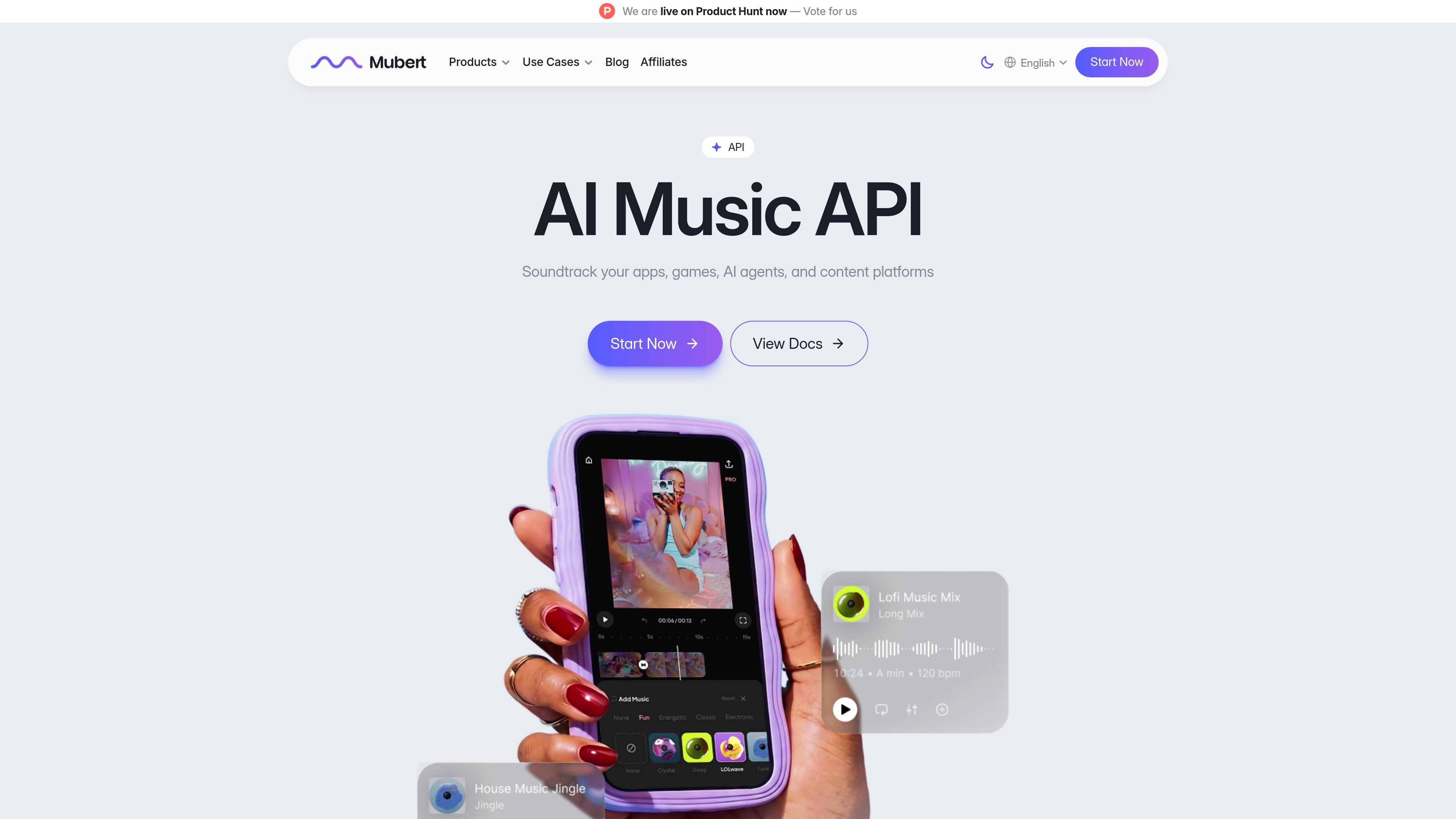
Mubert AI Music API is a developer-facing music generation service for apps, AI agents, web services, live streams, and content platforms. It is positioned around royalty-free music generation and realtime streaming rather than manual music editing.
The product pages show several workflows: generating tracks from text or images, serving realtime streams, and choosing from a curated library of tracks. Example API requests use customer and access token headers, and the site presents the API as suitable for commercial content, UGC, and other product experiences that need music on demand.
Generate tracks from text prompts, and the homepage also shows image-based generation as part of the workflow.
Create short tracks from 15 seconds up to 25 minutes, with the homepage noting that enterprise plans can go longer by request.
Generate realtime music streams for live use cases, including adaptive intensity and low-latency delivery through WebRTC.
Work from a large catalog of styles, with 150+ genres and moods on the API pages and more than 50 moods and themes mentioned on the homepage.
Use curated pre-generated tracks from a 12K library when instant selection is more useful than generation.
Apply personalization and sublicensing features for products that need user preference signals or broader distribution models.
Build music features into products that need original audio on demand, such as apps, web services, or AI agents. The site positions the API for developer workflows that generate royalty-free music through requests rather than manual composition.
Add realtime music to live content where the audio needs to adapt as the session changes. The API pages highlight streaming, WebRTC, and low-latency playback for live streams and similar experiences.
Generate soundtracks for uploaded images or prompt-based content creation flows. The homepage specifically shows text prompts and image inputs as ways to create tracks for videos, games, and podcasts.
Use the API in products that need a large style catalog and fast selection, such as UGC tools, creator platforms, or media editors. The site emphasizes 150+ genres and moods, plus a library of curated tracks for instant use.
Support monetized products or business models that need sublicensing or commercial use options. The feature list and pricing page both point to monetization, client work, agency use, and app or game distribution.
Mubert’s API is built for generating royalty-free music for apps, AI agents, web services, streams, and content platforms. The homepage and use-cases page show text-to-music, image-to-music, streaming, and library-based workflows.
The source shows a POST endpoint for generating tracks and a streaming link endpoint for realtime music. Example requests use customer-id and access-token headers, and the docs page is intended for developers.
The homepage shows outputs in WAV for generated tracks and the pricing page shows WAV and MP3 exports on paid plans. The streaming example returns a music stream link rather than a downloadable track file.
The pricing page says purchases are non-refundable because access is digital, and it notes that track downloads are not licensed for Content ID, standalone release on streaming platforms, or stock music sites.
The pricing page includes an API access call-to-action for products with generative music or custom terms and limits, which suggests direct team contact for API-based commercial use.

ByteAsk is a terminal-first AI coding agent for C and C++ that edits repositories and verifies changes with the real compiler, debugger, sanitizers, and tests before showing a diff. It offers a free tier plus paid plans, with editor connectors and zero-retention handling described in the source.

MeetStream is a meeting bot API for Zoom, Google Meet, Microsoft Teams, and Webex. It helps developers record, stream, and analyze meetings programmatically, with usage-based pricing and a $5 free credit to start.

CreateOS Sandbox is an isolated compute environment for running code and agent workloads inside Firecracker micro-VMs. It is designed for workflows that need machine-level isolation, private networking between sandboxes, and programmatic control through SDK, CLI, or MCP.

hob is an independent workspace for coding agents that keeps agent sessions, terminals, history, and follow-up work organized around the tools and providers you already use. It is aimed at developers who want local control over routing, history, and workspace structure rather than a bundled model stack.

Manta AI is an autonomous web app testing tool for teams that want to map application behavior, catch regressions, and generate tests without writing scripts or maintaining selectors. It works from a URL and supports plain-English test flows, run results with screenshots, and scheduled or deployment-triggered checks.

Redline is a budgeting tool for Claude Code that paces sessions to stay within time, token, cost, or plan-percentage limits. It uses Claude Code’s native hooks and statusline to help sessions finish with a usable result instead of stopping abruptly.