
Vendored source integration
Bring OpenClix client code into your repository as checked-in source so the integration remains inspectable and under your control.

OpenClix is an open-source, local-first mobile app retention and engagement automation system. It helps builders ship onboarding, reminder, and re-engagement flows that run on-device and stay in the repo.
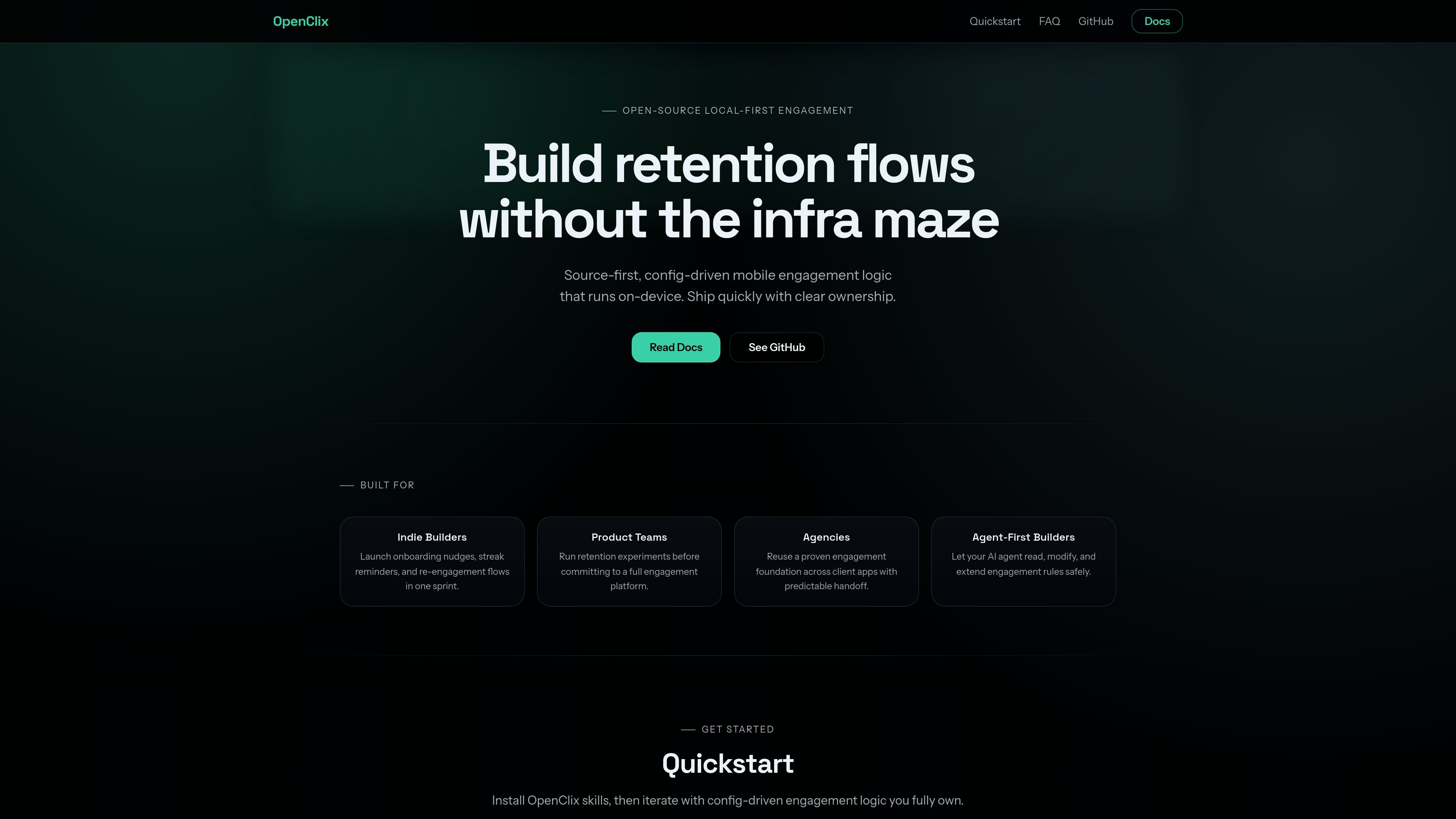
OpenClix is an open-source, local-first mobile app retention and engagement automation system. It is positioned as a source-first layer for building onboarding nudges, streak reminders, and re-engagement flows that run on-device and remain in your repository.
The product emphasizes ownership and reviewability: you vendor the client source, connect config JSON and app event hooks, and let rules execute locally with debuggable reasons and clear edit points. The homepage also frames OpenClix as agent-friendly for builders using OpenClaw, Claude Code, or Codex to modify engagement logic safely.
Bring OpenClix client code into your repository as checked-in source so the integration remains inspectable and under your control.
Define retention and engagement behavior in configuration rather than in a separate hosted system, which keeps the logic portable and easier to review.
Use app-resource or HTTPS JSON config together with app events so rules can respond to in-app activity without backend plumbing.
Run local notifications and in-app messaging logic on-device, with debuggable reasons and safe edit points for iteration.
Work from a legible folder structure, explicit interfaces, schemas, examples, and fixtures that are intended to support agent-assisted edits.
Operate without a backend or hosted control plane for local-first use, and without a package-runtime dependency model.
Launch onboarding nudges and other early-life retention flows directly in a mobile app without standing up a separate engagement backend.
Create streak reminders and re-engagement messages that react to in-app events and local rules instead of a central orchestration layer.
Let product teams test retention ideas before committing to a larger engagement platform or broader infra investment.
Reuse the same source-first engagement foundation across client apps when you need predictable handoff and inspectable integration details.
Use explicit interfaces, schemas, and safe edit points so AI-assisted changes to engagement logic can be reviewed and extended with less ambiguity.
OpenClix is designed to be used as source checked into your repo, with config-driven logic and on-device execution. The homepage also frames it as agent-friendly, so it can fit teams that want AI-assisted changes with explicit edit points and reviewable output.
The homepage says OpenClix runs local engagement flows on-device and presents it as a source-first approach with no backend required and no hosted control plane required for local-first use.
The page describes OpenClix as vendored source, not a package runtime dependency, so the integration model is based on bringing the client code into your repo rather than installing it as a standard library dependency.
The site suggests config-driven engagement logic with app events, app-resource or HTTPS JSON config delivery, and local notifications or in-app messaging. It does not publish a detailed pricing model on the homepage content provided.
OpenClix is presented as agent-friendly and mentions OpenClaw, Claude Code, and Codex in the product description, but the homepage does not document a full safety model beyond explicit interfaces, schemas, fixtures, and clear edit points.

CreateOS Sandbox is an isolated compute environment for running code and agent workloads inside Firecracker micro-VMs. It is designed for workflows that need machine-level isolation, private networking between sandboxes, and programmatic control through SDK, CLI, or MCP.

GitBot is a local browser-based workspace for creating reusable coding bots powered by Claude Code, Codex, or OpenCode. It helps developers run those agents across repository folders with persistent threads and configurable permissions.

ByteAsk is a terminal-first AI coding agent for C and C++ that edits repositories and verifies changes with the real compiler, debugger, sanitizers, and tests before showing a diff. It offers a free tier plus paid plans, with editor connectors and zero-retention handling described in the source.

Epherem is a static security scanner for web apps built with AI coding tools such as Lovable, Bolt, v0, Replit, Cursor, and Claude Code. It checks source files and dependencies for common security mistakes, then provides categorized findings and suggested fixes without running the app.

Goldfish is an AI memory app for macOS that helps you reply, write, summarize, and continue using the context already on your Mac. It stores memory locally and writes in your tone.

ArtDeck is a visual reference board app for iPhone, iPad, and Mac that lets artists collect mixed reference material on one canvas and study it with ToolBox lenses. It works offline, supports optional iCloud sync, and is sold as a one-time purchase with no account required.