
Remote transaction routing
UGF lets a user’s source-chain value trigger a destination-chain action without moving liquidity first, which is the central remote-transaction model described across the site.

Universal Gas Framework (UGF) routes source-chain value into destination-chain actions for wallets, dApps, and AI agents. It provides an SDK and gateway flow for quoting, paying, and executing cross-chain transactions without requiring a paymaster or smart-wallet migration.
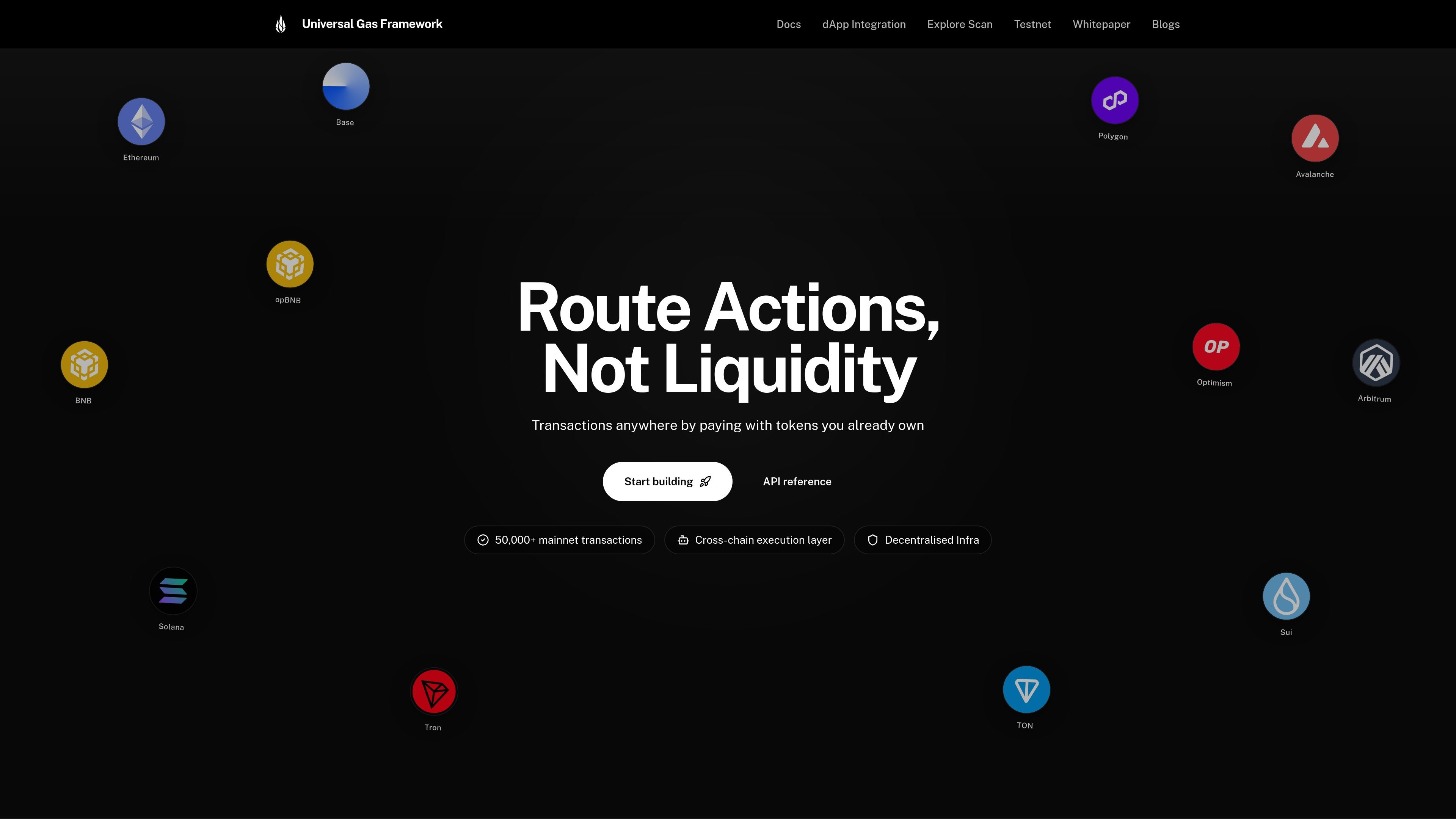
Universal Gas Framework (UGF) is a cross-chain payment routing and gas abstraction product for wallets, dApps, and AI agents. It is designed to turn source-chain value into destination-chain action so users can complete onchain work without having to hold the right native gas on the target network.
The site describes UGF as a remote-transaction layer that routes payment, then completes the requested action on the destination chain. The documented flow is linear: install the SDK, authenticate a signer, request a quote, pay through x402 or vault, and execute on the target chain. Supported source value includes USDC, EURC, $U, and native EVM assets, with execution guides for EVM, Solana, and Sui.
UGF lets a user’s source-chain value trigger a destination-chain action without moving liquidity first, which is the central remote-transaction model described across the site.
The framework supports payment routing through x402 or vault flows, giving the gateway a way to coordinate quote, payment, and execution steps.
The docs show supported source value including USDC, EURC, $U, and native EVM assets such as ETH, MATIC, AVAX, and BNB.
UGF includes documented coverage for EVM chains and non-EVM chains, with execution guidance for EVM, Solana, and Sui.
Developers can integrate through an SDK and gateway, authenticate a signer, request a quote, and execute with chain-specific clients.
The site exposes a React integration surface for dApps that want a modal-driven gasless flow for a concrete action such as minting or claiming.
Wallet teams can make the gas experience less visible by letting users keep value on the source chain and still complete actions on another network.
dApps can use UGF for checkout, claim, mint, subscription, or unlock flows when the app needs a single action to complete even if the user does not hold native gas.
AI agents can use the framework as an execution rail when controlled source value needs to become an onchain result on a different chain.
Builders working across EVM and non-EVM environments can route payment and complete destination-chain actions without rebuilding the entire fee abstraction stack themselves.
Frontend teams can embed the React integration shown in the docs to trigger a quoted, paid, and executed action from a product UI.
UGF is set up by installing the SDK, creating a client against the gateway URL, authenticating with a wallet signature, requesting a quote, paying through x402 or vault, and then executing on the destination chain.
The docs position UGF for wallet integrations, dApp enhancement, and AI agent execution where value is held on one chain but the destination action needs to happen on another.
UGF routes payment through supported source value such as USDC, EURC, $U, ETH, MATIC, AVAX, or BNB, then completes the requested destination-chain action.
The getting started docs describe two payment paths: x402 and vault. The exact payment mode depends on the quote returned by the gateway.
The site presents UGF as a routing layer for remote transactions rather than a full smart-wallet migration or paymaster stack, and it includes separate execution guides for EVM, Solana, and Sui.

CreateOS Sandbox is an isolated compute environment for running code and agent workloads inside Firecracker micro-VMs. It is designed for workflows that need machine-level isolation, private networking between sandboxes, and programmatic control through SDK, CLI, or MCP.

GitBot is a local browser-based workspace for creating reusable coding bots powered by Claude Code, Codex, or OpenCode. It helps developers run those agents across repository folders with persistent threads and configurable permissions.

AakarDev AI helps teams manage AI provider access, project-level setups, logs, and analytics from one dashboard. It supports BYOK workflows and lists providers including OpenAI, Google Gemini, Anthropic, Groq, Mistral AI, and Perplexity AI.

Trigger.dev chat agent is a durable AI chat backend for developers building stateful conversations that can survive refreshes, crashes, and long-running turns. It connects with the AI SDK `useChat` flow and runs on managed infrastructure with no timeout on a turn.

ByteAsk is a terminal-first AI coding agent for C and C++ that edits repositories and verifies changes with the real compiler, debugger, sanitizers, and tests before showing a diff. It offers a free tier plus paid plans, with editor connectors and zero-retention handling described in the source.

Epherem is a static security scanner for web apps built with AI coding tools such as Lovable, Bolt, v0, Replit, Cursor, and Claude Code. It checks source files and dependencies for common security mistakes, then provides categorized findings and suggested fixes without running the app.