
Adaptive onboarding without a placement test
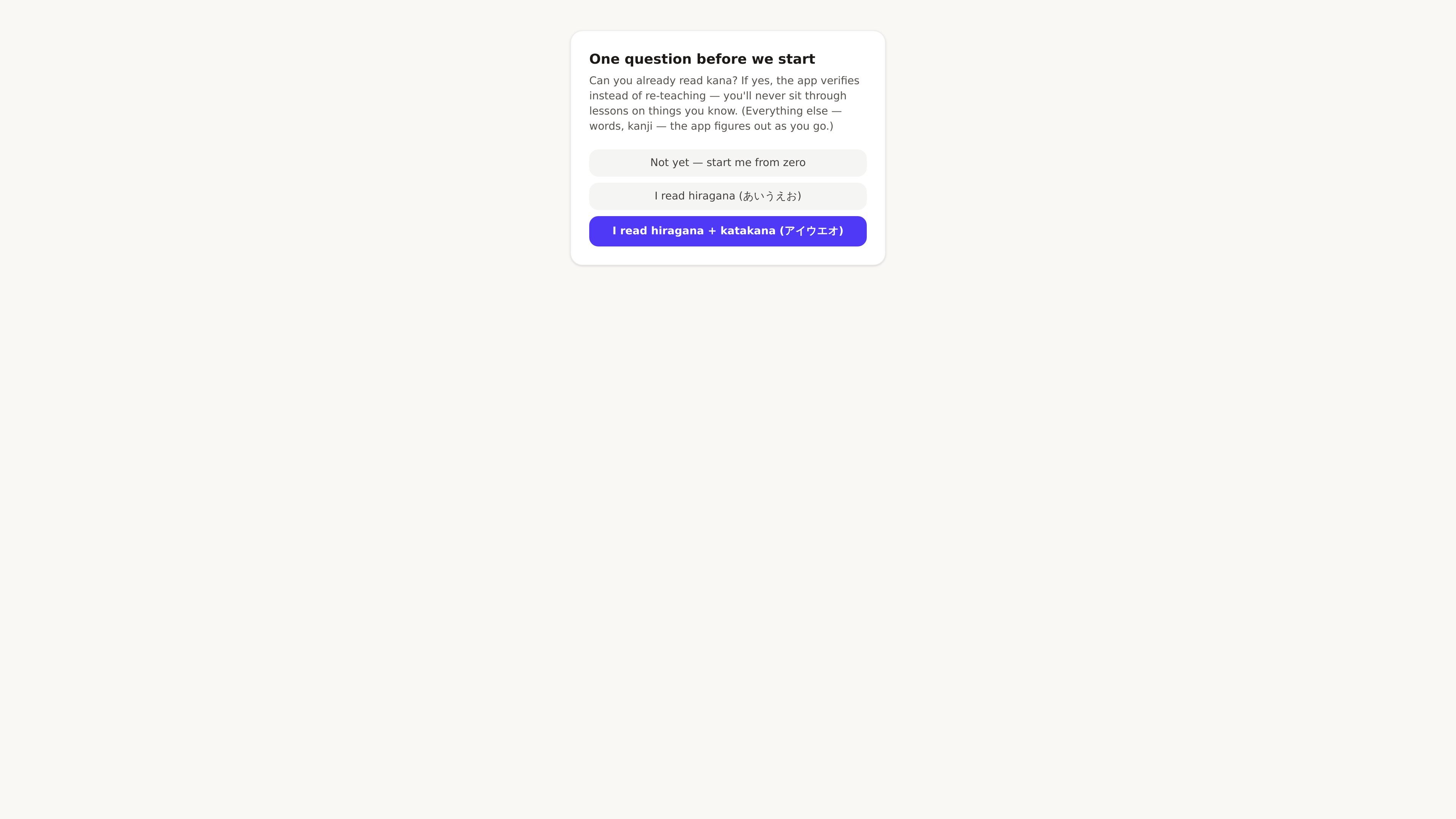
The app asks a few initial questions and checks what you already know instead of restarting from zero. Anything you can demonstrate is skipped, so study time stays on unfamiliar material.

Yokoso is a Japanese-learning app for people moving to or living in Japan. It focuses on practical daily language, adapts to what you already know, and supports offline learning with real-world content.
Yokoso is a Japanese-learning app focused on the language people need first after moving to Japan. Instead of broad textbook coverage, it starts with kana, numbers, signs, shop interactions, station language, and other day-to-day tasks that show up immediately in real life.
The app is designed to adapt to prior knowledge rather than reset it. It verifies what you already know, skips content you can demonstrate, tracks JLPT coverage honestly, and supports progress import from WaniKani so study can continue from what the learner already has.
Yokoso also includes practical learning paths built around real situations such as errands, stations, restaurants, clinics, and moving into a home. The result is a task-based workflow that aims to make everyday Japanese readable and usable sooner.
The app asks a few initial questions and checks what you already know instead of restarting from zero. Anything you can demonstrate is skipped, so study time stays on unfamiliar material.
Yokoso centers lessons on Japanese you encounter in daily life: shop doors, station signs, prices, menus, counters, and repair phrases that help you handle routine interactions.
The app tracks JLPT coverage honestly and also references other scales such as ILR, CEFR, and college-course equivalence. It distinguishes between coverage and readiness rather than treating them as the same thing.
WaniKani import carries kanji progress into Yokoso so users do not have to re-learn material they have already studied. The source also notes Bunpro import is paused for now.
The app uses spaced repetition, lets you rewrite memory hooks in your own words, and delays explicit grammar labels until after you have used the pattern correctly.
A new arrival can start with kana, numbers, prices, and the most common counter phrases so the first days in Japan are less dependent on romaji, translation apps, or guesswork.
Learners can practice the signs that appear on shop doors, station boards, parking lots, and restroom signs, with recurring kanji patterns that make unfamiliar signage easier to decode.
The app covers the phrases and vocabulary that come up at counters, convenience stores, restaurants, clinics, and city offices, which is where many first-time interactions happen.
People who have already studied Japanese can import WaniKani progress and skip material they can already show they know, which reduces duplication during setup.
Learners can use the JLPT coverage view to understand what the app has covered, while remembering that coverage and actual readiness are presented as different measures.
Yokoso is a Japanese-learning app built around real-life language for people living in or moving to Japan. It focuses on kana, numbers, signs, counters, station language, and other daily tasks before broader study.
The source says the app is free forever, with no ads, no streaks, and no locked lessons. Optional supporter contributions exist, but they do not unlock features.
No. The app says it verifies what you already know, skips material you can demonstrate, and does not make you re-learn lessons from the start.
Yes. The source says WaniKani import carries kanji progress over, and that Bunpro import is paused while Bunpro's public API is unavailable.
Yokoso is available on the App Store and also has a web version that works in a browser, including offline use.
LangPanda is a browser extension for learning languages from streaming video and other supported sites. It combines instant subtitle lookup, flashcard creation, vocabulary tracking, and spaced-repetition review for 36 languages.

Talkpal is an AI-powered language learning web and mobile app for practicing speaking, listening, writing, and pronunciation. It offers guided courses, roleplays, and call-style conversation practice across 130+ languages.

Lingofable is a story-based language learning app that helps learners practice reading at an appropriate level and review new vocabulary in context. It currently supports Spanish, with Android listed as coming soon.

GameGrad turns PDF study material into quiz questions that appear inside arcade games, so users can practice active recall while they play. It offers a free tier with one PDF and a Pro plan with more uploads, more questions, and answer explanations.

recall is an AI flashcard app that turns reading and notes into study cards through Claude, ChatGPT, or another MCP client. It uses one-time lifetime access pricing and spaced repetition review.

BeFreed is a personalized audio learning app that turns books and other knowledge sources into narrated listening experiences. It helps people learn on demand through interactive audio, voice selection, and built-in learning tools.