

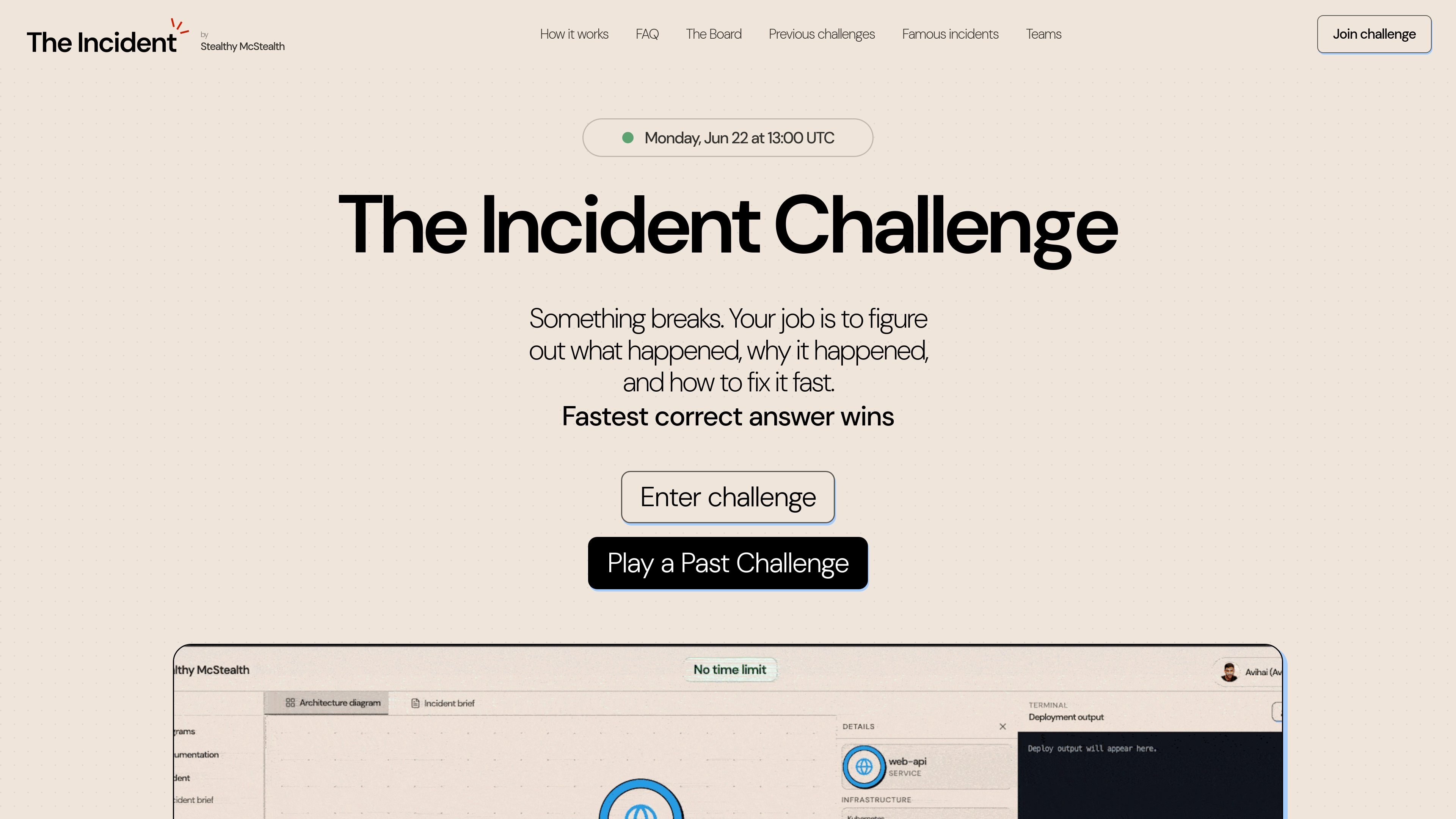
Incident-based debugging
Each challenge presents a production incident with logs, code, docs, architecture, and clues so you can reconstruct the failure from evidence instead of guesswork.
The Incident Challenge is a bi-weekly production incident challenge built around debugging a realistic system under time pressure. Each round asks participants to figure out what happened, why it happened, and how to fix it fast.
The experience is organized around evidence: players read logs, code, docs, architecture, and clues, then submit an answer before the 24-hour window closes. The site positions it as a practical exercise for engineers who enjoy troubleshooting messy systems and validating conclusions with data.
Each challenge presents a production incident with logs, code, docs, architecture, and clues so you can reconstruct the failure from evidence instead of guesswork.
You work under time pressure: a new incident opens every second Monday and stays available for 24 hours.
The challenge is scored around speed and correctness, with the fastest correct answer taking the win.
Winners are announced on The Incident Challenge’s page, making outcomes visible after each round.
The site encourages both reading the system and explaining the fix, which makes the workflow more than just spotting an error.
Use it to practice diagnosing a production-style outage from incomplete signals and trace the path from symptoms to root cause.
Use it as a timed exercise for engineers who want to work through logs, code, and architecture under pressure.
Use it to benchmark reasoning skills against other participants through a fastest-correct-answer format.
Use it as a structured way to test whether your debugging process depends on evidence rather than instinct.
The site describes it as a bi-weekly production incident challenge where you read the system, identify what happened, why it happened, and how to fix it.
A new incident drops every second Monday, and each incident opens for 24 hours.
The fastest correct answer wins.
The site says it is for people who like untangling messy systems, trust evidence over instinct, and enjoy finding signal in noise.
The site frames the challenge around reading logs, code, docs, architecture, and clues. It does not state pricing details or team rules in the source provided.

GameGrad turns PDF study material into quiz questions that appear inside arcade games, so users can practice active recall while they play. It offers a free tier with one PDF and a Pro plan with more uploads, more questions, and answer explanations.

DailyPlay.ai 是一个行为增长平台,借助 AI 站点扫描和微游戏帮助品牌提升互动与转化。支持 Web、移动端及其他数字触点,一行脚本即可快速接入,并提供免费互动扫描。

PixelForge 可将单张照片生成可直接用于游戏的 2D 角色精灵包,包含 4×4 雪碧图、透明帧、方向条和循环行走 GIF,适用于 Godot、Unity、Phaser、GameMaker 和网页游戏。

FixMyCWV is a web-based Core Web Vitals audit tool that produces developer-focused recommendations for improving LCP, INP, and CLS. It works across many site stacks and claims to handle sites with bot protection.

PromptLayer is an LLM operations platform for versioning, testing, and monitoring prompts and agents. It helps AI engineering teams and domain experts collaborate on prompt workflows without working directly in code.

MacYaps 是一款 macOS 菜单栏应用,会在 Mac 上的系统事件发生时播放有趣音频片段。支持内置语音包、自定义音频上传和一次性终身授权。