
Single gateway for multiple provider families
Route requests across OpenAI, Anthropic, and Google through a single base URL, while keeping the model family constraints required by apps like Claude Code or Cursor.

IQ Routing is a model-routing gateway that sends each request to the cheapest model tier that still meets a quality bar. It is built for teams running chatbots, RAG pipelines, agent loops, and finance workloads on OpenAI-, Anthropic-, or Google-shaped endpoints.
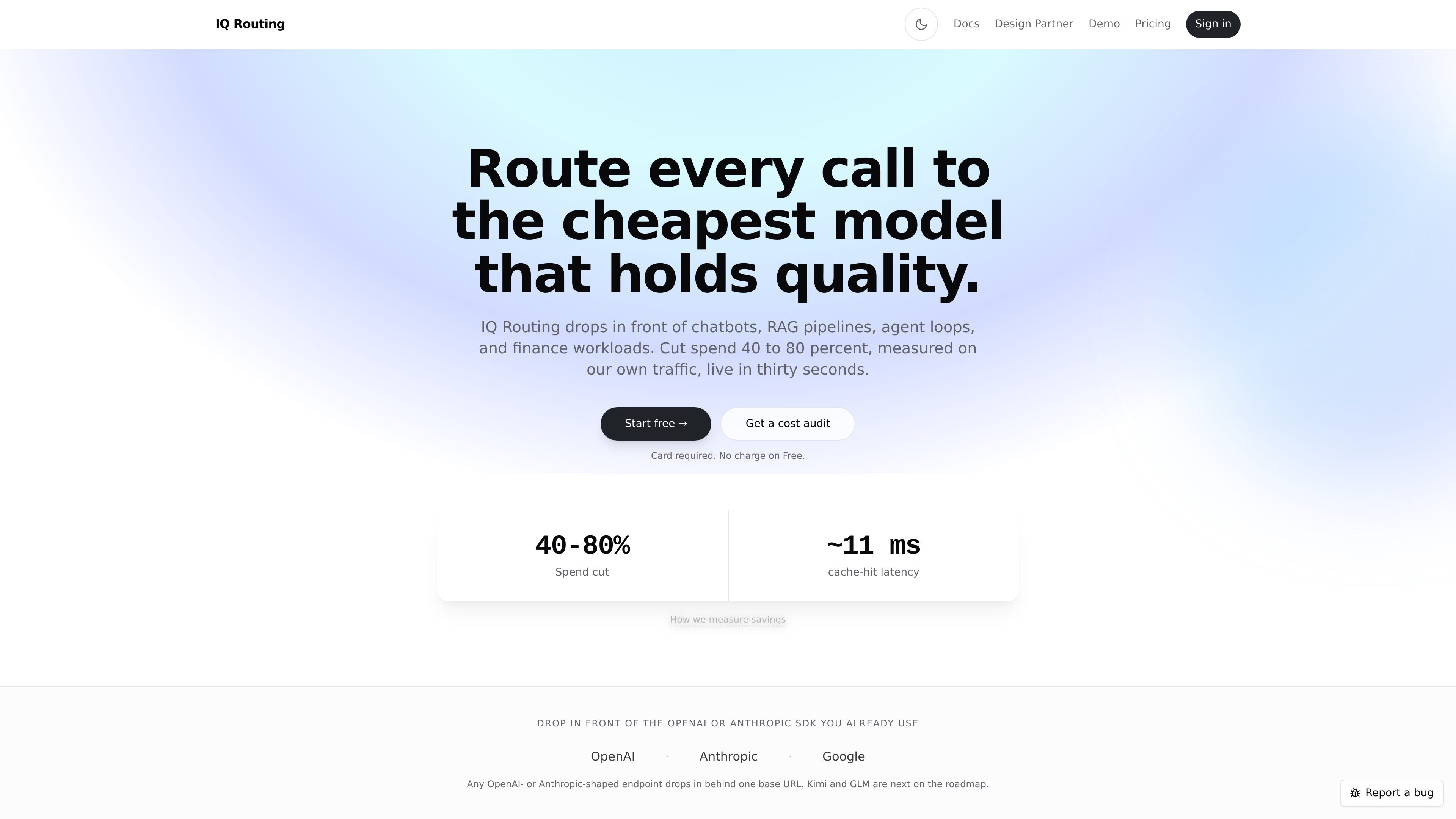
IQ Routing is a model-routing gateway for applications that call large language models through OpenAI-, Anthropic-, or Google-shaped endpoints. It sits in front of chatbots, RAG pipelines, agent loops, and finance workloads and sends each request to the cheapest model that still meets the quality bar.
The product is built to reduce model spend without changing the agent code path. The site describes it as a drop-in layer for existing SDKs and endpoints, with routing decisions based on prompt complexity, live cost and latency signals, and fallback handling when a model or provider path fails.
The pricing and docs pages show three live provider families, BYOK operation, response caching, per-team budgets, audit logging, and plan-specific controls such as alerting and org-scoped access. Enterprise adds deployment options like on-prem or VPC and support artifacts such as a SOC2 evidence pack on request.
Route requests across OpenAI, Anthropic, and Google through a single base URL, while keeping the model family constraints required by apps like Claude Code or Cursor.
Classify each prompt by complexity and choose a cheaper model tier when the request does not need the flagship model, with instant fallback if one option fails.
Use aliases such as auto, frontier, and other routing modes to control how broadly the resolver searches, with preferred-model and allowed-model lists to constrain the ladder.
Track spend by input, output, cached, and thinking tokens, with per-request detail that shows why a call cost what it did.
Keep repeated requests from billing twice through exact and semantic response caching, including conversation-scoped caching for agent loops and streaming replay.
Apply per-team budgets, per-key limits, audit logs, alerting, and org-scoped access controls on paid plans.
Route low-complexity classification, retrieval, cleanup, or verification steps to less expensive models while reserving the strongest model for the parts of the workflow that need it.
Place IQ Routing in front of a chatbot or RAG service so the application can use a single base URL while the router handles model choice behind the scenes.
Use per-team budgets, audit logs, and org-scoped access controls to track who spent what in shared environments and to make the billing trail easier to review.
Rely on the gateway response cache to return exact or semantic repeats without another provider call, which is useful when users ask the same thing in slightly different words.
Adopt Enterprise deployment options when the gateway needs to run in a cloud, VPC, or on-prem environment rather than only as a hosted service.
IQ Routing sits in front of OpenAI-, Anthropic-, and Google-shaped endpoints and routes each request to the cheapest model tier that still holds the quality bar. It is intended to work with chatbots, RAG pipelines, agent loops, and finance workloads.
The product is designed as a drop-in gateway. The site says it works behind the OpenAI or Anthropic SDK you already use, and any OpenAI- or Anthropic-shaped endpoint can point at one base URL.
Yes. The pricing page shows Free, Team, and Enterprise plans. Free is self-serve with BYOK, Team is $70 per month billed monthly, and Enterprise is custom annual pricing with on-prem or VPC deployment options.
The docs say every plan is bring-your-own-key, so you connect your own provider credentials and pay providers directly. The billing docs also note that a 402 response indicates provider credit exhaustion on your BYOK key.
The billing docs describe a gateway response cache that can return exact or semantic repeats without calling the provider again. The site also says a measured production cache hit returned in about 11 ms at no cost.
AakarDev AI helps teams manage AI provider access, project-level setups, logs, and analytics from one dashboard. It supports BYOK workflows and lists providers including OpenAI, Google Gemini, Anthropic, Groq, Mistral AI, and Perplexity AI.

ByteAsk is a terminal-first AI coding agent for C and C++ that edits repositories and verifies changes with the real compiler, debugger, sanitizers, and tests before showing a diff. It offers a free tier plus paid plans, with editor connectors and zero-retention handling described in the source.

CreateOS Sandbox is an isolated compute environment for running code and agent workloads inside Firecracker micro-VMs. It is designed for workflows that need machine-level isolation, private networking between sandboxes, and programmatic control through SDK, CLI, or MCP.

GitBot is a local browser-based workspace for creating reusable coding bots powered by Claude Code, Codex, or OpenCode. It helps developers run those agents across repository folders with persistent threads and configurable permissions.

hob is an independent workspace for coding agents that keeps agent sessions, terminals, history, and follow-up work organized around the tools and providers you already use. It is aimed at developers who want local control over routing, history, and workspace structure rather than a bundled model stack.

Ably Chat is a chat API platform for building custom realtime chat applications. It supports room-based messaging, typing indicators, presence, reactions, and message updates, with usage-based pricing options for different deployment stages.