
Symptom Intelligence
Users can describe how they feel in plain language. The platform maps those descriptions against clinical patterns to provide a starting point for the clinical interview.

QueroCura is a personalized healthcare platform that brings symptom input, medical records, prescriptions, and medication reminders into one health history. It also offers an emergency-access workflow designed to let verified care teams retrieve patient information without paper forms.
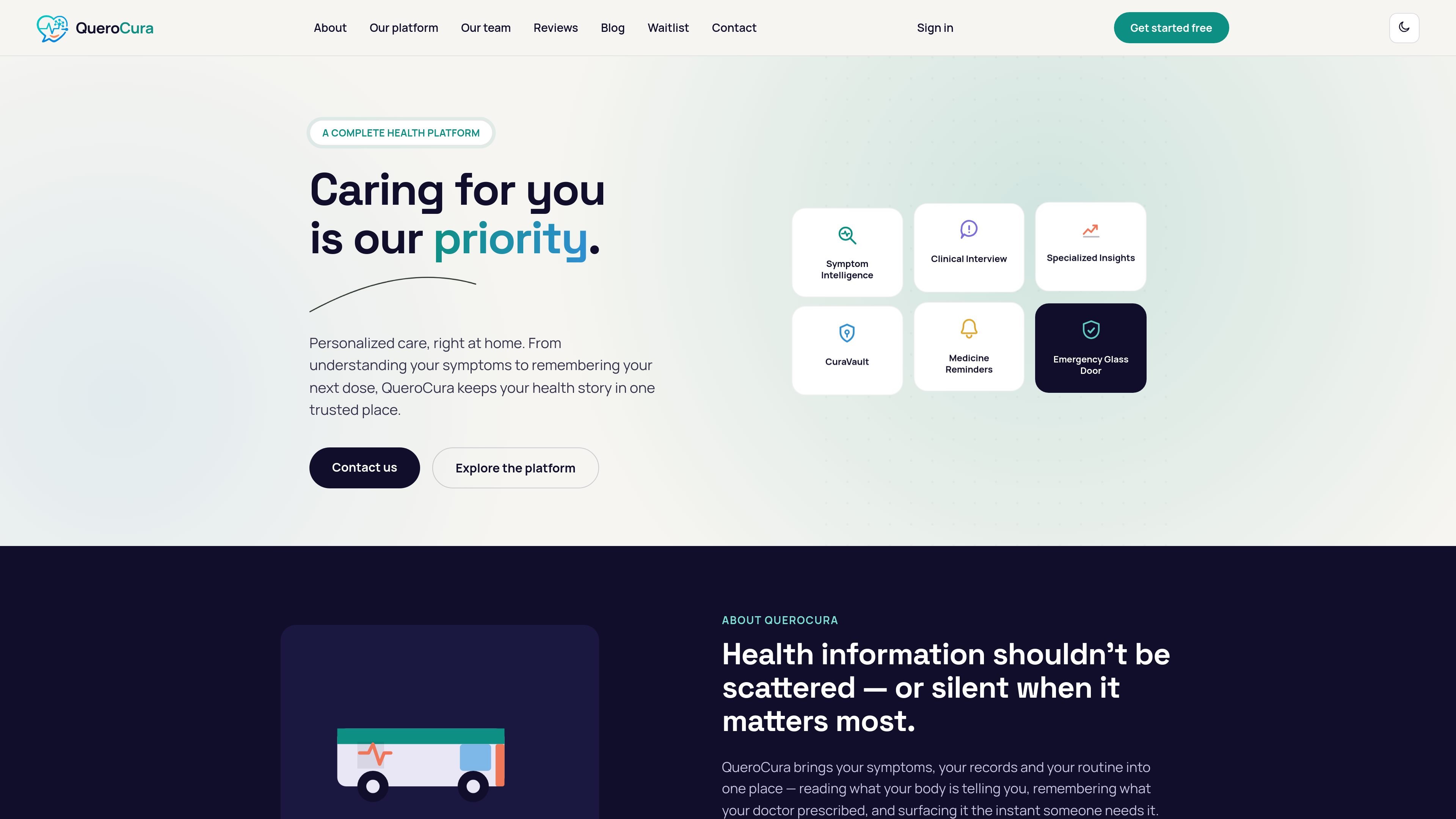
QueroCura is a personalized health platform designed to bring symptoms, medical records, prescriptions, and medication routines into one place. Its stated purpose is to reduce the gap between information recorded about a patient and the information available to the people providing care, particularly when time matters.
The platform combines tools for symptom intake and guided clinical questioning with longer-term record storage and analysis. Its Emergency Glass Door workflow is intended for urgent care: after a biometric match, a medical professional can access emergency data from CuraVault without completing a paper form. The site presents Emergency Glass Door as live, while several other platform components are marked in development.
Users can describe how they feel in plain language. The platform maps those descriptions against clinical patterns to provide a starting point for the clinical interview.
A guided interview uses dynamic follow-up questions rather than a fixed checklist, with each answer narrowing the range of likely explanations before a prediction is shown.
Uploaded laboratory and diagnostic reports are read automatically, and key markers are tracked across visits so changes can be viewed over time.
CuraVault stores reports, scans, prescriptions, and other health records in one place. The site says the information is analyzed over time to surface trends.
Prescription Reminders use prescriptions already stored in CuraVault to time reminders around the user's actual medication instructions.
A medical professional scans a patient's fingerprint or iris, which is matched against biometrics linked to the patient's Aadhaar card. A successful match provides the care team with emergency information from CuraVault without requiring forms.
A person can describe symptoms in ordinary language before visiting a clinic. Symptom Intelligence is intended to map that description to clinical patterns and prepare a starting point for the follow-up interview.
A guided interview can ask adaptive follow-up questions, giving the user a structured way to provide additional context instead of working through a fixed checklist.
Reports and prescriptions can be kept together in CuraVault, allowing a patient’s history to travel with them rather than remain in a drawer or a single clinic’s system.
A care team at an ambulance or hospital can scan a patient's fingerprint or iris during an emergency. When the identity match succeeds, the team can retrieve the emergency information entered during onboarding.
A patient can receive reminders based on prescriptions already stored in CuraVault, helping them follow the timing specified in their recorded medication instructions.
During onboarding, the user's physician or physicians enter the medical information. The site says QueroCura does not generate or guess what belongs in the record.
In the Emergency Glass Door workflow, a medical professional scans the patient's fingerprint or iris. The scan is matched with biometrics linked to the patient's Aadhaar card; if the match succeeds, emergency data is retrieved from CuraVault.
No. If the biometric match fails, access is denied and nothing about the patient is shown. The site says a failed match looks the same as if no record existed.
The site describes CuraVault as a secure store for reports, scans, prescriptions, and other records. It analyzes information over time to surface trends, while Prescription Reminders use prescriptions already stored there to schedule medication reminders.
The site lists Symptom Intelligence, Clinical Interview, Specialized Insights, CuraVault, and Prescription Reminders as in development. Emergency Glass Door is identified as live, while the company says it has not yet onboarded its first hospitals.

Malyatko is a baby tracker for logging feeding, sleep, growth, teething, and milestones in one app. It works on iPhone, Apple Watch, and widgets, with no sign-up, offline use, and family sharing through iCloud.
MIRA vision develops synthetic-data-driven AI for pathology image analysis in medical diagnostics. Its website positions the product for teams that need privacy-compliant training data, automatic annotations, and controlled data generation.

Dyson Oral care centers on the CameraJet™ electric toothbrush with flosser, a camera-guided toothbrush that aims to precision-floss between teeth while you brush. The range also includes accessories, non-foaming toothpaste, and low-foaming mouth rinse.

Renight is a sleep-focused app that plays Monaural Beats before bed. It is aimed at people who want to improve the quality of limited sleep and wake up feeling more refreshed.

KeptWell is an AI medical document hub for families navigating serious illness. It helps people upload records, track changes, share a family view, and ask questions with citations back to the source material.

Soonr Health is a preconception health optimization app for couples preparing for pregnancy. It combines shared lifestyle tracking, cycle-based fertility guidance, and optional hormone measurements to help partners prepare together.