
MusiKey Authentication
MusiKey is a cross-platform desktop application that replaces traditional passwords with encrypted musical compositions for secure authentication.
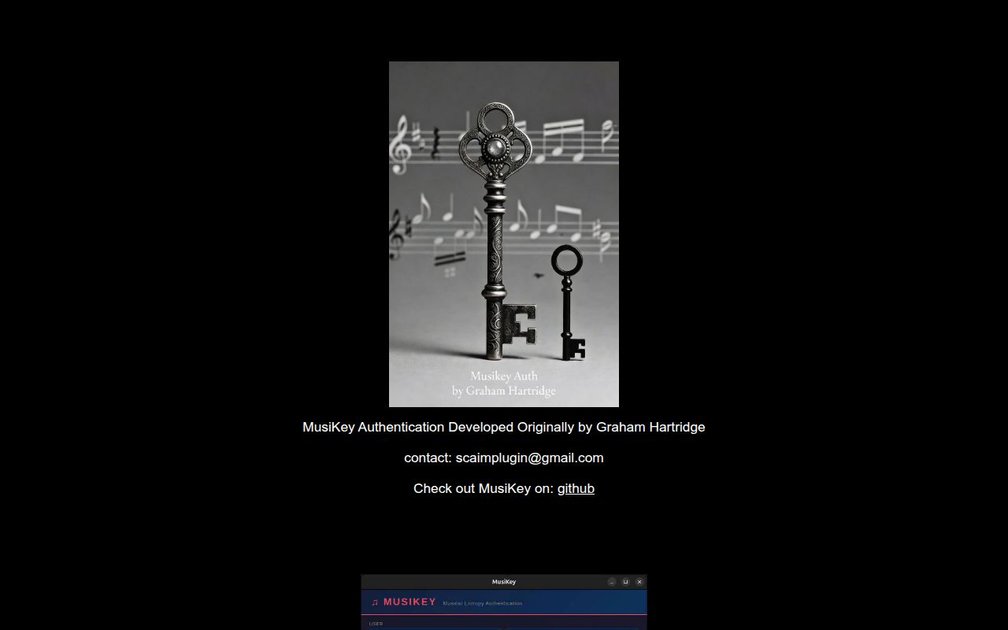
What is MusiKey Authentication?
What is MusiKey Authentication?
MusiKey Authentication is an innovative, cross-platform desktop application developed to fundamentally change how digital security is managed by replacing conventional, vulnerable passwords with unique, encrypted musical compositions. Instead of relying on memorized strings of characters, your identity is bound to an algorithmically generated song. This musical key is secured using military-grade cryptography, ensuring that only the correct passphrase can unlock and validate your identity.
The core innovation lies in binding security credentials to musical entropy. When a user enrolls, MusiKey generates a unique composition constrained to a user-selected musical scale (such as pentatonic, blues, major, or minor). This song is then sealed using a robust, cascaded key derivation pipeline involving PBKDF2 and scrypt, followed by double-layer AES-256-GCM encryption. This multi-layered approach ensures that the musical credential is both unique and extremely resistant to brute-force attacks.
Key Features
MusiKey stands out due to its deep integration of cryptographic security with an engaging, musical interface:
- Musical Entropy Binding: Credentials are tied to algorithmically generated songs based on user-selected musical scales.
- Advanced Cryptography: Employs a 15-layer security architecture, including cascaded key derivation (PBKDF2 with 600,000 iterations and memory-hard scrypt), and double AES-256-GCM encryption.
- Cross-Platform Compatibility: Fully functional on Windows, macOS, and Linux operating systems.
- Real-time Feedback: Features a live piano keyboard and frequency bar visualizer that responds to passphrase input.
- Passphrase Strength Meter: Provides real-time entropy estimation to guide users toward creating stronger passphrases.
- Four-Dimensional Musicality Scoring: Authentication involves a sophisticated analysis across harmonic, melodic, rhythmic, and scale adherence dimensions.
- Self-Destruct Mechanism: After five failed authentication attempts, the credential self-destructs permanently by overwriting the data with random noise.
- Secure Storage: Credentials are encrypted at rest using machine-bound keys and protected by HMAC tamper detection.
- Configurable Compositions: Users can configure song length anywhere from 32 to 256 notes.
How to Use MusiKey Authentication
Getting started with MusiKey involves a straightforward enrollment process followed by daily authentication:
- Installation and Setup: Download and install the cross-platform desktop application. Ensure you have no runtime dependencies, as MusiKey utilizes native platform APIs for its cryptographic operations.
- Enrollment: During initial setup, you will select your preferred musical scale (e.g., Major, Minor, Blues). MusiKey will then generate your unique, encrypted musical composition based on this selection.
- Passphrase Creation: Choose a strong passphrase. The application will provide immediate feedback via the real-time passphrase strength meter to guide you.
- Authentication: To log in, launch MusiKey and enter your passphrase. If correct, the application decrypts the song, performs the four-dimensional musicality analysis, and plays back the composition visually via the animated piano and frequency visualizer.
- Security Monitoring: Pay attention to the visualizers during input. If authentication fails repeatedly, the system will enforce exponential rate limiting, and after five failures, the credential will be permanently destroyed, necessitating a full re-enrollment.
Use Cases
MusiKey's unique security model makes it ideal for environments requiring high assurance and resistance to traditional phishing or credential stuffing attacks:
- High-Security Development Environments: Developers handling sensitive source code or proprietary algorithms can use MusiKey to secure access to local repositories or critical build servers, ensuring only authorized personnel with the specific passphrase can access the musical key.
- Financial Services and Compliance: Banks or fintech companies needing stringent multi-factor authentication for internal systems can leverage the self-destruct feature as a final failsafe against unauthorized access attempts.
- Creative Professionals: Artists, musicians, and designers who value the concept of musical identity can use MusiKey to protect their digital portfolios or intellectual property stored on their local machines.
- Enterprise Endpoint Security: Organizations looking to move beyond simple passwords for workstation login can deploy MusiKey to enforce a higher standard of local authentication that is inherently resistant to keylogging due to the musical input mechanism.
- Personal Data Vaults: Individuals storing highly sensitive personal documents (e.g., tax records, medical history) can use MusiKey to encrypt and secure local data vaults, relying on a memorable musical concept rather than a complex, easily forgotten password.
FAQ
Q: Is MusiKey open source or proprietary? A: MusiKey was developed by Graham Hartridge and is available for review on GitHub, suggesting an open or transparent development model regarding its security implementation.
Q: What happens if I forget my passphrase? A: Since the passphrase is the only key to decrypt the musical composition, forgetting it will result in the credential being permanently destroyed after five failed attempts. You will need to re-enroll and generate a new musical key.
Q: Can I back up my MusiKey credential? A: Yes, the application supports credential export and import functionality, allowing users to create secure backups of their encrypted musical keys for disaster recovery purposes.
Q: How does the musicality analysis work during authentication? A: The system analyzes four dimensions—harmony, melody, rhythm, and adherence to the initial scale—to confirm the decrypted song matches the expected pattern, adding a layer of verification beyond simple decryption.
Q: Does MusiKey require any external libraries to run? A: No, MusiKey is designed to have zero runtime dependencies, utilizing native platform APIs for cryptographic functions (like Web Crypto API, Node.js scrypt) via its Electron framework build.
Alternatives

Biji
Biji is a versatile platform designed to enhance productivity through innovative tools and features.

Prompty Town
Prompty Town is an innovative platform that allows users to transform their links into virtual buildings, creating a unique and engaging way to share and interact with content.

Planndu: Daily Task Planner
Planndu is an intuitive productivity application designed to help users organize tasks, manage projects, build routines, and enhance focus using tools like AI generation and a built-in Pomodoro timer.

AI Song Maker
Create royalty-free songs effortlessly with our AI Song Maker and Music Generator.
MealTime
MealTime is your personal, offline-first recipe companion designed to help you save, organize, plan meals, and generate smart grocery lists, all while keeping your data private.

LALAL.AI
LALAL.AI is a next-generation vocal remover and music source separation service that allows users to quickly and accurately extract vocal and instrumental tracks from audio and video files.